"Dangerous demagogues once again threatening even some of our oldest democracies," Evil Donald Trump déjà vu
Life in Hitler’s Capital- Berlin Germany
In a new book about everyday existence in wartime Berlin, students, musicians, Nazi maidens, and members of the resistance are allowed to speak for themselves. Book review by Elizabeth Kolbert published in The New Yorker magazine. |
| "No one is a Nazi. No one ever was. There may have been some Nazis in the next village, and as a matter of fact, that town about twenty kilometres away was a veritable hotbed of Nazidom. To tell you the truth, confidentially, there were a lot of Communists here. We were always known as very Red. Oh, the Jews? Well, there weren’t really many Jews in this neighbourhood. Two, maybe six. They were taken away. I hid a Jew for six weeks. I hid a Jew for eight weeks. (I hid a Jew, he hid a Jew, all God’s chillun hid Jews." Martha Gellhorn. |
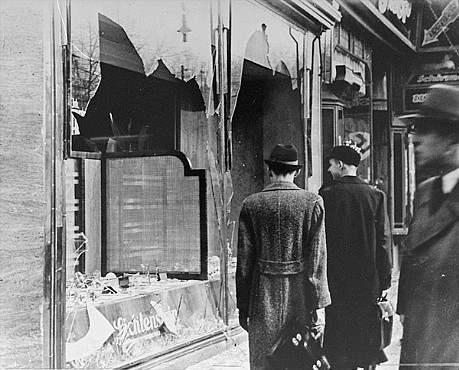
Not long before Kristallnacht, in 1938, my grandmother—by this point married, with a daughter of her own—immigrated to New York. After I, the daughter of that daughter, came along, she used to tell me, “We were the lucky ones.” My grandmother had managed to get her immediate family out of Germany thanks to a wealthy uncle in Chicago. This, however, was not what she meant. She and my grandfather had been “lucky” because the only difficult choice that they’d had to make was to flee, and that choice had, in effect, been made for them. History had taken a host of fraught decisions out of their hands.
Over the years, I’ve often been reminded of my grandmother’s words. Recently, while I was reading Ian Buruma’s new book, “Stay Alive: Berlin, 1939-1945” (Penguin Press), they played on repeat. Buruma is a writer who grew up in the Netherlands. In the opening pages of “Stay Alive,” he recounts the story of his father, Leo, whose experience was, in key ways, the mirror image of my grandmother’s. Leo didn’t flee Berlin to escape the Nazis; he arrived there to work for them.
Leo was attending law school in the occupied Netherlands when the Germans demanded that Dutch students sign a loyalty oath. Instead of complying, he went into hiding. For reasons that he was never able to discover, another student, who had also gone underground, advised Leo to return to his home town of Nijmegen. Leo’s father came to meet him at the train station, and both men were immediately surrounded by police. Leo had to make an agonizing call: either he could coöperate with the Nazis or both he and his father would be arrested. He opted for the former and was sent to a labor camp in Lichtenberg, a neighborhood in east Berlin.
Leo was one of those who managed to stay alive, though how, exactly, is unclear. At some point, he met a Frau Lehnhardt, the widow of a Jewish lawyer, who lived on the opposite side of the city. Lehnhardt had an elegant, well-heated home, and Leo seems to have spent a good deal of time there, accompanying the widow on the piano. By the end of the war, he had moved into Lehnhardt’s house. In April, 1945, Russian soldiers knocked on the door. When they found a gun, which belonged to another Lehnhardt hanger-on, the Russians very nearly shot everyone in the place.
Leo’s time in Berlin, Buruma reports, “haunted him” until his death, in 2020. He knew that some of his contemporaries, who had remained in hiding, regarded him as “morally compromised.” Was he? Was this true, as my grandmother’s formulation suggests, of everyone in the capital, including the many Berliners who despised the Nazis and spent the war years just trying to get by? “I wanted to know more about life in the city that marked my father’s life,” Buruma writes.
On September 1, 1939, the day that the Germans invaded Poland, Hitler made a speech in Berlin, at the Kroll Opera House. It was broadcast on the radio and also piped, via loudspeaker, out into the streets. Two days later, France and Britain declared war. Again, the news was blared across the capital. William Shirer, the Berlin correspondent for CBS Radio, heard it announced from the speakers in the Wilhelmplatz. Some two hundred and fifty Berliners were standing around him in the sunny square. “They listened attentively to the announcement,” Shirer reported. “When it was finished there was not a murmur. They just stood there as they were before.”
Berlin was, at that point, continental Europe’s largest city, with a population of nearly four and a half million. What its typical—or, for that matter, atypical—resident was thinking at the start of the Second World War would have been impossible to ascertain. Since the Reichstag Fire Decree of 1933, Germany had been a one-party state, and only Nazis were free to speak their minds.
Following the war, it would have been almost as difficult to get an honest account of Berliners’ experiences. The city’s population had shrunk by a million and a half, and Allied bombing had reduced many neighborhoods to rubble. Few people wanted to dwell on what they’d seen, or to reckon with their role in the catastrophe. The German author Hans Magnus Enzensberger described the collective response as a “form of moral insanity.”
Eighty years later, the task that Buruma has set himself—learning what life was like in wartime Berlin—has, in obvious ways, become even tougher. The vast majority of people who actually experienced the period have, like Leo, taken their memories to the grave. In some ways, though, the job has grown easier. As the so-called Tätergeneration, the perpetrator generation, has died off, Germany as a nation has become more open about its past. This is especially true in Berlin, where it’s hard to walk more than a few blocks without encountering a sign or plaque or monument devoted to some horror that occurred there. In the last few decades, the diaries of a number of Berliners who lived through the war have been published, along with a variety of memoirs and collections of letters.
Buruma relies heavily on works like “Das Blaue Buch” (“The Blue Book”), a wartime diary kept by the author Erich Kästner, which was not published in its entirety until 2006. (Kästner, who’s best known for his children’s story “Emil and the Detectives,” hid the volume among the thousands of others that he owned, and, as an additional precaution, he wrote in it in shorthand.) Kästner appears and reappears in “Stay Alive” like a restless ghost.
So does a half-Jewish guitarist named Coco Schumann, who wrote a memoir that appeared in German in 1997. (An English translation came out in 2016.) Schumann was part of a group of jazz-loving teens who liked to greet one another with an insouciant “Swing Heil!” He and his friends spent the night after the invasion of Poland listening to music at a bar on the Kurfürstendamm. Three years later, Schumann was still performing at jazz clubs, even though jazz was verboten, and flouting the Nazi regulation that all Jews wear a yellow star. One evening, he had just completed a set when an S.S. man approached.
“You should arrest me,” Schumann says he called out. “I’m a minor, and a Jew to boot.” The S.S. man at first looked puzzled, then started to laugh. Clearly, Schumann must be joking.
“Stay Alive” is itself organized like a diary, with a section devoted to each year of the war. This structure lets Buruma incorporate a wide variety of viewpoints; in addition to diaries, memoirs, and letters, he draws on advertisements, fashion magazines, propaganda leaflets, and interviews with aged Berliners. Students, musicians, Nazi maidens, and members of the resistance are all allowed to speak for themselves—to judge their own behavior, or not to.
According to Buruma’s sources, life in 1939, proceeded much as before for most Berliners, albeit with less illumination (the street lights were turned off) and less food (beer, milk, and meat were rationed). Attendance at the city’s cinemas went up. Goethe’s play “Iphigenia in Tauris” was performed at the Volksbühne, and “Tosca” played at the Volksoper. Buruma quotes a woman named Hilde Korseck, who was studying medicine in Berlin when the war began. “We had a lot of fun,” Korseck told a television interviewer. “It was a wonderful time, especially at night when we danced with small groups of friends.” Buruma himself interviews a Berliner named Jörg Sonnabend, who was in elementary school when the war broke out. “As a boy I must confess I loved uniforms,” Sonnabend tells him. “But otherwise, things were entirely normal.”
That some Berliners would be having a normal, even wonderful, time of it as others “were being tortured in the Gestapo cellars on Prinz-Albrecht-Strasse, and murdered or worked to death at Sachsenhausen, is disturbing but should not surprise anyone,” Buruma writes. “Human beings adapt, carry on, turn away from things they don’t wish to hear or see.”
Soon, it became more difficult for Berliners to remain quite so oblivious. In August, 1940, the British started bombing the city; practically every night, the air-raid sirens screamed. The Nazis, who seem not to have anticipated that the war they had unleashed would come to their own capital, belatedly ordered the construction of massive bunkers. (After the war, one of these, designed under the direction of Hitler’s favorite architect, Albert Speer, was transformed into a Soviet prison, then a fruit storehouse, then a rave space. It now houses a collection of contemporary art.)
Most of the eighty thousand or so Jews who had stayed in Berlin or become stranded there were, initially, herded into Judenhäuser (Jewish houses). Among them was a relative of Buruma’s, on his mother’s side, Hedwig Ems. In 1941, when the deportation of the city’s Jews began in earnest, Ems was in her early seventies. “Whenever you met an acquaintance, the first question was bound to be: ‘Are you going to commit suicide, or will you let them deport you,’ ” Ems wrote in an unpublished memoir. Trains bound for the concentration camps left from Platform 17 at the Grunewald station, today the site of another grim memorial. In her memoir, Ems lists twelve of her family members who killed themselves and one who was revived from an attempt, only to die later in Theresienstadt. Ems herself managed to survive Theresienstadt, an outcome she attributed to her decision to wear fourteen layers of clothes when she was rounded up.
In the summer of 1941, Germany justified its invasion of the Soviet Union as a preëmptive strike against the “Judeo-Bolsheviks.”
The Battle of Stalingrad, often described as the turning point of the war, drew to its bloody close in February, 1943. German casualties ran to something like a million. (Soviet losses were even greater.) “The mood in Germany has become very grave,” Erich Kästner recorded in his diary. Toward the end of the month, the authorities moved to round up Berlin’s remaining Jews, most of whom were performing forced labor in munitions factories. Some went underground. So-called Taucher, or “divers,” kept themselves alive by staying on the move, sleeping wherever they thought they could avoid detection, including in the Berlin Zoo.
Meanwhile, the British renewed their bombing of the city, after a lull during which they had focussed on destroying Germany’s ports.
When Leo Buruma arrived in the capital, in May, he was assigned to work for Knorr Brakes, a concern that, in addition to brakes, manufactured light machine guns. The guns were so shoddy that the S.S. handed them off to allies in places like Latvia. Perhaps because he spoke German, Leo was soon relieved of manual labor and sent to work in Knorr’s accounts department. He can’t have been paid very much; nevertheless, Buruma writes, he “was able to attend classical concerts at the Berlin Philharmonic, watch soccer matches, take walks around the many lakes on the outskirts of Berlin, and go to the movies.” He ate his first Chinese meal, at a restaurant on the Kurfürstendamm; attended a dance party at another labor camp; and struck up a romance, or perhaps just a flirtation, with a Ukrainian worker named Nadja. She “is a married woman and chaste,” Leo wrote in a letter to his parents.
The Dutch workers at Knorr were housed together in drafty barracks. Nearby were more heavily guarded quarters for Russian workers. In November, bombs destroyed the Russian camp. “Things did get a little scary last night,” Leo wrote home. “But don’t worry too much about me.”
Buruma likes jokes, and offers several that made the rounds in Berlin as the bombs rained down. One went like this:
Man in an air-raid shelter: “Where would we be without our Führer?”
A calm voice behind him: “In bed.”
And, another went: The Nazi regime has ended. Judgment has been passed. Hitler, Goering, and Goebbels are suspended from the gallows. Goering, always the know-it-all, turns to Goebbels one last time and moans, “As I’ve always told you: the whole thing will be decided in the air.”
Buruma’s title comes from another joke of sorts, the humor of which is difficult to convey in English. “The new greeting in Berlin now is: Bleiben Sie übrig,” Kästner noted. The phrase übrig bleiben, which Buruma renders as “stay alive,” usually refers to something left over: a last piece of cake, for example, or some odd change.
By 1944, much of Berlin was a ruined hulk. A member of the Bund Deutscher Mädel, the girls’ version of the Hitler Youth, confided to her diary, “I’m a disgusting traitor. . . . I wish for peace, precisely for the sake of the soldiers. Is this the proper attitude for a Prussian, a German woman? No, and no again.”
The more that signs pointed to defeat, the more furiously the Nazis tried to stamp out “defeatism.” They formed a special task force to spy on people sitting in cafés (and even air-raid shelters) and report back negative comments. One Berliner who was overheard mocking the Führer was a cartoonist named Erich Ohser. In the Weimar years, Ohser had worked for a leftist newspaper; as a consequence, he’d been banned by the Nazis from practicing his trade. Under a pseudonym, he had gone on to publish a popular comic strip and then, amazingly enough, to work for Goebbels’s propaganda sheet, Das Reich, drawing caricatures of Allied leaders. Ohser was arrested for expressing anti-Nazi opinions. He hanged himself in his cell the day before his trial was set to begin. A journalist friend who was arrested with him was beheaded.
In early 1945, as the Soviets closed in on Berlin, prisoners of war were forced to dig tank traps in the city’s rubble-strewn streets. These were referred to—privately, at least— as Lachsperren, or “comic traps,” because it seemed that the only use they would serve was to give the Soviets a laugh. The hunt for defeatists continued, ever more gruesomely. S.S. men and military police went around searching for deserters and “cowards.” When they found someone they thought fit the bill, they hanged him from a lamppost.
Ruth Andreas-Friedrich, a German journalist who was part of a resistance group called Uncle Emil, wrote in her diary about encountering one such corpse. Passersby tried not to look at the body, which was swaying in the wind. “There are so many lampposts in Berlin, thousands of them,” Andreas-Friedrich noted.
Every so often, “Stay Alive” provides a glimpse of Berliners facing the kinds of hard choices that my grandmother felt lucky to have avoided. Marie Jalowicz was one of about fifteen hundred Berlin Jews who survived the war as “divers.” In 1942, she was hiding out with a distant relative when she found the relative’s husband standing by her bed. “He indistinctly muttered a few revolting obscenities,” Jalowicz would later recall. “You can guess the rest of it. I could neither kick up a fuss nor send him back, so I just let him have his way.” In 1945, Jalowicz was raped by Soviet soldiers. She allowed one of her rapists to become her “fiancé,” thus securing his protection.
More common are the evasions. “We never encountered any Jews,” Dorrit Sonnabend, the wife of the man who as a child loved uniforms, tells Buruma—a line that could easily have been dreamed up by Martha Gellhorn. A Lutheran pastor named Kurt Rasenberger writes encouragingly to his son, “Even if you are not a Nazi . . . you must be true to the Germans. God will reward loyalty. Even with tears in our eyes, we should remain loyal to our blood.”
Leo Buruma, too, seems to be seeking exoneration. He may have been haunted by his experience, but in his letters home, which his parents saved, he comes across as a young man intent on sparing his family and also himself pain. “Even in these times I have doubts whether we should demand of every Dutch person that they put themselves in serious danger,” he tells his sister in 1943. “I used to take a different view, but I’m no longer so zealous.” In July, 1944, with much of the city in ashes, Leo reports that he has gone to see a highly entertaining operetta called “The Golden Cage.” The jokes, he writes, “were very daring.”
Is Leo’s self-protectiveness justified? How about that of the many, many other Berliners who made ugly accommodations to stay alive? I confess that I’m not sure, and I don’t know that Buruma is, either. At the end of the book, Buruma characterizes his project as “partly a love letter to Berlin.” This, he acknowledges, may sound perverse; the book is, explicitly and unrelentingly, about the Berlin of the war years, when, in his words, “unspeakable crimes were planned and perpetrated there.” Buruma explains that his affection is for the city of the present and “the way the scars of its worst crimes are openly on display.” Elsewhere in the book’s final pages, Buruma offers a different account of his purpose, more along the lines of a warning. “Dangerous demagogues are once again threatening even some of our oldest democracies,” he writes. This is, or should be, the book’s claim to relevance, in which case not love but shame and terror would seem the pertinent emotions.
(Maine Writer- Excellent question here....)
What historians of the future will do with all of our diaries and blog posts and TikToks is anyone’s guess, but in the meantime, as they used to say in Berlin, Bleiben Sie übrig❗ (Stay Behind!). In other words, "hold that thought", ensure this idea is not forgotten .)
Labels: Elizabeth Kolbert, Ian Buruma, Kristallnacht, Martha Gellhorn, Reichstag Fire, Stay Alive Berlin, The New Yorker
posted by Juliana L'Heureux | 4:33 AM
|
0 comments