Maine Writer

Its about people and issues I care about.

My Photo
Name:
Location: Topsham, MAINE, United States

My blogs are dedicated to the issues I care about. Thank you to all who take the time to read something I've written.

Tuesday, March 18, 2025

Donald Trump continues to disregard the rule of law he selected an incompetent Cabinet he must resign

Trump should preemptively resign. He was derelict in duty even before the January 2025, inauguration. An echo opinion letter published in the Colombus Ohio Dispatch.
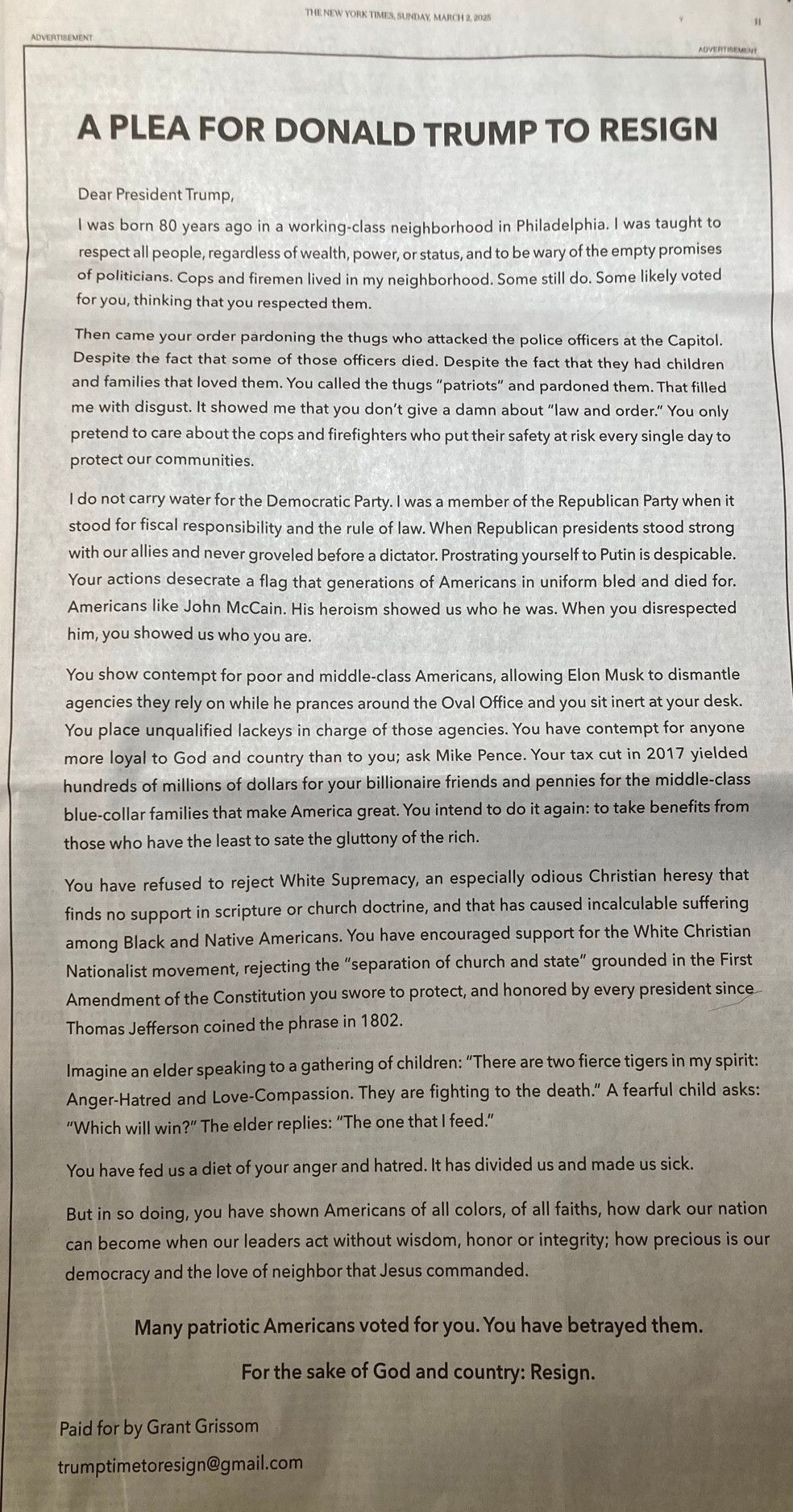
Subsequent to this Columbus Ohio letter, check out the paid full page ad published in a letter in The New York Times.  the letter is on line on my Maine Writer at this site here.

Trump should resign already❗

The word “resignation” not only has “nation” in it. It cuts both ways for understanding the state of politics in America.

Democrats are expected to resign themselves to a new administration.(#IDTS 😒) believing it is the right thing to do, it would seem, considering Trump got a majority of the votes cast in the November election.

But a slim majority, nonetheless, considering that he received a mere 2.3 million more of the roughly 152.2 million votes cast, a fact which reveals a balance of power in America.

But Americans don’t just disagree.

Democrats and Republicans digress to the point of being at each other’s throats.

To expect Democrats to resign themselves to an administration they voted against because they consider it an aberration of America’s core values❓ NO💢  #RESIST❗ America is now under attack from domestic enemies. Our democracy is worth fighting for❗

Trump gave half of America even more reason to strongly resist him llast month when he told NBC’s “Meet the Press” moderator Kristen Welker that he could mass deport children of Dreamers after moving to end birthright citizenship enshrined in the 14th Amendment of the U.S. Constitution.

Not to mention that the incompetency inherent in Trump’s Cabinet-level picks suggests dereliction of duty on his part.

While Republicans stubbornly stick with Trump, Democrats could call for him to step down citing that President Richard Nixon’s “resignation” was for something relatively minor by comparison.

From John E. Reinier Sr., in Columbus Ohio

Labels: , , , ,

Tuesday, October 15, 2024

Donald Trump is a threat to world peace. Read about what one expert says- Scott D. Sagan

Echo Opinion  published in the Detroit Free Press by Scott D. Sagan Sagan: I study nuclear war. Kamala Harris must be our next president.

The risk of nuclear war in the Middle East today is dangerously high, and Donald Trump is responsible. Let me explain.
IMO This essay brings to my mind the "Daisy" political ad of 1964

I grew up in Dearborn, Michigan in the 1960s, at the height of the Cold War. I clearly remember the "duck and cover" exercises we conducted in elementary school, crawling under the wooden desks when an alarm bell rang out at the Greenfield Village School. Our teacher tried to calm our nerves by claiming this was “a hurricane drill.” But, with Nikita Khrushchev and John F. Kennedy and the Cuban Missile Crisis on the CBS evening news with Walter Cronkite, we all knew what the drills were really about.

And I recall how scared I was again about the danger of nuclear war a few years later, as a teenager in the 1970s. On October 6, 1973, Israel was attacked by Egyptian and Syrian forces in a surprise attack in the Sinai Peninsula and the Golan Heights. The Israeli Defense Forces gradually fought back, supplied by U.S. emergency arms shipments, defeating the Syrians and crossing the Suez Canal to surround the Egyptian Third Army in the Sinai desert. Then, on October 24, 1973, the Soviet Union threatened to send troops to Egypt to enter the war, on the side of its Egyptian allies.
Daisy ad changed political advertising and influenced the outcome of the 1964 election. IMO The powerful ad conjured up the image about the threat of nuclear war.

Suddenly, President Richard Nixon put U.S. nuclear forces on a high-level DEFCON 3 alert to try to deter the Soviet Union from sending forces to the Middle East. Threatening nuclear war was not prudent (I thought that even in my teenage years), but simultaneously, Secretary of State Henry Kissinger successfully put pressure on Israel to accept a cease-fire and end the 1973, war. This cease-fire eventually led to the Camp David Accords and the peace between Israel and Egypt that still exists today.


We also now know that Nixon, facing Watergate soon thereafter, was so distraught and irrational in his decision-making that Secretary of Defense James Schlessinger actually warned the Joint Chiefs of Staff not to automatically follow military orders from the president, but rather to check with him first. 


Schlessinger’s actions were not constitutional, but were prudent and wise.  This dark history is relevant today. For I have never been worried about a nuclear war in the Middle East since then ... until now.  

No deal: A war is raging in the Middle East, and Iran is on the brink of getting nuclear weapons.  Donald Trump is responsible for this dangerous development because his administration withdrew, in 2018, from the U.S.-Iranian nuclear deal that restricted Tehran's ability to make highly enriched uranium bomb material.


The International Atomic Energy Agency (IAEA) inspectors in Iran verified that Tehran was in compliance, but then ❗- (former) President Donald Trump claimed that he, the self-proclaimed “master of the deal,” would get a better agreement.

He did not.   Iran was a year or two away from getting the bomb when the Obama Administration negotiated the Iran nuclear agreement, and when Trump cancelled it. Now, U.S. intelligence agencies report that Iran “has greatly expanded its nuclear program” and “has the infrastructure and experience to quickly produce weapons-grade uranium.” The head of the IAEA now estimates that Iran has “amassed enough nuclear material for several weapons, not just one.” That is the direct result of Trump's ego and poor decision-making.


In the coming weeks or months, Israel may well attack the Iranian nuclear facilities in response to Iran’s recent missile and drone attack on Israel. But, Israel lacks the confidence that it could destroy all of the Iranian nuclear materials, both because the enrichment centrifuges are in deep underground facilities — and because most of the IAEA inspectors were kicked out of Iran due to Trump’s rash withdrawal from the nuclear deal. 

This means Israel can’t be sure that it knows where all Iran’s uranium enrichment facilities are now located. And even if an attack is successful in the short-term, Iran will likely then rush to rebuild a nuclear arsenal.

High stakes:  When you get to the polls, think about that scenario.

Do you want a President Kamala Harris who supports Israel, but has expressed doubts about the way Israel is fighting its wars today?

Or do you want a President Trump, who criticized calls for a cease-fire in Gaza, has said Israeli Prime Minister Benjamin Netanyahu “knows what he’s doing” and advised him “have victory, get your victory, and get it over with.”

Do you want a President Harris, a former prosecutor known to stay calm and focused under pressure?

Or do you want a 😔President Trump, who was so impulsive and vengeful at the end of his term in office that his chairman of the Joint Chiefs of Staff, like Nixon’s secretary of defense, told senior military officers to check back with him before following any presidential orders to use military force?

The voters of Michigan may well decide who is the next president of the United States. They should remember that the risk of nuclear war is on the ballot in November. 

Scott D. Sagan is a Professor of Political Science at Stanford University 

Labels: , , , ,

Friday, January 04, 2019

A terrible Trumpzi year - past time to exit

2019 will be the worst year of Donald Trump’s life

An echo opinion by Jon Weiner published in The Los Angeles Times

Some presidents have really bad years.

For Richard Nixon, it was 1974 — the Watergate year, which ended with his resignation. For Clinton, it was 1998 — the Monica year, which culminated with an impeachment trial in the Senate in 1999. He won that vote easily and came out more popular than before.

It’s a good guess that Donald Trump’s really bad year will be 2019. And it’s not yet clear whether he’ll survive, like Clinton, or be forced out of office, like Nixon.

Nixon’s worst year resulted from crimes in his 1972 reelection effort, when burglars working for the campaign got caught breaking into the Democratic headquarters, and then Nixon and others conspired to stop the break-in investigation and cover up what had happened.

The events that brought Clinton to an impeachment trial in the Senate had nothing to do with his political campaigns. His misdeeds were strictly personal: He had sex with a White House intern, Monica Lewinsky, and then denied it under oath.

The storm clouds gathering around Trump involve both the personal and the political. 

More than a dozen federal and state investigations are underway focused on Trump and those who worked on his election effort. He will also soon be facing aggressive congressional investigations by the House Democrats.

It’s easy to get lost in the details of Russiagate and the guilty pleas of Trump associates involved in a range of crimes, but what is developing is not that complicated: It’s a political corruption scandal with the potential to be larger than anything we’ve seen before in American history.

The infamous Trump Tower meeting, where Don Jr., Jared Kushner and campaign chief Paul Manafort met with a Russian operative offering help in the election, could turn out to be far worse than anything that happened in Watergate. And Trump’s sexual troubles would be worse than Clinton’s, too, if he is found to have violated campaign funding laws in trying to buy the silence of women he slept with.

Still, there are many similarities between Trump’s troubles and earlier presidential scandals — along with some differences.

Both Nixon and Clinton faced allegations of obstruction of justice. They were tripped up not so much by the acts themselves, but rather by attempts to cover them up.

Obstruction is also a focus of the investigations facing Trump. 

For Trump, the possible obstruction involves his efforts to stop the Russiagate investigation and his firing of FBI Director James Comey.

Trump is also facing potential charges that neither Nixon nor Clinton had to deal with. The biggest question is whether Russiagate was a quid pro quo in which Russia offered to help Trump win the election in exchange for Trump easing Russia sanctions. We will probably learn more this year about what Russia did, exactly, during the election, both with “information influence” spread through social media and cyberattacks on the Dems. But the big question will remain what the Trump campaign knew about those efforts, and who exactly was in the loop.

I’m betting that, in the end, Trump resigns and gets an advance pardon for himself and his children.


Trump also faces campaign finance issues that neither Nixon nor Clinton had to deal with. 

If, as Trump’s former lawyer Michael Cohen has said, Trump directed that payments be made to two women to keep them silent during the election campaign, then the payments could be construed as illegal campaign contributions.

Trump also faces allegations that he violated the emoluments provision of the U.S. Constitution, which prohibits federal officeholders from receiving payments from foreign or state governments while in office. The attorneys general of the District of Columbia and Maryland argue that Trump violated the emoluments clause by receiving money from foreign governments while holding office, through hotels owned by his family.

And if that weren’t enough, Trump also faces investigations into alleged illegalities at the Trump Foundation and in the fundraising and spending by his inauguration committee.

Nixon’s troubles hold another possible caution for Trump in a year when committees in the House will almost certainly be subpoenaing the president’s tax returns. For Nixon, news that he had violated tax laws by taking an illegal write-off did a lot to turn the public against him. Nixon had backdated the deed of gift of his papers to the National Archives in order to take his write-off in a more advantageous year.

People who shrugged off Watergate on the grounds that “everybody does it” were outraged that the president had claimed an illegal deduction of $576,000 — the equivalent today of more than $3 million.

We don’t know whether Trump’s tax returns contain dubious write-offs, but it seems likely we’ll find that out this year — and also, perhaps, whether the public is more forgiving of him than of Nixon for tax shenanigans.

Both Clinton and Nixon faced impeachment proceedings. 

The House Judiciary Committee voted articles of impeachment in 1974 against Nixon, but the full House never voted on them, and the Senate never held an impeachment trial. He resigned before that — and was promptly pardoned by his successor, his former vice president, Gerald Ford, for any crimes he may have committed. Clinton was impeached by the House and went on to face a Senate trial, which fell far short of the required two-thirds vote for conviction.

I’m betting that, in the end, Trump resigns and gets an advance pardon for himself and his children. That may not happen until 2020, but in the meantime, 2019 will be the worst year of his life.

Jon Wiener is a historian and a contributing editor to the Nation. He is the author of “How We Forgot the Cold War: A Historical Journey Across America.”

Labels: , , , ,

Wednesday, August 29, 2018

Idaho echo opinion letter: Where is Patriotism?

Donald Trump followers fail to show patriotism because they clearly are not supporting democracy.  An echo letter to the editor published in the newspaper Idaho Statesman.

Like Richard Nixon supporters before them, most who supported Trump were just supporting their party’s nominee. But as compelling criminal evidence unraveled, America realized that it was time for Nixon to go. Even Nixon himself was patriotic enough to step down, sparing America further humiliation.

As Donald Trump’s inner circle of power brokers fall one by one for serious crimes, all patriotic Americans must face the compelling evidence that it’s time for Trump to step down (note: historically, mob bosses have always maintained several layers of protection from prosecution ... they simply have all their subordinates carry out the crimes ... exactly what happened with Nixon and now Trump).

Look at the people who show up at Trump rallies en masse — neo-Nazis, white supremacists — intolerance peddlers of every persuasion. Is this really what American patriotism has been reduced to?

Don’t count on Trump being as patriotic as Nixon. As impeachment looms, his vindictive, vengeful nature will manifest. Remember Saddam Hussein setting Kuwait’s oil fields aflame as he went down? Trump will go after the environment, too ... and humanity’s most vulnerable citizens.

Trump has literally flipped Kennedy’s renowned refrain to (sic): “Ask not what you can do for your country; ask what your country can do for you ....”

Michael Howard, Boise

Labels: , , , ,

Thursday, May 03, 2018

Deja vu "all over again" ~ Watergate echo

Richard Nixon tried to fire Watergate investigators ~ failed!
Donald Trump should learn from Watergate and Richard Nixon ~ echo Editorial Board opinion published in Newsday.

Trump’s threats risk undermining our democratic institutions by discrediting them in a cynical appeal to his base.


Donald Trump is again attacking the Justice Department for resisting efforts to politicize special counsel Robert Mueller’s investigation. Trump is again threatening to follow the destructive path of Richard Nixon as he struggles with the reality that he has two awful options on the table: 


  • Either answer Mueller’s questions or 
  • Assert his Fifth Amendment right against self-incrimination.
To Trump, it seems so much easier to fire the prosecutor.

Trump’s repeated threats risk undermining our democratic institutions by discrediting them in a cynical appeal to his base. This approach is also against his self-interest because when he boasts or tweets negatively about the investigation, he appears to put himself in more legal jeopardy.


Trump must let the process unfold and answer the prosecutor’s questions. Instead, Trump is using his storm troopers in Congress to taint the probe. On Monday, the Justice Department notified House Republicans Mark Meadows and Jim Jordan that it will not turn over a memo by Deputy Attorney General Rod Rosenstein that set the parameters of the special counsel probe. Justice officials said it was part of an ongoing criminal investigation.

On Tuesday, Meadows let it be known that he might try to impeach Rosenstein, a prime Trump target. By the end of the day, Rosenstein fought back, a signal of how seriously he takes the threats. “And I think they should understand by now, the Department of Justice is not going to be extorted.” Think about it, the No. 2 person at the Justice Department claims he is being extorted by members of Congress and the president.

Here’s why. A week ago, Trump said he was “very disappointed in my Justice Department” in a “Fox and Friends” interview, calling the probe “an absolute disgrace.” 


Moreover, Trump continued trying to set up Rosenstein for a fall, concluding a tweet: “At some point I will have no choice but to use the powers granted to the Presidency and get involved.” By the afternoon, White House press secretary Sarah Sanders adopted Trump’s strategy, calling the investigation into Russian meddling in the 2016 election a “witch hunt.”

Well, Congress can’t get just any access it wants to documents in an ongoing investigation. That is not how its oversight powers work. And Trump might oversee the Justice Department, but our nation’s rule of law does not bend to the president’s whims. The judicial system will determine whether the Mueller investigation overstepped its authority. Learn from history: President Richard Nixon’s “Saturday night massacre” didn’t work out so well, and the Supreme Court later required him to turn over Oval Office recordings to a federal court.

Mueller wants to interview Trump. In fact, Trump's (crisis managers!) lawyers are threatening a showdown with the special counsel if he issues a subpoena to the president. Such a dispute would likely go to the Supreme Court. Trump is pursuing a political strategy: Discredit the investigation and fire those who are doing it.

It’s wrong, and it won’t work. “You’d have to fire the entire FBI and the entire Justice Department” is how fired FBI Director James Comey described the consequences if Trump follows up on his threats.

Those firings would leave Trump’s presidency and his party in ashes.

Labels: , , , ,

Friday, March 30, 2018

Enough is Enough ~ Parkland and the Vietnam protests

An Echo from The Washington Post and Newspaperdirect 
By James Hohomann (Echo articles and opinions are selected by my MaineWriter via random searches of the nation's newspapers.)

The great achievement . . . was to bring a large swath of Americans together in dissent, establishing their (unified) cause.."

US Navy officer John Kerry and Ted Kennedy during the Vietnam War era
In the Vietnam War years (1955-1975), millions of young people lived in fear that they — or someone they loved — would have their number called, and they’d be shipped off against their will to the rice paddies and jungles of a faraway land, for a cause they felt was unjust and futile. 

From 1964 to 1973, the U.S. military conscripted 2.2 million men — boys, really — out of an eligible pool of 27 million. This helped fuel the mass movement against the war.

A key reason the protests against the war in Vietnam were so much more potent than against the war in Iraq is that there was a draft back then.

Young people today aren’t worried about being drafted to fight Kim Jong Un in North Korea. But many are palpably concerned that they or someone they know could get shot at school. 

High-profile incidents, culminating with the February 14, 2018, mass shooting in Parkland, Fla., have shaken many middle-class kids, who would not otherwise be inclined to activism, out of their suburban comfort zones.

Saturday’s (March 24), March for Our Lives was so big because the fears are so personal. A whole generation has come of age since the 1999 massacre at Columbine High School in Colorado that left 13 dead. More than 100 people have died from gunfire at school since then, and more than 187,000 students attending at least 193 primary or secondary schools have experienced a shooting on campus during school hours, according to a Washington Post analysis.
These numbers are relatively small when compared with the 58,000 Americans who died during Vietnam, but they are nonetheless staggering. Schools, of course, are not supposed to be war zones. Like other forms of terrorism, these shootings instill panic in the rest of the population.

From coast to coast, hundreds of thousands of people protested Saturday for stricter gun laws. Many attendees said during interviews or speeches that they were motivated by dread and anxiety that they could be next.
Former secretary of state John F. Kerry sees parallels between the Parkland survivors and “many of the Vietnam veterans who returned home and felt compelled to speak out about their experience.”

“Every historic moment has its own power, and these young people deserve their own moment,” Kerry said in an email.

“Many of the students have earned the right to be heard through a shared loss that innocents should never experience. Their moral clarity defies politics or partisanship. . . . These young people have touched the conscience of the country about common sense on guns, and they have the power to make it a voting issue again.”

Kerry became an antiwar activist after volunteering as a naval officer in Vietnam, an experience that profoundly shaped his worldview and service in the Senate. 

“Marjory Stoneman Douglas High students were compelled because they’d seen friends suffer and die for a policy that they thought was a mistake,” he said, referring to the veterans who became protesters. “Because they’d served, they couldn’t be dismissed by Spiro Agnew and the Nixon White House. The same way, these young people from Parkland and all over the country can’t be written off by mere politicians. Their moral authority is unimpeachable.”

The 74-year-old also sees analogues between the March for Our Lives and the movement to protect the environment, another issue that many view in existential terms. “The environment was written off for a long time as a minor issue,” he said. “Earth Day 1970 changed all of that when millions filled the streets of America and turned the environment into a voting issue and forced [Richard] Nixon to create the EPA.”

The march in Washington on Saturday, March 24, mixed political activism with the raw emotion of teenagers who are dealing with the murder of their friends under the glare of the national spotlight, which in this era means nasty criticism from trolls on the Internet.

“Sam Fuentes, a senior shot in the leg at Stoneman Douglas, up on stage while delivering her speech to a national television audience. She recovered and led the crowd in a rendition of ‘Happy Birthday’ for her slain classmate Nicholas Dworet, who would have turned 18 on Saturday,” according to The Post’s account.

“Emma González, 18, took the stage in a drab olive coat and torn jeans, speaking of the ‘ long, tearful, chaotic hours in scorching afternoon sun’ as students waited outside . . . on the day of the shooting. With a flinty stare, tears streaming down her face, González stood silent on the rally’s main stage for nearly four minutes — evoking the time it took Parkland shooter Nikolas Cruz to carry out his attack. The crowd began chanting, ‘Never again.’ ”

History tells us that change won’t happen overnight. Zachary Jonathan Jacobson, a historian of the Cold War, saw echoes in the Saturday protests of the nationwide demonstrations against the Vietnam War on Oct. 15, 1969. Students skipped class in 10,000 high schools, and experts estimate that about 2 million Americans protested that day.

“A withdrawal from Vietnam was not negotiated for three more years; a full withdrawal not for another six,” Jacobson said. “But while [Nixon] refused to comment publicly on the demonstrations, letting ‘it be known that he was watching sports on TV in the White House’ that day, we now know that the president was privately spooked. The protests forced Nixon to cancel plans to expand the war with an offensive of aerial bombing, harbor mining [and] even an invasion of North Vietnam.

“The unity of action firmly established that the antiwar movement had a constituency that could be mobilized,” he added. “The great achievement . . . was to bring a large swath of Americans together in dissent, establishing that their antiwar cause was not fueled by a dangerous fringe that Nixon could, with a few dirty tricks, stamp out or discredit.”

Cathy Richardson, lead singer of the rock band Jefferson Starship, said the energy emanating from the *Enough is Enough* Washington DC crowd is reminiscent of the anti-Vietnam War protests. 

Labels: , , ,

Friday, February 02, 2018

Historians: Opinions about Donald Trump war with the FBI and intelligence

“Unprecedented”: historians on why Trump’s war with the FBI is so stunning: Penn State, Emory University and others.....


House Republicans have wrongly voted to release a memo alleging anti-Trump bias at the FBI. The classified memo reportedly details how the FBI used the Trump dossier produced by ex-British spy Christopher Steele to unlawfully surveil the president.

As my colleague Zack Beauchamp noted, there is no evidence so far that the FBI was plotting against Trump, and it’s unlikely that the memo will provide any. As it stands, the president has until Saturday to decide whether to release the memo. (The FBI has privately and publicly urged him not to do so.)

If the president decides to release the memo, the White House and the FBI will be in open war with each other.

Commentary published in Vox.com

Douglas M. Charles, professor of history, Penn State University

Regarding the current antagonism between the White House and FBI, there is no good historical precedent. Never has a president of the United States attacked the FBI so publicly. Furthermore, congressional committees with oversight responsibilities have also never openly attacked the FBI in this way.

In the J. Edgar Hoover days (1924-1972), the FBI worked in some cases to advance the political interests of the White House: Franklin Delano Roosevelt’s foreign policy interests, Eisenhower’s anti-communist interests, Lyndon Johnson’s and Nixon’s political intelligence interests.

When Harry Truman was president and allegedly was “soft on communism,” FBI Director J. Edgar Hoover secretly worked with congressional committees and Sen. Joe McCarthy to advance the anti-communist cause, but there was never a public rift between the FBI and the White House. 


The idea that a president would so publicly condemn the FBI and its work is unprecedented, and does appear to be an effort to pull the FBI back into the presidential orbit as an agency doing its bidding....

Carol Anderson, professor of history and African-American studies, Emory University

Yes, the independence of the FBI is under siege. Bringing an independent judiciary and investigative branch under the domination of the executive is one of the first moves of regimes that do not respect the rule of law. Pinochet’s Chile. Nazi Germany. The Soviet Union. Putin’s Russia.

The rationale is simple. Besides the military, the judiciary and law enforcement branches are the most powerful in a state. 

Control and politicization of that wing allows the ruler to criminalize his opponents, to label them enemies of the state, when in fact those so-called enemies are really defenders of a more viable, democratic nation. That is why they are a threat.

Rhodri Jeffreys-Jones, professor of history, University of Edinburgh

There have been tensions in the past between the White House and the FBI. For example, President Johnson made it known that he was disappointed the FBI could not prove there were communists behind the domestic protest movement against the Vietnam War. The CIA concluded the same, and LBJ had to abandon any urge he may have felt to fire the bureau’s director, J. Edgar Hoover. But that fracas was a storm in a teacup compared with today’s confrontation.

It seems to me that there has been incompetence all round. Russian President Vladimir Putin rightly thought there was a chance of an ally in the White House, [and] then, to further that goal, sanctioned interference in the presidential election. Donald Trump indeed wanted to be friends with Russia but suffers from Putin-like hubris ... and has thwarted his own aim in that he cannot now be friends with Russia without appearing to be part of Putin’s conspiracy.

What happens to the FBI may seem a side issue compared with all this, but presidential disrespect for the law is reminiscent of Richard Nixon’s behavior, which led to his resignation in disgrace.

Meg Jacobs, professor of history, Princeton University

The contest of wills between Trump and the FBI is not so much a part of a long-term battle between the president and the director of intelligence as much as it is the latest episode in the GOP effort to sideline and discredit the Russia investigation.

When Christopher Wray testified during his confirmation hearings, he assured the Senate committee he was “not faint of heart.” 

If and when necessary, he would be willing to stand up to the president. And so far, it looks like he’s living up to his promise. However, the fight over the House Republican memo is less about historical precedence or weakening of the checks on the presidency than it is a reflection of the polarized politics we are living through and, more generally, the attack on the credibility of all government institutions.

The memo scandal is a move on behalf of the White House ... to tarnish the reputation of the FBI and of the Justice Department, and by extension call into doubt the motives of the Mueller investigation. In that way, it takes us further down the path of turning every development in the investigation into a partisan ploy.

That, of course, is nothing new — think of the attacks on Kenneth Star by the Clinton White House. But here, the charges are not simply that Mueller is an overzealous prosecutor, but rather that the FBI tried to help throw an entire election. The House memo seems like it will suggest that the FBI was implicated in an attempted coup. The long-term significance of the memo release is that it may confirm for some how few in government can be trusted to act in an independent and honest way, even the FBI —which has historically been seen as beyond the partisan fray.

Carol Anderson, professor of history and African-American studies, Emory University

Yes, the independence of the FBI is under siege. Bringing an independent judiciary and investigative branch under the domination of the executive is one of the first moves of regimes that do not respect the rule of law. Pinochet’s Chile. Nazi Germany. The Soviet Union. Putin’s Russia.

The rationale is simple. Besides the military, the judiciary and law enforcement branches are the most powerful in a state. Control and politicization of that wing allows the ruler to criminalize his opponents, to label them enemies of the state, when in fact those so-called enemies are really defenders of a more viable, democratic nation. That is why they are a threat.

Ivan Greenberg, author of Surveillance in America: Critical Analysis of the FBI, 1920 to the Present

This level of open combat between President Trump and the FBI is unprecedented. In the past, President Jimmy Carter took on the FBI and reformed it substantially, reducing its investigations in politics. That reform followed the death of longtime FBI Director J. Edgar Hoover and the Senate Church Committee hearings in 1975-’76 on abuse of power by the FBI and other Intel agencies. But Carter did much of the reform behind the scenes. It was not open combat, as Trump is waging today.

Trump is the second president to fire an FBI director. The first [FBI director] was William Sessions in 1993 [who was dismissed by then-President Bill Clinton]. But there was little open feuding like today surrounding that decision. Greenberg says that Trump has a deep-seated suspicion of the US intel agencies, which may be due to contact with them from his days in Atlantic City, or from his father’s experience with the FBI.

The claim that the FBI’s “independence” is a thing to preserve is misguided. In the past, much of that so-called “independence” allowed the bureau to go rogue in its spying on Americans and evade congressional or Justice Department accountability.
Morton Keller, professor of history, Brandeis University

The major theme in earlier FBI-White House relations was the tension between the presidents and an all-but-autonomous J. Edgar Hoover. Strong chief executives like FDR, Truman, Eisenhower, and LBJ contained him pretty well, but there was constant tension.

I have no idea whether there will be an increase or a decline in the FBI’s independence. I do know this: The tension between the Democratic presidents of the past and J. Edgar Hoover closely resembles the relationship between Trump and the current FBI leadership. It appears to be inherent in the institutional relationship of the presidency and the FBI.

Timothy Naftali, clinical associate professor of public service, New York University

Donald Trump is not the first president to have a fraught relationship with the Federal Bureau of Investigation. 

Trump is, however, the first to launch both a public and private war on its credibility. When Richard Nixon found that there were limits to what J. Edgar Hoover and the FBI were willing to do for the White House, he ordered that a White House investigative unit (dubbed “the Plumbers”) be set up to go after his enemies.

But Nixon did not dare take on Hoover or the bureau publicly. After Hoover’s death, Nixon put his own man in the job and expected loyalty. The bureau beneath L. Patrick Gray pushed back when “loyalty” meant obstruction of justice. In the long post-Hoover period, the relationship between the bureau and presidents has seemed less fraught.

The one exception, before the Trump era, was the tense relationship between President Clinton and his FBI Director Louis Freeh, who was very supportive of the Lewinsky investigation. However, that tension remained largely hidden, and no evidence has ever surfaced that the president tried to have Freeh fired.

There’s another phenomenon of the Trump era that portends a real threat to the independence of the FBI. Not since the “season of investigations” of the CIA and the FBI in the 1970s have members of Congress been so suspicious of the bureau. The FBI’s force of dedicated public servants will not be alone in bearing the burden of this hyperpartisan moment. In the end, whether the American people fully recognize it or not, they need an independent, nonpartisan federal investigative force.

H.W. Brands, professor of history, University of Texas

I can’t think of a single time any president has done anything like this. Harry Truman privately worried that the CIA would become an American Gestapo. And several presidents muttered against J. Edgar Hoover. But no one went public the way Trump has.

Stanley Kutler, the historian who knew more about Watergate than anyone, called it the “war of the FBI succession.” The death of J. Edgar Hoover left the bureau in a state where Richard Nixon could try to employ it to cover his misdeeds. But the FBI had its own interests and secrets, and in the tangle that ensued, it was the president who was brought down. The lesson might be that if a president has secrets he wants to keep hidden, he shouldn’t mess with the FBI.
David Stebenne, professor of history, Ohio State University

There was serious antagonism between the FBI and the White House during the Kennedy administration (over Director Hoover’s attitude toward the civil rights movement in general and Dr. [Martin Luther] King in particular).

There was also serious antagonism between the FBI and the White House during the Nixon administration. Nixon believed that Hoover might have wiretapped a conversation dealing with the Nixon campaign and the South Vietnamese government in the fall of 1968, and feared Hoover might release it, implicating Nixon and his campaign chief in a violation of the federal statute that prohibits private citizens from interfering with the conduct of American foreign policy.

Once the Watergate break-in happened, that tension between the FBI and the White House intensified.

As for the current situation, it seems fair to say that the White House appears to be pressuring the FBI, but it’s too soon to tell whether that leads to a significant loss of the FBI’s independence from the White House.

The Nunes memo, explained with diagrams

Labels: , , , , , , , , ,

Tuesday, May 24, 2016

Ann Coulter has no moral compass she sold her soul to be a Trumpy

Without doubt, the "jenny one note" Ann Coullter would be vitriolic if Secretary Clinton had refused to release her financial and tax information. Nevertheless, she's now a Trumpy by defeding his decision to withhold income tax reports.  Hypocrisy is endemic in Coulter's personae. Obviously, Coulter is more concerned with promoting rabid conservatism than promoting fairness.  
Now, she was challenged to defend her hypocrisy. In fact, she failed to rise to the opportunity. Rather, she deflected the issue, spewing Donald Trump's stupid excuses for not releasing his income taxes.

Salon.com reports;

On MSNBC’s Hardball Monday, host Chris Matthews played a clip of Democratic front-runner Hillary Clinton demanding Donald Trump release his tax returns, then asked Trump supporter Ann Coulter why he wouldn’t release them if he had nothing to hide.

“I think the reason he hasn’t released them is exactly why he says he hasn’t — he’s under audit,” she said. “It’s legal for him to do so, just like it’s legal for someone on trial for murder to talk to the press — but their lawyers wouldn’t be happy about it.”

Donald Trump is a horror movie: No, really!
Donald Trump has a moral obligation to release his income tax information

“Poor baby,” Corn sarcastically replied, though whether he was referring to Trump, Coulter, or both was unclear. “Every other president has done that — including [Richard] Nixon, when he was also under audit. Because you can tell whether he’s hiding money offshore, [or] whether he gives money to charity.”

“Exactly,” Coulter said, seemingly not understanding Corn’s point. “Why should he do that?”Photo published for WATCH: MSNBC’s David Corn destroys Ann Coulter for defending Trump’s decision not to release tax...
David Corn challenges right wing diva Ann Coulture

“That’s good,” Corn replied, “you want a crook in the White House — that’s fine, Ann, you can go ahead and have that.”

Coulter argued that he’s “not a crook,” unwittingly summoning the ghost of Nixon for the second time in two minutes, to which Corn replied, “we don’t know if he’s a crook or not.”

“We don’t know if you’re a crook,” Coulter shot back, randomly, before noting that none of this matters to Trump supporters anyway.
(HELLO?  Ya'think? In fact, Ms. Coulter, you have no political soul. Obviously, you have covered politics enough to know an incompetent candidate when you see one #NeverTrump.)

Coulter is now an official Trumpy. Sad.
Scott Eric Kaufman is an assistant editor at Salon. 
Follow him at @scottekaufman or email him at skaufman@salon.com.

Labels: , , ,