Maine Writer

Its about people and issues I care about.

My Photo
Name:
Location: Topsham, MAINE, United States

My blogs are dedicated to the issues I care about. Thank you to all who take the time to read something I've written.

Sunday, April 26, 2026

Donald Trump and maga Republicans illegal war of choice in Iran paid for by Americans paying higher costs on almost everything

Chattanooga Times Opinion: Americans continue to bear the cost of Trump’s chaos.

Last April, 2025, Donald Trump announced what will go down as one of the dumbest economic policy decisions in American history.

Nearly every economist told the president that tariffs imposed using the International Emergency Economic Powers Act were a loser — with disagreement coming mostly from how bad their impact would be — and the administration was warned the move was likely unconstitutional.

Trump pushed on anyway, causing Americans to spend millions more for goods.

Now, a year after Donald Trump's so-called Liberation Day tariffs began, it is time for the government to repay more than
💲166 billion in duties that were struck down by the U.S. Supreme Court.

So much for making America wealthy again.
🙄

Even after being rebuffed by the court, Trump enacted new tariffs, which are expected to cost the average U.S. family more than
💲2,500 this year — a 43󠀥 increase ( ) from the 💲1,745 average estimated during the first year of his second term, according to data recently released by the Joint Economic Committee.

Small-business importers paid an average of
💲306,000 more per business in tariffs.

All for nothing.

A year of economic chaos just so Trump can go on a power trip. But that is what Trump's second term is shaping up to be.

Jeremy Siegel, professor emeritus of the Wharton School of the University of Pennsylvania, called Trump's tariffs the "biggest policy mistake in 95 years," alluding to the 1930, Smoot-Hawley Tariff Act.

The 1930, measure raised import duties on more than 20,000 goods by 50 to 100, aimed at protecting American farmers and industries from foreign competition during the Great Depression. 

But, it backfired, triggering retaliatory tariffs from other nations, causing a 26% drop in global trade and worsening the economic downturn.

Trump's tariffs added about 💲20,000 to the price of a new home 
🏠. They also increased the cost of clothes by 14. Household furnishings, cleaning supplies and toilet paper are up  at least 5.

Tariffs increased food prices on a host of items, including beef, up 16, coffee up nearly 20 and seafood up more than 6%.

The president claimed tariffs would magically revive American manufacturing. In fact, nearly 100,000 U.S. manufacturing jobs have been lost since the start of Trump's second term.

To add warmongering to injury, Trump's conflict with Iran added to the cost pressures on consumers. Gas prices jumped above 💲4 a gallon. Energy Secretary Chris Wright told CNN on Sunday that gas wouldn't drop below 💲3 a gallon until next year. 💢

Thanks to Trump's illegal war of choice in Iran and tariffs, consumer confidence dropped to its lowest level since 2014.


Meanwhile, Trump keeps threatening to commit war crimes in Iran, while his administration's diplomatic efforts amount to the Three Stooges, with the former hillbilly and former Marine Corps corporal Vice President JD Vance, Trump's son-in-law, Jared Kushner, and New York developer Steve Witkoff charged with negotiating peace.

Trump's shortsighted policies, rogue tactics, and erratic leadership have caused major allies to see the U.S. as unreliable and destabilizing. Trump is causing harm around the world, and yet expects the international community to help him out of the mess he created in Iran. Few allies have heeded his call.

For all his tough talk, America has never looked more incompetent or weaker.

In his concurrence with the high court opinion that Donald Trump exceeded his authority when he imposed sweeping tariffs, Justice Neil Gorsuch, a Trump appointee, reminded legislators of their responsibility to represent the people. 

Nevertheless, Republicans who control Congress have stood aside as Trump flails around with no clear plan.

Fortunately, many Americans are now paying attention. Trump and his policies are highly unpopular, and two-thirds of U.S. adults disapprove of his handling of inflation and the Iran war. Even the MAGA coalition is beginning to fray in the face of White House chaos and broken promises.

As the midterm elections approach, voters seem intent on sending the message that America can no longer afford the cost of an unchecked Trump presidency.

Labels: , , , ,

Friday, April 24, 2026

Donald Trump inconsistency: "more stable direction from a weather vane" opinions

Donald Trump the UN-stable genius is emotionally unbalanced.


To the Editor of the New York Times: Trump Is Turning America Into a Psychotic State,” by Jonathan Rauch and Peter Wehner. (Opinion guest essay, April 12), is disconcerting on many levels. 

To date, the other two branches of our government - judiciary and legislative- have failed to hold Donald Trump in check. 

Perhaps he feels that the Supreme Court decision that granted him sweeping immunity allows him to rule without restraint. Congress seems unwilling to hold Trump accountable when he clearly acts beyond the legal limits. These factors, combined with a president who can be emotionally unbalanced and whose circle of advisers seldom pushes back, place the country in an extremely precarious position. From Amy M. Ferguson Dunmore, Pennsylvania

To the Editor: Jonathan Rauch and Peter Wehner are ultimately making an argument about process, not just personality. Strip away the rhetoric, and what remains is a concern that the machinery of government — deliberation, consistency, institutional memory — is no longer reliably engaged. When that discipline weakens, policy begins to look less like strategy and more like improvisation.

The United States has weathered strong presidencies, weak presidencies and moments of real turmoil. What is different here is the suggestion of sustained unpredictability at the institutional level. That is not a governing philosophy. It is the absence of one.

I’ve seen more stable direction from a weather vane — and at least it knows which way the wind is blowing. At this point, the only consistent policy is inconsistency, and even that seems subject to revision.  
From Douglas Shields in Pittsburgh, PA

Jonathan Rauch and Peter Wehner lay out in depressing detail Donald Trump’s lethal combination of qualities: evil, ignorance, out-of-control anger and disorganization. And he has freed up and nurtured the parts of our society and culture that share those qualities.

The results have plunged the rest of us into a state of dread💢😨

But, like the rest of Americans, I was mesmerized watching the return of the Artemis II astronauts and the ground team that pulled off this mission, I felt a bracing shot of optimism.

We were treated to an awesome display of the qualities of the other part of our culture: thirst for knowledge, intelligence, drive, planning, attention to detail and cooperation. And diversity — among both the crew members and the entire mission team. These qualities remain alive and well
❗ From Natasha Lisman in New York

Labels: , , , , , , , , , ,

Saturday, October 18, 2025

Donald Trump and maga Republicans are hurting American business with Trump Tariffs and consumers pay higher prices

Echo opinion published in the Los Angeles Times by Veronique de Rugy:  Trump’s tariffs are already hurting American businesses

With yet another round of tariffs taking effect this week — this time on cabinets and other furniture, timber and lumber — the White House insists that its policies are about “fairness” and “reciprocity.” The evidence now tells a different story of higher prices for Americans, lower margins for U.S. firms, collapsing exports in flagship industries, investment paralysis and mounting risks of an economic slowdown.
Start with exports. American goods are losing ground fast. A recent KPMG survey finds that “60% of businesses reported decreased overseas sales” in the first six months of Trump’s tariffs. For instance, U.S. liquor exports tumbled 9% in the second quarter of this year, with steep declines across the European Union, Canada, Britain and Japan, which together buy about 70% of these exports. In another example, China — once a key customer for U.S. farm goods — has turned instead to Argentina and other suppliers, and total U.S. soybean exports are down 23% this year.

Smaller companies are also adversely affected. A valve and gas-component maker in Napa Valley just announced that it will shut down a plant and discharge 237 employees, citing weak overseas demand linked to tariffs. 

Let’s not forget the upcoming Supreme Court case of V.O.S. Selections Inc. vs. Trump, where U.S. importers and resellers of wine, electronics kits, apparel and other goods argued that the 
April 2, (Fake) “Liberation Day” tariffs disrupted their supply chains, forced steep price increases and threatened their viability.

American consumers, too, are paying the price. KPMG (aka, economic intelligence) finds that nearly half of American companies have already raised prices because of tariffs; two-thirds have passed at least part of those costs on to shoppers; and nearly 40% have paused hiring, with a third cutting jobs.

CEOs overwhelmingly expect tariffs to weigh on business for years. Goldman Sachs estimates U.S. consumers are now footing 55% of the total tariff bill, while foreign exporters bear only a sliver of the costs.

Sometimes, though, the cost we pay isn’t higher prices — it’s no product at all. One of Europe’s largest farm-equipment manufacturers, Krone, has halted U.S. sales after a new wave of “steel derivative” tariffs required exporters to document the origin, weight and value of every screw, nut and bolt in their machinery. This bureaucratic tangle is so extreme that many European manufacturers are simply giving up. For American farmers waiting on harvesting equipment, that means delays, shortages and higher costs down the line.

The chaos doesn’t stop there. UPS has been drowning in a customs backlog since the administration scrapped the long-standing rule that allows imports costing less than $800 to enter the U.S. duty-free. Thousands of packages, from Japanese tea to engagement rings, are stuck or even “disposed of” because of missing tariff paperwork. It’s a vivid reminder that protectionism jams everyday commerce.

No product is too small. Italian pasta makers warn that Trump’s new duties, some nearing 92%, could double the price of a $4 box of rigatoni. Italian newspapers have dubbed it “Trump’s war against pasta.” Rome and Brussels accuse Washington of strong-arming companies like Barilla and Garofalo into producing in the U.S. Either way, the result is Americans paying more for our dinners.

Get ready for your kids’ lunches to get more expensive, too. Peanut butter could be swept into expanding steel and aluminum tariffs, with petitions asking the Commerce Department to treat food products packaged in metal as “derivatives” (subject to a 50% national-security tariff) under consideration.

So much for draining the swamp. All of this explains the wild uncertainty business leaders have experienced in recent months. Retailers are now bracing for 100% tariffs on Chinese goods scheduled for Nov. 1, right before the holiday rush. Some firms have scurried to ship early, but even a few days’ delay at sea could blow up their margins. With deadlines set, delayed and often re-announced with each news conference, companies can’t plan or invest.

The big-picture story isn’t any better. Each new round of tariffs rattles markets and makes investors more nervous about what the White House might do next. The result is a toxic mix for the economy: higher prices, slower growth and growing fears of stagflation. For the Treasury and the Federal Reserve, that means harder choices on interest rates and a rising risk that emergency measures to keep the financial system steady will be called for.


U.S. tariffs are taxes on Americans, and stealthy ones. They show up as higher prices in grocery aisles, lower wages for factory workers and greater global risk premia.

If Washington truly wants lower prices, stronger investment and resilient supply chains, officials should see at this point that the answer isn’t higher tariff walls. It’s stable rules, open markets and the simple economic truth that prosperity grows from trade.

Veronique de Rugy is a senior research fellow at the Mercatus Center at George Mason University. This article was produced in collaboration with Creators Syndicate.


Labels: , , , , , , ,

Tuesday, October 14, 2025

Donald Trump and maga Republicans ignore illegal murder of Venezuelans in open seas without evidence

Getting Away with Murder David Cole
Trump has now ordered the killing of at least seventeen people on the high seas—with no accountability.


Echo essay by David Cole published in The New York Review of Books:  During his first presidential campaign Donald Trump famously claimed that he could “stand in the middle of Fifth Avenue and shoot somebody” and not lose any voters. At the time it felt like an empty boast. No more.

Between September 2, and September 19, the US military, acting on President Trump’s orders, bombed three boats traveling in international waters, reportedly killing seventeen civilians in cold blood. Ordinarily when US armed forces kill civilians, the president does not brag about it, yet Trump is apparently so proud of the executions that he posted video footage of them on Truth Social. And while ordinarily the killing of any civilian prompts investigations and apologies, in this instance the administration has promised only that there are more to come. “To every terrorist thug smuggling poisonous drugs into the United States of America,” Trump said during his speech at the UN General Assembly on September 23, “please be warned that we will blow you out of existence.”

There was no conceivable legal authority for these killings. We are not at war with drug traffickers. The “war on drugs” is a metaphor, not a legal term of art that authorizes killing the “enemy.” The human beings on these boats were civilians, and even if there were an actual war going on, the laws of war prohibit targeting civilians unless they are directly engaged in hostilities. Even if the boats’ occupants were, as the administration alleges, carrying illegal drugs, that offense would at most have authorized their arrest, trial, and, if convicted, incarceration for a period of years. It would not authorize the death penalty, much less their summary execution without trial.

Trump has called the dead “narcoterrorists” and has asserted that the eleven killed in the first strike were associated with the Venezuelan gang Tren de Aragua, a “foreign terrorist organization.” But that designation authorizes only economic sanctions against the group, such as freezing their assets, and criminal penalties against Americans who do business with them. It does not authorize any use of military force, much less the intentional lethal targeting of civilians.

The boats did not pose any conceivable threat to the United States requiring lethal force. They were found on the high seas, reportedly coming from Venezuela. The first boat, according to The New York Times, had turned around before it was bombed, and the military reportedly continued to bomb it even after it had been disabled. Secretary of State Marco Rubio acknowledged that they could have interdicted the vessel, but said that instead they bombed it to send a message: “This president is not a talker; he’s a doer—he’s going to do it.”

Trump has maintained that drug cartels kill tens of thousands of Americans every year, presumably through overdoses, and that other nations are not doing enough to stop the trade. The result, he insisted in a letter to Congress after the first strike, is that “we have now reached a critical point where we must meet this threat to our citizens and our most vital national interests with United States military force in self-defense.” But the fact that drugs are a scourge in the US in no way gives the president the authority to start killing drug dealers—here, abroad, or at sea. And it is farcical to cite “self-defense” to justify bombing these ships to smithereens, without even a shred of evidence that they threatened to attack us.

In the absence of any conceivable military justification for these acts, it is difficult to view them as anything but premeditated murder, pure and simple. Federal law makes it a crime to kill a human being “with malice aforethought” on the high seas, and to conspire to do so. As my Georgetown Law colleague Marty Lederman, a former Justice Department official in the Office of Legal Counsel, has explained in an essay on the website Just Security, not only is it “questionable whether the President had any affirmative legal authority to order” the attack, but it is hard to escape the conclusion that, “absent further facts that haven’t yet been disclosed, the strike would appear to have implicated the federal felony murder statutes.”


Maybe “most alarming,” in Lederman’s estimation, is how dramatically these killings break from the Defense Department’s stated commitment, required by international law, not to target civilians, even in wartime. Indeed, Trump’s actions are so indefensible that even John Yoo, who as a Justice Department official authorized waterboarding and other forms of torture against suspected al-Qaeda detainees, and who takes about as robust a view of executive authority over national security as anyone, has seriously questioned the legal basis for the strikes, insisting that it is dangerous to blur the line between law enforcement and war.

But the White House couldn’t care less. This was made crystal clear when Vice President J.D. Vance, ever the good learner at the foot of his boss, posted on X that “killing cartel members who poison our fellow citizens is the highest and best use of our military.” When Brian Krassenstein, a critic of the Trump administration, replied that “killing the citizens of another nation who are civilians without any due process is called a war crime,” the vice-president of the United States responded, “I don’t give a shit what you call it.”

This is not normal. Prior presidents have invoked war authorities on dubious grounds to justify the use of lethal force and other unlawful measures, as when Ronald Reagan ordered the invasion of Grenada on the pretense of protecting Americans in medical school there, or when George W. Bush asserted the authority to disappear suspected al-Qaeda terrorists into secret CIA “black sites” and torture them, or when Barack Obama resorted to drones to assassinate suspected members of al-Qaeda or ISIS. Each questionable exercise of executive authority eases the way for further expansions. But never before has a US president asserted the authority to order the cold-blooded execution of civilians outside any even arguable military conflict. And never before has a US president then turned around and boasted about his own crimes to the public at large. If the president can order the summary killing of drug dealers on the high seas, why not elsewhere—say, Mexico, or Chicago?

Now a draft bill is reportedly circulating in Congress and the White House that would expressly authorize Trump to execute more “narcoterrorists,” a veritable license to kill civilians without trial. The fact that the White House and its allies are considering such a bill only underscores the absence of existing authority for the strikes. Such a blank check, moreover, would not change the fact that targeting civilians who are not directly engaged in combat is illegal under international law. It would just make Congress complicit in Trump’s crimes.

When the Supreme Court last year granted Donald Trump absolute immunity from any criminal prosecution for “official” acts taken while in office, Justice Sonia Sotomayor warned in her dissent that the Court was giving presidents a green light to kill. Trump has now apparently acted on that opportunity—by his own count, on at least three separate occasions. Yet, in keeping with his 2016, campaign boast, as far as we can tell Trump has not lost any support to speak of as a result. Indeed, amid the White House’s barrage of daily assaults on the rule of law, the killings seem barely to have registered on the nation’s conscience.

So much of what Trump has done since taking office is beyond the pale that it’s easy to lose track. He’s pardoned the January 6 rioters, even those convicted of violent attacks on police. He’s invoked the Alien Enemies Act, a wartime authority, to summarily deport Venezuelans, even though we are not at war with that country. He’s dismantled agencies that Congress established, and refused to spend billions of dollars that Congress directed him to spend. He’s tried to deny birthright citizenship to the children of immigrants, in direct violation of the Fourteenth Amendment. He’s used pretextual charges of antisemitism to target universities he considers too liberal, and imposed blatantly unconstitutional penalties on law firms for filing cases or hiring attorneys he does not like.

But since long before the founding of this nation, the law has recognized that in the hierarchy of illegal and immoral acts, premeditated murder sits at the very apex. The US remains one of the only democracies to continue to employ the death penalty, a punishment most of the world has rejected as cruel and unusual. But at least there are limits on that sanction. It can only be imposed for homicide (not drug smuggling), and only after a full trial and a robust round of appeals. The hapless—and thus far nameless—persons on board the boats that Donald Trump literally had blown out of the water this month did not even get that. .

—September 25, 2025


Labels: , , , , , , ,

Thursday, October 09, 2025

Donald Trump and maga Republicans use the First Amendment Free Speech as a weapon to punish others who also have this freedom

"The postman always rings twice"- The weaponization of Free Speech haunts Donald Trump's legacy because he lies about everything.

Where the Battle Over Free Speech Is Leading Us
Echo essay published in The New Yorker magazine.
Doxing, deplatforming, defunding, persecuting, firing, and sometimes killing—all are part of an escalating war over words. What happens next? By Louis Menand

The United States is in a speech war.
😯😧😥


Normally, human beings fight over money or land or love, but that is not what is happening today. Today, people are fighting over words. People’s lives are being damaged and sometimes destroyed not for something they did but for something they said. We live in a society of doxing, trolling, cancelling, sanctioning, slandering, deplatforming, defunding, persecuting, prosecuting, firing, and sometimes killing over the expression of an opinion. A big part of the craziness is that some of the people going to war over words are casting themselves as champions of free speech. It’s the people they are trying to silence, they claim, who are the enemies.

The lord of misrule here is the person you would expect. On January 20th, his first day back in office, Donald Trump issued an executive order titled “Restoring Freedom of Speech and Ending Federal Censorship.” It accused the Biden Administration of chilling speech it disagreed with and announced that  "It is the policy of the United States to:
(a) secure the right of the American people to engage in constitutionally protected speech;
(b) ensure that no Federal Government officer, employee, or agent engages in or facilitates any conduct that would unconstitutionally abridge the free speech of any American citizen;
(c) ensure that no taxpayer resources are used to engage in or facilitate any conduct that would unconstitutionally abridge the free speech of any American citizen;
(d) identify and take appropriate action to correct past misconduct by the Federal Government related to censorship of protected speech.

Donald Trump and his Administration then proceeded to ban the Associated Press from certain press events because it did not refer to the Gulf of Mexico as the Gulf of America, sanction law firms that represented clients whose political views the Administration regards as unfriendly, arrest and seek to deport immigrants legally in the United States for opinions they expressed in speech or in print, defund universities for alleged antisemitic speech and leftist bias, sue the Wall Street Journal for libel, extort sixteen million dollars from the corporate owner of CBS because of the way a “60 Minutes” interview was edited, set about dismantling the Voice of America for being “anti-Trump” and “radical,” coerce businesses and private colleges and universities to purge the word “diversity” from their websites, and order the National Endowment for the Arts to reject grant applications for projects that “promote gender ideology.”

After threats from the head of the Federal Communications Commission, a late-night television personality had his show suspended because of some (rather confusing) thing he said about Trump’s political movement. Other media outlets were advised to get in line. Trump has proposed that licenses be withdrawn from companies that air content critical of him. The Administration has opened Justice Department investigations into and yanked security details from people whose political views it dislikes. It has also warned that it may revoke the visas of and deport any foreign nationals who joke about the death of Charlie Kirk. West Point cancelled an award ceremony for Tom Hanks, after having already winnowed its library of potentially offensive books.

Donald Trump is suing the Times, which he calls “one of the worst and most degenerate newspapers in the History of our Country,” for libel. (In the initial iteration of the case, the judge threw out the eighty-five-page-long court filing as “decidedly improper and impermissible.”) A top complaint in his lawsuit is that the paper ran its “deranged endorsement” of Kamala Harris on the front page. Apparently, this is tortious behavior. At press conferences, Trump makes noises about investigating reporters whose questions he doesn’t like. (Who’s the snowflake now?)

This is not social shunning. This is not speaking from the bully pulpit. Apart from the libel suits, which Trumpziism can add teeth to by threatening regulatory sanctions or by slow-walking mergers and other business deals that require government approval, this is the persecution of people and organizations based on point of view. Much of this is exactly what the Supreme Court has said the First Amendment prohibits the federal government from doing. The Administration is not even pretending to follow the law, let alone its own proclamations about free speech. It’s getting results, so why should it

Compared with all this, a bunch of college students shouting down the conservative political scientist Charles Murray—an incident at Middlebury College now immortalized through endless retelling—is small potatoes. Somehow, though, in the war of words, college students tend to get the blame. “Charlie Kirk was assassinated while speaking on a college campus,” the president of Barnard College, Laura Ann Rosenbury, wrote in a recent Times opinion piece. “This is a grim moment for higher education, for our country and for freedom of speech. Violence is never a legitimate means of disagreeing with a speaker on a college campus.”

What is she talking about? Neither Mr. Kirk nor his alleged shooter was a student. The incident says nothing about tolerance for speakers on college campuses, and it is irresponsible for a college president to suggest that it does. Rosenbury notes disapprovingly that there was a petition to rescind Kirk’s invitation. A petition is classic First Amendment-protected expression. Surely the president of Barnard is not suggesting that students are inciting violence when they sign a petition. She is effectively throwing a bone to the White House, which can claim that Mr. Kirk was the victim of academic cancel culture.

As many people have rightly remarked, the response to Mr. Kirk’s murder is emblematic of the current hypocrisy. Mr. Kirk is being celebrated as a champion of free speech who was willing to debate anyone anywhere and who was killed by someone who could not tolerate his views. At the same time, Mr. Kirk’s admirers are campaigning to get people who make negative comments about those views—which are, after all, highly controversial and designedly so—fired from their jobs. And many have been. The Attorney General initially suggested that Mr. Kirk’s detractors could be prosecuted for hate speech (which happens to be constitutionally protected). Evidently, saying racist things is not hate speech, but calling someone out for saying racist things is.

All this suggests that Christopher L. Eisgruber’s new book, “Terms of Respect: How Colleges Get Free Speech Right” (Basic), is not ideally timed. Eisgruber is the president of Princeton University. It is a truth universally acknowledged that university presidents should not write books about their own schools, to which they have a fiduciary duty. The terms of their tenure require that they not do or say anything that might damage the school’s reputation or fund-raising capacity. It is therefore impossible for them to comment disinterestedly or openly on topics bearing on their own institutions.

Within the self-censoring limits of the genre, Eisgruber has sensible things to say, maybe too sensible. His main practical point is that, as he puts it, “speech must be both uncensored and regulated.” This seems to mean that we should be in favor of what are called “time, place, and manner” restrictions on campus speech—no chanting in the library, no bullhorns in the quad, and so on. Fair enough. There are all kinds of things you cannot lawfully do in public spaces. The problems arise when you try to draw the line of permissibility, and Eisgruber doesn’t help us much here. His own reactions to speech controversies at Princeton, as he relates them, seem to have been largely seat-of-the-pants. And, so far, reasonably successful.

Eisgruber also believes that speech should conform to norms of civility. “It is possible to believe in free speech and insist that people ought to address one another civilly and politely,” he writes. Again, nice to say. But the right to free speech is intended to protect what the Supreme Court Justice Oliver Wendell Holmes, Jr., called “opinions that we loathe and believe to be fraught with death.”

In the free-speech marketplace, “fuck you” is legal tender. But private universities can constrain speech in ways public universities cannot, and, if Princeton wants to impose civility constraints on its students, it may. No one is being forced to go there.

The same is true of the workplace. There is what we might call a free-speech norm in the United States, such that we are sensitive to the suggestion that someone is being penalized—not getting a promotion, say—for things they have said or beliefs they espouse.

Most Americans would not want to give up this norm. But it is unenforceable. You have a right to say what you like, but you do not have a right to host a late-night talk show. ❓A lot of campus speech regulation is an effort not to violate this norm, but this is not because students need a “safe space.” It’s because maintaining an ethos of free speech is central to the educational mission. You can’t run Princeton like Disney.

In general, Eisgruber thinks that “free speech is more robust on college campuses than in other sectors of our polarized society” and that “when it comes to getting free speech right, colleges and America’s young people deserve higher marks than they get.” A lot of what look like acts of censorship from the outside, he argues, are actually attempts to negotiate a level playing field.

There may be some whistling past the graveyard here. Many surveys show that college students are fearful of saying something that will alienate them from their peers or invite the disapproval of their instructors. And faculty worry that teaching certain subject matter and texts might offend students and, if students complain, lead to administrative sanctions. The faculty experience has been that administrations often side with the complainers. If this is so, it is because, until recently, the complainers have had agencies on their side that enforce federal anti-discrimination law (Title VI of the 1964, Civil Rights Act, Title IX, and the Americans with Disabilities Act, plus, for public schools, the equal-protection clause of the Fourteenth Amendment). Universities did not want to sanction the professors, but they did want the complaints to go away.

You could say, as Eisgruber does, that campus speech anxieties reflect the polarization in our society as a whole, but the freedom to say what you think is not the essence of most jobs, and it is the essence of liberal education. Without the ability to speak freely, teachers are not educating and students are not learning.

Eisgruber discusses some of the well-known campus disputes, many of them venerable chestnuts in the free-speech wars, like the picketing of Charles Murray, which happened eight years ago, and the blowup over Halloween costumes at Yale, which happened when Barack Obama was President and we were still living on the Big Rock Candy Mountain. All the same, it is hard to fight off the sense that Eisgruber is mainly interested in defending Princeton. He is doing, much less recklessly, what Barnard’s president was doing with her opinion piece: he is preëmptively defending his institution against government attack.

That’s fine. That’s his job. But you would never know, reading his book, that there was a pro-Palestinian encampment on the Princeton campus in the spring of 2024. You would never know that there were sit-ins and that students were arrested. There is virtually no mention of Trump in the book, apart from a vague reference to “multiple Trump administration executive orders that targeted higher education” and a remark that Trump has not done a lot for civility norms. This is despite the fact, also not mentioned, that last April the Administration suspended hundreds of millions of dollars in federal grants to Princeton.

Eisgruber spoke out quite assertively at the time in defense of academic freedom, but he has said little publicly since. That Harvard is in court and subject to multiple phony “investigations” as the government tries to bully it into submission goes unmentioned in his book, too. Yet he does see fit to critique Harvard’s institutional-voice policy, which limits public pronouncements by the university to issues affecting higher education, that being the one subject academics are competent to opine on. He prefers an approach unconstrained by such “mechanical formulae.” Again, fine as long as it works.

You also would not know from the book that in 2020, hundreds of Princeton graduate students, staff, and faculty—including professors from thirty-four of Princeton’s thirty-six departments—sent the university administration a four-thousand-word petition demanding that it address systemic racism by, among many other things, rewarding departments that have hired underrepresented minority professors and denying new appointments to departments that have not, and granting extra pay and sabbatical time to professors who are members of underrepresented minority groups.

The petitioners further demanded that the administration 
constitute a committee composed entirely of faculty that would oversee the investigation and discipline of racist behaviors, incidents, research, and publication on the part of faculty, following a protocol for grievance and appeal to be spelled out in Rules and Procedures of the Faculty. Guidelines on what counts as racist behavior, incidents, research, and publication will be authored by a faculty committee for incorporation into the same set of rules and procedures.

This could be read, and by many people was read, as a chilling assault on the principle of academic freedom, which courts have interpreted as a component of the First Amendment protection of free speech.

Eisgruber’s elision of this episode—there is an oblique reference to “widespread student and faculty interest in seeing the university do more to address the effects of racism on the university community and America”—is understandable. The petition was widely circulated in the academic world, and it was not received with enthusiasm. The idea of a faculty committee empowered to vet scholarly publications for racial bias has, ineluctably, a Star Chamber vibe.

The omission is particularly unfortunate because it bears directly on the main point Eisgruber wants to make, which is that free speech and equality are not rival ideals but, in fact, belong together. His key text is the Supreme Court’s opinion in the 1964, case New York Times v. Sullivan. That is where the Court raised the bar in libel suits by public officials, ruling that, absent “actual malice,” meaning willful or reckless disregard for the truth, you can publish anything you want about someone the Court recognizes as public—a category that has expanded over the years.

Eisgruber, who is a scholar of constitutional law, believes that Sullivan is the cornerstone of American free-speech law. And it is significant, he argues, that it was a civil-rights case. It involved an advertisement in the Times soliciting donations to Martin Luther King, Jr.,’s defense fund that contained some factual inaccuracies. Those were the basis for the lawsuit, which was filed by an Alabama official. In ruling for the Times, the Court was in solidarity with the civil-rights movement. of course, the authors of the 2020 Princeton petition were also trying to strike a blow for racial equality. For them, a highly permissive interpretation of free-speech law gives cover to racists, and a permissive interpretation of the principle of academic freedom allows for the perpetuation of exclusionary scholarship.

Fara Dabhoiwala teaches in the history department at Princeton, but he was not a signatory to the petition. Which is surprising, since his new book, “What Is Free Speech? The History of a Dangerous Idea” (Belknap), is entirely in its spirit. (Although it is a good rule never to sign a letter you did not write. You will be responsible for every word.)

When we see “a dangerous idea” in the subtitle, we naturally assume that Dabhoiwala means dangerously good, in the sense of dangerous to bullies and tyrants. But this is not what he means. He means that free speech is a bad idea. Eisgruber thinks that the maximalist character of American free-speech law is the best thing about it, but Dabhoiwala thinks it’s the worst. (Maine Writer comment here...."who's on first"❓ )

When we think of the history of free-speech rights, we tend to think of the Anglo-American legal tradition. A virtue of Dabhoiwala’s book is that it is transnational, and there are discussions of free-speech traditions less familiar to American readers. The first free-speech law, for example, was enacted in Sweden, in 1766.

The point Dabhoiwala wants to make is that the Anglo-American concept

is not universal. On the contrary, he says, “America is now the only country in the world where even local ordinances against ‘hate speech’ are treated as presumptively unconstitutional.” First Amendment jurisprudence is absolutist and libertarian. Other nations have speech rights, but they are qualified. Hate speech can be prosecuted in the United Kingdom.

For a historian, Dabhoiwala is rather judgy. He calls free speech “a kind of secular religion, with its own shifting dogmas and hagiography,” an “inherently unstable fiction,” and “a contrived, invented concept.” 

Of course, all our concepts are invented. They are tools for dealing with the world, which happens to include a lot of other human beings, many of whom, sadly, don’t agree with us.

“The creation and interpretation of rules about ‘free speech,’ ” he says, “is a perennially mutable and politicized process: freedom is never equally distributed.” And he shows that, ever since the idea of free-speech rights arose in eighteenth-century Europe, the concept has been, as he puts it, racialized and gendered. 

Freedom of expression, like, to a large extent, the franchise, was understood to be a right enjoyed by white men. Even John Stuart Mill, the model nineteenth-century liberal and a feminist, did not think that Indians in British India were ready for free speech. In other words, free-speech rights—like all rights, really—reflect, and therefore can be enlisted to perpetuate, existing power relations.

But we don’t think the right to vote is suspect because the franchise was once restricted. Those restrictions may be shocking to twenty-first-century sensibilities, but aren’t they what we should expect? In a patriarchal and highly class- and race-stratified society like Mill’s England, it is not surprising to find legal rights reproducing those inequities.

We are in a different place today, and one of the things that make us feel we are is the expansion of First Amendment freedoms throughout the twentieth century, beginning in 1919 with the dissents of Justices Holmes and Louis Brandeis, and then in Court rulings in the nineteen-fifties and sixties that protected not only political speech but artistic expression. Yet Dabhoiwala thinks that the trend is all in the wrong direction. He says that, since the sixties, “American free-speech jurisprudence has gradually abandoned any conception of the common good, beyond its abstract obeisance to ‘free debate’ as the
highest ideal.”

The right way to determine what speech should be tolerated, he says, is to give up the “dubious distinction” between words and actions. “Their supposedly different potency,” he maintains, “is just a convenient myth.” We should regulate speech in the same way we regulate behavior. It is “perfectly reasonable to oppose utterances that you believe to be seriously harmful,” Dabhoiwala says, “and to argue that these shouldn’t qualify as ‘free speech.’ ”

Which is exactly what Trump argues. I hope that he has given Dabhoiwala second thoughts. When academics tried to stigmatize certain terms and beliefs, as they did at Princeton, they forgot the first rule of free speech: the postman always rings twice. Today’s policed are tomorrow’s policemen. (IOW 
fate or justice will inevitably catch up with you, even if you manage to avoid it the first time.)

If the Administration’s actions are so blatantly unlawful, why does everyone seem to be caving
Some of it is just cost-benefit analysis. Paramount, which owned CBS, wanted to merge with Skydance Media, a transaction that required government approval. The company calculated that it was not worth jeopardizing the deal over a news program, which is a tiny piece of its empire. Jimmy Kimmel’s show was suspended after Nexstar, which owns some thirty ABC affiliate stations, put pressure on Disney, which owns ABC. Nexstar intends to buy a competitor, Tegna, which owns thirteen ABC affiliates, and the transaction needs F.C.C. approval. (The following week, after a “thoughtful conversation” with Kimmel, ABC reinstated the show, but Nexstar and Sinclair said that their affiliates would not air it.)

Government agencies can be challenged in court, and some of those challenges have succeeded at the appellate level. But the buck has generally stopped at the Supreme Court. For some whom the government now casts as enemies in the free-speech wars, that’s a worry. Universities that shut down or rename their diversity offices are not merely trying to appease the President. They anticipate that the Court will back government agencies that interpret “diversity” as an alibi for impermissible racial classification, in violation of the equal-protection clause and Title VI. Professors who complain that their schools are “caving” when they drop the term “diversity” should know this. But university presidents can’t tell them the reason they are renaming diversity offices, because they would basically be telling the Court that they’re cheating and are just racially classifying students under a different rubric. So there is a lot of crosstalk.

In the case of the attacks on the First Amendment, one big concern (unmentioned by Eisgruber) is the future of Sullivan. Members of the Court, specifically Clarence Thomas and Neil Gorsuch, have indicated an interest in overturning that holding, thereby reinstating a lower bar for libel suits by public figures by removing the “actual malice” requirement. There is little reason to assume that, given the right occasion, this Court will not overrule Sullivan, handing Trump another weapon in his war against free speech. 

Of course, if the law were to change, it might not be a total win for him. After all, no one is more reckless with the🤥 truth than Trump. He could be sued almost every time he opens his mouth. ♦

An earlier version of this article misstated the category of person covered by the “actual malice” standard in the original New York Times v. Sullivan decision.

Published in the print edition of the October 6, 2025, issue, with the headline “Sticks and Stones.”


Labels: , , , , ,

Saturday, July 19, 2025

Donald Trump cruelty campaign includes ending birthright citizenship but every child born in the USA is NOT an immigrant WWWTP?

The Stakes of the Birthright-Citizenship Case: The Trump Administration is trying to use the case to stop lower-court judges from issuing “nationwide injunctions"  against its unconstitutional executive orders. By Ruth Marcus published in The New Yorker magazine.
An hour into the oral arguments in the birthright-citizenship case at the Supreme Court last Thursday, Justice Ketanji Brown Jackson offered a tart summary of the Trump Administration’s playbook in what will surely be its losing bid to end the constitutional guarantee. “Your argument,” Jackson told D. John Sauer, the Solicitor General, would “turn our justice system” into a “ ‘catch me if you can’ kind of regime,” in which “everybody has to have a lawyer and file a lawsuit in order for the government to stop violating people’s rights.” Jackson kept going: “I don’t understand how that is remotely consistent with the rule of law.”

Nationwide injunctions have been around for years but didn’t become a regular occurrence until 2015. Back then, they were a thorn in the side of a Democratic Administration, as Texas challenged Barack Obama’s executive order granting legal protections to Dreamers, undocumented immigrants who had been brought to the United States as children. A federal judge appointed by George W. Bush issued an injunction against the program—not just in Texas but nationwide. That ruling opened the spigots: twelve such injunctions were issued during the Obama Administration, sixty-four during the first Trump Administration, and fourteen during the first three years of the Biden Administration, according to a 2024 Harvard Law Review study. But the first months of the second Trump Administration have made that pace look leisurely: Sauer told the Justices that the Administration has been hit with forty nationwide orders.

Her diagnosis applies beyond the birthright-citizenship case. The Trump Administration has unleashed a torrent of unconstitutional executive orders and other questionable legal actions; with many of them, its goal seems less to win in the end than to inflict as much damage as possible along the way. That is why it is so determined to use the birthright-citizenship case to stop lower-court judges from issuing “nationwide injunctions”—orders that block Administration policies from taking effect across the country while their legality is hashed out in court. Lower courts, Sauer argued to the Justices, must limit their rulings to the individual parties in the case before them. Others who are harmed by the policies need to find ways to bring their own suits—unless and until the Supreme Court steps in with a definitive ruling. In other words, “catch me if you can.”

On Inauguration Day, shortly after taking an oath to defend the Constitution, Donald Trump sought to rewrite the document by executive fiat. He signed an order that purported to eliminate birthright citizenship for children without a parent who is a U.S. citizen or a permanent resident. (The order applies to children born in the United States more than thirty days after its issuance.) His action violated the clear language of the Fourteenth Amendment, which states, “All persons born or naturalized in the United States, and subject to the jurisdiction thereof, are citizens of the United States.” It contravened a 1940 federal law codifying that protection. It ignored a hundred-and-twenty-seven-year-old Supreme Court precedent making clear that the guarantee applies to the children of noncitizens, and also subsequent rulings reaffirming and expanding that view. “So, as far as I see it, this order violates four Supreme Court precedents,” Justice Sonia Sotomayor told Sauer.

But, Thursday’s arguments, in cases that were brought by blue states, by immigrants’-rights groups, and by individual pregnant women, weren’t really about birthright citizenship; the Trump Administration could have pressed the Justices to tackle that issue, but it chose not to. Instead, the unusual mid-May session, after regular oral arguments had finished for the term, focussed on the technical matter of injunctions. That is an issue on which the Administration has a far stronger argument, although, for the reasons Jackson outlined, an unconvincing one, at least when it comes to birthright citizenship.

Nationwide injunctions have been around for years but didn’t become a regular occurrence until 2015. Back then, they were a thorn in the side of a Democratic Administration, as Texas challenged Barack Obama’s executive order granting legal protections to Dreamers, undocumented immigrants who had been brought to the United States as children. 

A federal judge appointed by George W. Bush issued an injunction against the program—not just in Texas but nationwide. That ruling opened the spigots: twelve such injunctions were issued during the Obama Administration, sixty-four during the first Trump Administration, and fourteen during the first three years of the Biden Administration, according to a 2024, Harvard Law Review study. But the first months of the second Trump Administration have made that pace look leisurely: Sauer told the Justices that the Administration has been hit with forty nationwide orders.

Questions about the practice were exacerbated by litigants’ blatant forum shopping, filing lawsuits in liberal areas when seeking to block Republican Presidents and in conservative jurisdictions to challenge the policies of Democratic Presidents. 

According to the Harvard study, fifty-nine of the sixty-four injunctions against Trump during his first term were issued by judges appointed by Democrats; all fourteen against Biden came from Republican-nominated judges. This is not a good look for the judiciary, and it is a problem for Administrations of both parties. Among those who have criticized the use of such orders are Trump’s Attorney General William Barr and Biden’s Solicitor General, Elizabeth Prelogar.

But although there are legitimate questions about whether lower-court judges have overstepped, there are also, as Thursday’s arguments illustrated, situations in which broad injunctions may be necessary. And birthright citizenship is particularly ill-suited as a vehicle for curbing them. Citizenship is, by definition, a national issue. It makes little sense to have a patchwork nation in which, while the question wends its way through the courts, children born in one state are citizens and those born in another are not.

“Look, there are all kinds of abuses of nationwide injunctions,” Justice Elena Kagan told Sauer. But, she added, “let’s just assume you’re dead wrong” about ending birthright citizenship. “Does every single person that is affected by this [executive order] have to bring their own suit? Are there alternatives? How long does it take?” Kagan warned that the Administration could game the system by simply not appealing to the high court. Sauer suggested that plaintiffs could try bringing class-action suits—which the government would probably oppose. He also said that there should be “appropriate percolation” through the federal courts. His argument wasn’t helped by his unsettling assertion that the government might not even consider itself bound to follow rulings issued against it within the same appellate circuit. Sounding incredulous, Amy Coney Barrett asked, “Are you really going to answer Justice Kagan by saying there’s no way to do this expeditiously?”

Justice Neil Gorsuch, who has been one of the sharpest critics of nationwide injunctions, seemed similarly eager to move quickly to the business of birthright citizenship. No Justice, not even the most conservative, expressed a hint of sympathy for eliminating it. And, by the end of the two-hour-and-sixteen-minute session, it seemed as though the Justices might be thinking that they had blundered by getting sucked into the injunction debate. They had substituted a hard question for an easy call: that, Trump notwithstanding, birthright citizenship is the law of the land

Labels: , , ,

Saturday, December 07, 2024

Donald Trump puts loyalty before the Constitution but his oath of office requires allegience to the nation

Donald Trump's incompetant and unqualified Cabinet picks: Echo opinion letter published in the Houston Chronicle
Regarding “As he fills his new administration, Trump values loyalty above all else,” (Nov. 14): Donald Trump’s picks for Cabinet posts aren’t prepared to run their various departments anywhere but into the ground. It’s hard to believe they were appointed to manage their departments or to make them work better. Many seem to be there only to destroy them.

We elected a president, not a dictator god-king. The U.S. government is based on the rule of law, not the rule of men. The rule of law itself is the target, and the Republican Party, it seems, has been putting shots on the bullseye for decades.

They are now in a position to kill the rule of law entirely. They love democracy when they win, and call opposition to their power treason. They don’t call opposition to the Democrats treason when Democrats are in power. They call enforcing the law “lawfare” under a Democratic president, and breaking any laws they feel like “democracy” under a Republican president.

The stacked, partisan Supreme Court ruled that presidents can break the law with impunity if, in their opinion, the president does so as an “official act,” yet would not let President Joe Biden forgive student loans. They argued it was a “vast new program” that exceeded congressional authorization.

Under the Republicans, the law is something to be ignored and laughed at as they trample it underfoot. Power is a drug, and they are on a crack binge.

From Bruce Ellis, in Houston Texas

Labels: , , ,

Sunday, November 24, 2024

American journalists teaching voters about Civics- How the government is supposed to work in our democracy

Americans seem to be in a "learn as we go along" about basic American civics 101. Journalists like David French are educating us about a subject we should have learned in primary school.

These are the times that try a constitutional conservative’s soul.
Echo opinion essay published in The New York Times by David French:
Donald Trump and his allies have proposed two legal maneuvers that could have profound consequences for the function of the federal government. He has proposed confirming presidential appointments through an abuse of his power to make recess appointments, and his allies have proposed reviving a mostly banned practice called impoundment, under which the president can refuse to spend money appropriated by Congress.

These proposals together would gut core constitutional functions of Congress and could make Trump our nation’s most imperial peacetime president.

You can’t fully comprehend how pernicious these proposals are without knowing Congress’s intended role in our republic. If you read the Constitution carefully, you see that the United States was not intended to have coequal branches of government. Instead, it is clear that the branch of government closest to the people, Congress, was given more power than any other.

While other branches can check Congress’s power — the president can veto bills and the Supreme Court can use the power of judicial review to invalidate statutes passed by Congress, to give the most obvious examples — Congress’s enumerated powers surpass those of both the president and the court.

Article I, Section 7 of the Constitution says, “All Bills for raising Revenue shall originate in the House of Representatives.” This constitutional provision is particularly important, given that in the original Constitution the House was the only part of the federal government chosen directly by the people. The power of the purse is inseparable from democratic rule.

Congress has the sole constitutional power to declare war, even if presidents frequently usurp that authority. It can fire the president, executive officers and judges through impeachment and conviction. It can override presidential vetoes, and the Senate can reject presidential appointees.

But if Trump gets his way, he will have the power to nullify congressional enactments, even if they’re passed with veto-proof majorities. He’ll destroy the Senate’s advice and consent authority. He’ll make the executive the most powerful branch of government by far, creating a version of monarchical government that the founders despised.

In Federalist No. 1, Alexander Hamilton warned that “of those men who have overturned the liberties of republics, the greatest number have begun their career by paying an obsequious (aka "excessive attention") court to the people; commencing demagogues, and ending tyrants.” A similar pattern is playing out here — claiming a popular mandate, Trump is threatening to further diminish American democracy.

In one version of a Trump recess plan, Trump could pressure the Republican majority in the Senate to agree with the House to adjourn, granting Trump the ability to make immediate recess appointments. This is the clear message of Trump’s post on the subject on Truth Social. He wants the Republican leader to agree to an adjournment, thus forfeiting the Senate’s constitutional role.


But if the Senate holds firm, Trump theoretically has another option. He could conspire with the speaker of the House, Mike Johnson, to request that Congress enter into a recess. If the Senate refuses a recess, then he’ll rely on Article II, Section 3 of the Constitution — which provides that the president can adjourn Congress “to such time as he shall think proper” if the two chambers disagree about the timing of a recess — and then use his constitutional power to make recess appointments without the Senate‘s advice or consent.


The recess appointments wouldn’t be permanent. They’d lapse at the beginning of the next congressional term, but he could have his handpicked team for up to two years, and there is nothing the Senate could do about it, at least according to Trump’s theory.

The founders never intended for Article II, Section 3 to permit the president to shut down Congress and name his cabinet without Senate approval. Recess appointments were created to permit presidents to fill vacancies when Congress was out of session in a large nation, when travel was often slow and difficult.

When legislators were traveling by horseback to Washington, permitting recess appointments made a degree of sense. It could be weeks before Congress could assemble. But now it takes hours, less when they assemble online.

There is no meaningful question about whether Trump’s scheme violates the spirit of the Constitution. Advice and consent exists precisely because the founders believed that a president should not possess unchecked power to name his team.


In Federalist No. 76, Hamilton wrote that the advice and consent power is “an excellent check upon a spirit of favoritism in the president, and would tend greatly to prevent the appointment of unfit characters from state prejudice, from family connection, from personal attachment, or from a view to popularity.”

In fact, a key purpose of the power is to prevent the confirmation of exactly the kind of obsequious yes men with whom Trump surrounds himself. Hamilton warned against the selection of nominees who have “no other merit” than “being in some way or other personally allied to him, or of possessing the necessary insignificance and pliancy to render them the obsequious instruments of his pleasure.”

Trump’s potential scheme violates the letter of the Constitution as well. In a 2014 case called National Labor Relations Board v. Noel Canning, the Supreme Court unanimously rejected President Barack Obama’s recess appointment of three members of the National Labor Relations Board. A majority of the court held that even when the Senate was in a mere “pro forma” session — when no formal business was conducted — it was not technically “in recess,” and thus the recess appointment power wasn’t available to the president.

Four members of the court, however, went further. In a persuasive concurrence, Justice Antonin Scalia argued that the recess appointments clause covered only the space between congressional sessions, not breaks within the session. Chief Justice John Roberts, Justice Samuel Alito and Justice Clarence Thomas all joined with Scalia.

According to this reasoning, even if Trump engineered a disagreement between the House and the Senate and forced a recess, his recess appointment power wouldn’t attach because the recess occurred after the congressional term started.


Yes, that’s a concurrence — and concurrences aren’t binding law — but the current court’s jurisprudence is far more aligned with Scalia’s than it is with that of Justice Stephen Breyer, the author of the Canning majority. It is highly unlikely that a Roberts-led court would abandon Scalia’s logic and rubber-stamp an obvious end-run around one of the Senate’s core constitutional powers.

Now let’s talk about impoundment. During earlier periods of American history, presidents would sometimes refuse to spend money appropriated by Congress. This process, which came to be called impoundment, could give presidents the ability to nullify acts of Congress, even if the act passed with a veto-proof majority.

Imagine that Congress passed a statute mandating the construction of a new bridge across the Potomac, at a cost of $200 million. If impoundment were a real option, the president could simply choose not to spend the money, block construction of the bridge and frustrate the will of Congress.

American presidents periodically used impoundment to block the use of appropriated funds until 1974, when Congress largely banned the practice through the Impoundment Control Act. The act was passed after Richard Nixon frustrated Congress by impounding funds more than his predecessors, blocking spending for multiple programs across several federal agencies.

The constitutional justification is obvious. It prevents the president from exercising an unconstitutional version of a veto. Nonetheless, in a Wall Street Journal essay last week, Elon Musk and Vivek Ramaswamy — the two men Trump named to lead his new Department of Government Efficiency — raised the prospect of reviving impoundment. They suggested it was the Impoundment Control Act itself that was unconstitutional.


Russ Vought, Trump’s former director of the Office of Management and Budget (and the man Trump has chosen to choose to lead the O.M.B. again), is an enthusiastic supporter of impoundment. The Center for Renewing America, which Vought founded in 2021, has published a raft of materials attacking the constitutionality of the Impoundment Control Act.

I very much want to limit the growth of government spending, but not at the expense of our constitutional structure. There is no authority for impoundment in the text of the Constitution. The president’s principal check on Congress is the veto, and the process for vetoes (and for overriding them) is plainly detailed in the text.

One of the reasons American democracy is under duress is that Congress has spent decades abdicating its power to the president. Congressional inaction has created a power vacuum that presidents and courts have been only too eager to fill.

Unilateral executive action elevates the power of the presidency, increases the stakes of each presidential election and sidelines our nation’s most democratic branch of government. According to Trump and his team, however, Congress has not abdicated enough power. They want the president to get the yes men (and women) he wants in government, no matter how corrupt or unqualified. They want the president to block government spending, no matter if Congress has mandated the expenditure.

Trump isn’t in office yet. We don’t know whether he’ll follow through on his threats and try to engineer a recess or impound funds. But his threats are still destructive. He’s trying to cow Congress into becoming an extension of his own will and desires. And if the Republican-led Congress capitulates, the party that long prided itself on constitutional fidelity will become an instrument of its decline.

Labels: , , , , , ,

Saturday, June 01, 2024

Trump supporters must face reality because he is not qualified to be president. He was a disaster the first time.

Echo opinion published by the Los Angeles Times’ editorial board:

The felony conviction of Donald Trump in a Manhattan courtroom Thursday was a momentous event, even if the charges — falsifying business records — are less weighty than others the former president is facing. The prospect of a convicted felon being elected president ought to give pause to voters who haven’t been persuaded to reject him despite his manifest unfitness.
Trump was convicted of all 34 counts in the indictment accusing of him of falsifying business records related to payments to his former lawyer Michael Cohen. Prosecutors argued that the payments were reimbursements for money Cohen provided out of his own pocket to adult film star and director Stormy Daniels to keep her quiet about an alleged sexual encounter in 2006, with Trump that if made public could have affected the outcome of the 2016, election.

Ordinarily, falsifying business records is a misdemeanor, but the prosecution contended that it rose to the level of a felony because it was done to conceal another crime such as a violation of federal campaign finance law. That layered argument provoked considerable criticism from actual lawyers and the armchair variety, but the jury seems to have grasped its complexity and concluded that Trump was guilty.

The charges of which Trump has been convicted pale in comparison with the other charges he faces connected with his attempt to overturn the 2020, election and his retention of national defense documents after he left the White House. Lamentably, it seems unlikely that he will face trial on those allegations before the November election. To its discredit, the Supreme Court has contributed to the delay of a trial of Trump on federal charges connected to the 2020, election by dithering on Trump’s absurd claim of immunity for “official acts,” defined broadly to cover some of his election-related actions.

Trump’s unfitness for another term as president does not depend on the outcome of any of these prosecutions. Even if he had been an exemplary chief executive — which he wasn’t — he should be disqualified for scheming to overturn the 2020, election, a disgraceful assault on democracy that culminated in the riot at the U.S. Capitol on January 6, 2021.

Trump’s outrageous attempt to subvert the democratic process isn’t the only reason to oppose his return to the White House. He also should be rejected by voters because of his authoritarian tendencies, his propensity for falsehoods and his volatile temperament. The latter two character flaws were evident in his unhinged attacks on the judge in this case and his incredible claim that his prosecution by the state of New York was instigated by the Biden administration. (After the verdict was announced, Trump also asserted that the trial had been “rigged,” the same absurd accusation he has continued to make about the 2020, election he lost.)

It shouldn’t take a criminal conviction to convince conscientious voters of Trump’s epic unfitness. But those who support him must now reckon with the fact that their candidate of choice is a convicted felon.

Labels: , , , ,

Friday, May 31, 2024

Donald Trump ignores American flag desecration he demostrates patriotic hypocrisy

 Echo opinion published in the Boston Globe by Joan Vennochi

Let’s talk about Donald Trump and American flags

The democracy that those Trump supporters demean - i.e., they want to destroy 😡 gives them the right to that free expression.

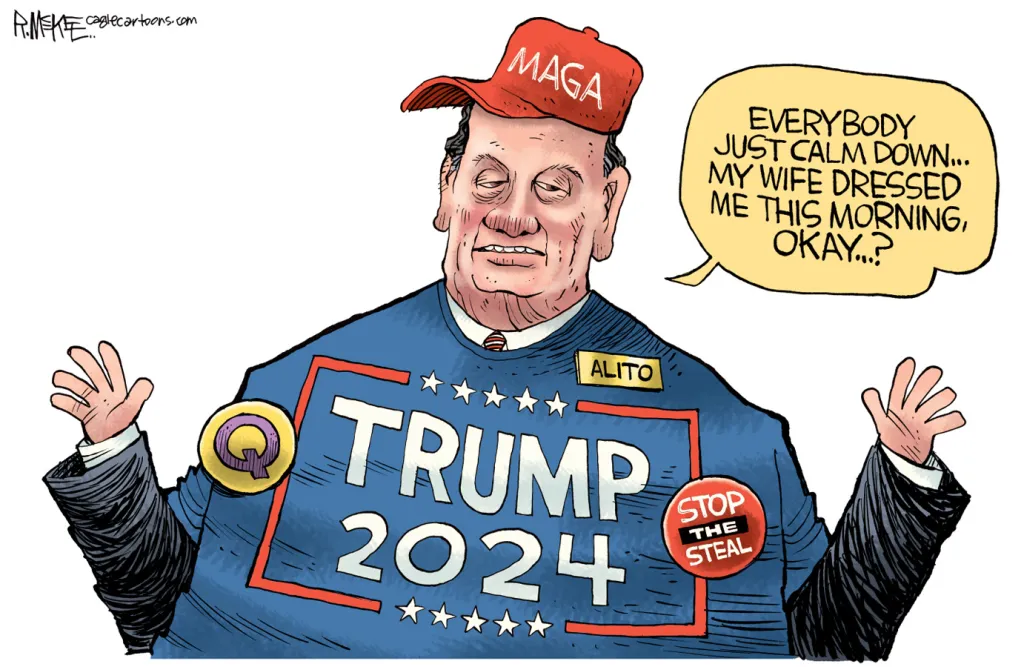
In the days leading up to Memorial Day, there was a lot of talk about the flags flown at homes owned by Supreme Court Justice Samuel Alito Jr.
Judge Samuel Alito is unqualified to serve on the Supreme Court

As The New York Times first reported, an inverted American flag — a symbol embraced by rioters at the US Capitol on Jan. 6, 2021 — was flown outside Alito’s Virginia home soon after that event. He blamed it on his wife and said he had nothing to do with it. Two years later, a Pine Tree flag, also known as an “Appeal to Heaven” flag, was displayed at Alito’s New Jersey vacation home, the Times subsequently reported. As of this writing, Alito had not responded to questions about the beach house flag, which has also been adopted by “Stop the Steal” MAGA supporters. 

Democrats, however, along with an array of legal scholars and ethicists, have been arguing that Alito should recuse himself from cases involving January 6th because those flags show bias.
They do. But beyond the implications for Alito and the Supreme Court, the flag controversy reveals yet another contradiction about Donald Trump, who is consumed by them. Trump’s kissing, hugging, and caressing of the American flag has turned it into a symbol of allegiance to him and the MAGA movement — so much so that in a blue state like Massachusetts, simply flying an American flag in its proper, upright position can be taken as a statement of support for TrumptiDumpti!

The pickup trucks with streaming American flags invariably boast a Trump sign, too. Trump merchandise is awash with American flags and Trump rallies feature enormous American flags. As a result, non-Trump supporters are not big on flag displays.

As a candidate and as president, Trump also said he would support laws criminalizing flag burning. 
Yet, weirdly, an inverted American flag is a symbol of his favorite movement — the one that supports his false claims that he won the 2020 presidential election. Yet people who believe in the integrity of the electoral process shy away from flying the flag, at least in this part of the country. Isn’t it sad that a former president with such low regard for the democratic process has been able to take ownership of what is supposed to be a symbol of democracy? Like so much about Trump, it doesn’t add up.

From the start, Trump and his supporters have used the flag as a way to divide, not unite. Right after his 2016 election, Trump tweeted, “Nobody should be allowed to burn the American flag — if they do, there must be consequences — perhaps loss of citizenship or year in jail!” While he was president and protests were breaking out over the murder of George Floyd, Trump also said he would support laws criminalizing flag burning and that it was time for the Supreme Court to take up the issue again. Of course, thanks to a landmark Supreme Court decision, the burning of flags is considered protected speech, and so is the inverted flag that Alito said his wife put up.


My father was a World War II veteran who proudly flew a flag outside our home. I have some wonderful photos of him saluting it alongside his then-young grandson. If he were still alive, I’m sure my dad would still fly a flag — as a patriotic American, not as a Trump supporter. That sense of common cause beyond political differences is what’s missing from America right now and no one seems to know how to get it back. But there are moments when we still try. The more than 37,000 American flags that were set up on Boston Common over the Memorial Day weekend to honor the men and women of Massachusetts who have died since the Revolutionary War while serving their country were also a tribute to a shared bond, not necessarily to shared opinions. Flags will wave again during Fourth of July parades and concerts.

At the same time, a former president and current presidential candidate who wraps himself in flags has supporters who are flying upside-down flags as a symbol of resistance to election results. Republican Representative Marjorie Taylor Greene of Georgia went on social media to tell people to turn their American flags upside down while criticizing efforts to hold Trump and others accountable for January 6th. The democracy that those Trump supporters demean gives them the right to that free expression.

Meanwhile, a Supreme Court justice allowed an upside-down flag to be flown outside his home. When it was reported, he expressed no contrition about it or gave any sign that he will recuse himself from cases related to January 6th and Trump’s efforts to overturn the 2020, election.

No one should talk about Trump and American flags without thinking about that.

Labels: , , ,