Maine Writer

Its about people and issues I care about.

My Photo
Name:
Location: Topsham, MAINE, United States

My blogs are dedicated to the issues I care about. Thank you to all who take the time to read something I've written.

Friday, March 29, 2019

A Donald Trump world view - brilliantly articulated from Great Britain

He makes Nixon look trustworthy and George W look smart.

#Quora: Nate White Hilariously Answers the Query –”Why Do British People NOT Like Trump?”

MaineWriter....In other words, making Donald Trump feel unwelcome....again.
Brits fly a Trump Baby balloon over London which makes the POTUS “feel unwelcome”…
“Why British people not like Donald Trump?”

Nate White, a witty writer from England wrote the perfect response.

“A few things spring to mind…

Trump lacks certain qualities which the British traditionally esteem.

For instance, he has no class, no charm, no coolness, no credibility, no compassion, no wit, no warmth, no wisdom, no subtlety, no sensitivity, no self-awareness, no humility, no honor and no grace – all qualities, funnily enough, with which his predecessor Mr. Obama was generously blessed.

So for us, the stark contrast does rather throw Trump’s limitations into embarrassingly sharp relief.

Plus, we like a laugh. And while Trump may be laughable, he has never once said anything wry, witty or even faintly amusing – not once, ever.

I don’t say that rhetorically, I mean it quite literally: not once, not ever. And that fact is particularly disturbing to the British sensibility – for us, to lack humor is almost inhuman.

But with Trump, it’s a fact. He doesn’t even seem to understand what a joke is – his idea of a joke is a crass comment, an illiterate insult, a casual act of cruelty.
Trump is a troll.

And like all trolls, he is never funny and he never laughs; he only crows or jeers.

And scarily, he doesn’t just talk in crude, witless insults – he actually thinks in them. His mind is a simple bot-like algorithm of petty prejudices and knee-jerk nastiness.


There is never any under-layer of irony, complexity, nuance or depth. It’s all surface.

Some Americans might see this as refreshingly upfront.

Well, we don’t. We see it as having no inner world, no soul.

And in Britain we traditionally side with David, not Goliath. All our heroes are plucky underdogs: Robin Hood, Dick Whittington, Oliver Twist.

Trump is neither plucky, nor an underdog. He is the exact opposite of that.

He’s not even a spoiled rich-boy, or a greedy fat-cat.
He’s more a fat white slug. A Jabba the Hutt of privilege.

And worse, he is that most unforgivable of all things to the British: a bully.

That is, except when he is among bullies; then he suddenly transforms into a snivelling sidekick instead.

There are unspoken rules to this stuff – the Queensberry rules of basic decency – and he breaks them all. He punches downwards – which a gentleman should, would, could never do – and every blow he aims is below the belt. He particularly likes to kick the vulnerable or voiceless – and he kicks them when they are down.

So the fact that a significant minority – perhaps a third – of Americans look at what he does, listen to what he says, and then think

‘Yeah, he seems like my kind of guy’ is a matter of some confusion and no little distress to British people, given that:

Americans are supposed to be nicer than us, and mostly are.

You don’t need a particularly keen eye for detail to spot a few flaws in the man.

This last point is what especially confuses and dismays British people, and many other people too; his faults seem pretty bloody hard to miss.

After all, it’s impossible to read a single tweet, or hear him speak a sentence or two, without staring deep into the abyss. He turns being artless into an art form;

He is a Picasso of pettiness; a Shakespeare of shit.

His faults are fractal: even his flaws have flaws, and so on ad infinitum.

God knows there have always been stupid people in the world, and plenty of nasty people too. But rarely has stupidity been so nasty, or nastiness so stupid.

He makes Nixon look trustworthy and George W look smart.
In fact, if Frankenstein decided to make a monster assembled entirely from human flaws – he would make a Trump.

And a remorseful Doctor Frankenstein would clutch out big clumpfuls of hair and scream in anguish:

‘My God… what… have… I… created?
If being a twat was a TV show, Trump would be the boxed set.”

Labels: , , ,

Saturday, March 03, 2018

National Health Service - Great Britain cares for all

What Britons Think Of The National Health Service

National Public Radio ~ Lauren Frayer reporting

Donald Trump says people have taken to the streets in Great Britain to complain about their National Health Service — but most it's absolutely not true Rather, the Brits love the NHS. They just want the government to improve the funding.

LULU GARCIA-NAVARRO, HOST:

Anger was sparked in Britain month when Trump tweeted that the country's National Health Service was, quote, "going broke and not working." 

British officials responded with polls showing most Britons love the NHS. They just want its funding improved. NPR's Lauren Frayer reports from London.
(Chanting) When they say cut back...

(Chanting) We say fight back.

LAUREN FRAYER by line

These are the street protests Trump was tweeting about. Thousands of Britons have been marching to demand more funding for their state-funded health system, which guarantees care for all. 

Trump accused it of providing really bad and non-personal medical care.

Since the 2008 financial crisis, government spending on the National Health Service has grown but at a slower pace. 

That means drugs are being rationed. Tens of thousands of operations have been postponed this winter. 

Wait times at the emergency room are up, says Richard Murray, policy director at The King's Fund, a health care think tank.

RICHARD MURRAY: If the Emergency Room is really busy, it makes the ambulances queue outside the front door - not great. And in some cases, the hospital's simply full.

FRAYER: But Trump's tweet offended many. The British health secretary tweeted back, pointing out America has 28 million people with no coverage at all. The NHS spends less than half of what Americans spend per person on health care. And yet life expectancy is higher here. Defense of the NHS runs straight across the British political spectrum, Murray says.

MURRAY: You wouldn't find a single leading politician on either the left wing - the Labour Party - or the right wing in the Conservative Party that would talk about privatizing the NHS. That would be electoral poison.

FRAYER: The National Health Service polls better than the Queen. A lawmaker once said the NHS is the closest thing the English people have to a religion. It featured big in the opening ceremony of the 2012 London Olympics...

FRAYER: ...With doctors dancing to swing music and hospital beds arranged to spell out the letters NHS in aerial views from above.

UNIDENTIFIED MAN #1: Please welcome Erich McElroy.

FRAYER: Erich McElroy is stand-up comic originally from Seattle. He's been in the U.K nearly two decades and now lives in suburban South London with his wife, two kids and a new puppy. He likes to tell jokes about the first time he saw a doctor here.

ERICH MCELROY: So I went there with an American expectation where you have to pay and have to put, you know, credit card first, basically, or your insurance paperwork first. And then I saw a doctor - gave me a couple of pills. And he sent me on my way.

FRAYER: You were like, where's the cash register?

MCELROY: Yeah. So I went back to the same receptionist. And I was like, what do I do now? And she said, you go home. And that was it. And I was like, this is amazing.

FRAYER: British health care is funded through payroll taxes, not at the point of service. Erich doesn't have to worry about needing health care through an employer.

MCELROY: Yes. It's not spa care, but it's care.

FRAYER: What would happen if you had to move back to the States?

MCELROY: We don't know what we would do, you know? Or I'd have to get a real job again, which would be awful (laughter).

UNIDENTIFIED MAN #2: This new health service will be organized on a national scale.

FRAYER: The NHS was founded 70 years ago.

ROBERTA BIVINS: The war was barely over, you know? The rubble was still smoking.

FRAYER: Historian Roberta Bivins, another American expat who has been in Great Britain for decades, says after the pain of World War II, Britons wanted health care for all. And they're still very protective of that today.

BIVINS: People here are very, very uncomfortable with the idea that companies should profit out of someone getting sick. In the U.S., of course, we're much more comfortable with the idea that the market will provide services.

FRAYER: Erich, the comedian, says there is one thing he would change. His comedy routine includes another joke about what happened after he had minor surgery here.

MCELROY: The first thing they gave me after I came out of surgery was a fish pie, which I say in the routine - that it put me back in the hospital because it was disgusting - because, you know, they might give us health care, but the food is still terrible in this country.

FRAYER: Lauren Frayer, NPR News, London.

NPR transcripts 

Labels: , ,

Tuesday, September 19, 2017

Spy writer's insight- John LeCarre "something wicked is happening"

Donald Trump era- something seriously bad is happening.

https://www.theguardian.com/books/2017/sep/07/john-le-carre-on-trump-something-truly-seriously-bad-is-happening

Published in The Guardian
British novelist John le Carré
In my sadly ominous (MaineWriter) opinion, the era of American idealism is at risk of disappearing, unless we find the leadership to transcend this period of regressive Donald Trump cultism. Novelist John le Carré draws attention to this risk, in this Guardian interview. 

John le Carré on Trump: ‘Something seriously bad is happening’

Spy author draws parallels between Donald Trump and rise of 1930s fascism, in rare public appearance at Royal Festival Hall


John le Carré is one of Britain’s greatest living writers. He has spoken of the “toxic” parallels between the rise of Donald Trump and the rise of 1930s fascism.

In a rare public appearance, the 85-year-old novelist and former spy spoke of his disdain for Trump and his despair for the US and the wider world.

“Something truly, seriously bad is happening and from my point of view we have to be awake to that,” he told an audience at the Royal Festival Hall in London.

A Legacy of Spies, by John le Carré – Smiley returns in a breathtaking thriller. Vintage Le Carré as he ingeniously closes the circle of his long career.

“These stages that Trump is going through in the United States and the stirring of racial hatred … a kind of burning of the books as he attacks, as he declares real news as fake news, the law becomes fake news, everything becomes fake news.

“I think of all things that were happening across Europe in the 1930s, in Spain, in Japan, obviously in Germany. To me, these are absolutely comparable signs of the rise of fascism and it’s contagious, it’s infectious. Fascism is up and running in Poland and Hungary. There’s an encouragement about.”

Even today, Le Carré said, Ang Sang Suu Kyi is speaking of “fake news” in Burma. “These are infectious forms of demagogic behaviour and they are toxic.”

Le Carré was speaking at an event in aid of the charity Médecins Sans Frontièresand which was also beamed to cinemas – to mark the publication of his latest book, A Legacy of Spies, which features the return of his fictional spymaster George Smiley.

The audience, which included Tom Stoppard, Nigella Lawson, Frank Skinner, Jarvis Cocker, Richard Osman and Robert Winston, listened as Le Carré looked back on his life and work and answered tweeted questions from the public, chosen by moderator Jon Snow.


Le Carré was employed by both MI5 and MI6 before becoming a writer, but he said the service then was a kind of “non-violent fairyland” hugely different to the security services of today.


Asked whether he would recommend being a spy, he said: “It is is such a huge industry now, with so many different compartments, it is almost like saying: would you take up the law? These services have altered so vastly since my day.”

If people are, though, “by instinct a befriender, a seducer and a liar, in the sense of a gentleman who lies for the good of his country” then MI6 is for you, “but think of the second half of your life because not many people have one”.

Despite Le Carré’s new book being billed as the return of Smiley, his appearance is, according to one review, “the slimmest of cameos”.

Nevertheless, it has been rapturously received. Reviewing for the Guardian, John Banville writes: “The ingenuity and skill with which the thing is brought off is breathtaking – really, not since The Spy [Who Came in from the Cold] has Le Carré exercised his gift as a storyteller so powerfully and to such thrilling effect.”


The book tells the story of Smiley’s right-hand man Peter Guillam, summoned to MI6’s headquarters in Vauxhall, to explain the events from The Spy Who Came in from the Cold, which resulted in the deaths at the Berlin wall of agent Alec Leamas and his lover Liz Gold.

Le Carré said Guillam, “when I’m feeling confused but willing”, was the character he most related to, but there were parts of him in all his characters. “You can’t actually make character without putting something of yourself in to each one, even the most larcenous and wicked, the most lecherous, the most pure. Each of them has, in his or her own way, something that you can relate to.”

Le Carré’s previous Smiley novels are set in the cold war, an almost unimaginably different era to which he said he did not hark back.

He admitted being old-fashioned, writing every day with a pen. And although there will be no more Smiley he said he would continue writing and was working on his next novel. “I would go on writing even if I knew I was not going to be published, ever. I couldn’t help it.”

Labels: , , , , ,

Tuesday, April 25, 2017

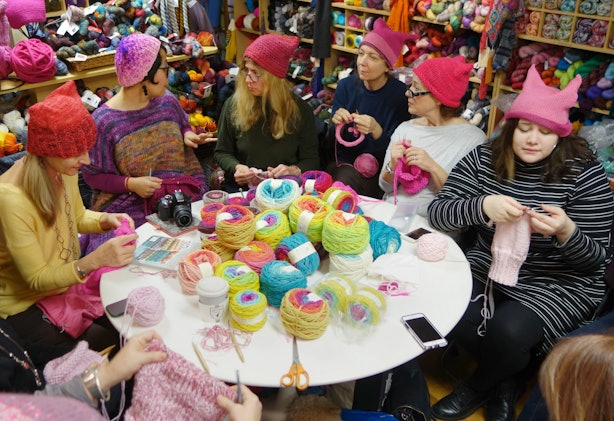
Pussy Hats are now classy collectibles


What questions does a pussyhat bespeak? “It’s about collective action, it’s about solidarity...”

The Victoria and Albert Museum in London gains a "Pussyhat"!

(What is a "Pussyhat"? It's a reclaim the word "pussy" as a term of empowerment, especially meaningful, considering the man who was inaugurated as president of the United States the day before the Woman's March in January, was once recorded saying that when you're a celebrity, you can do "anything" you want to women — like "grab her by the pussy.")

Those of us who are fortunate to visit the Victoria and Albert museum are left with an appreciation for the concept of "eclecticism"(deriving ideas, style, or taste from a broad and diverse range of sources). 

In other words, in a stately "Londonish" sort of way, some of the collections at the Victoria and Albert Museum are, to be polite, "quaint".

 The London museum’s Rapid Response team acquires contemporary objects of topical importance. So, of course, they wanted a "pussyhat", a relic of the highly successful international 2017, womans march. But,  which one? In The New Yorker by Anna Russell.

In March 2017, the Victoria and Albert Museum, in London, unveiled the newest addition to its Rapid Response Collecting gallery: a pink pussyhat that was worn at the Women’s March in Washington, the day after Donald Trump’s Inauguration. The hat sits on a faceless mannequin head, ears slightly splayed, behind nonreflective glass. Next to it is a mounted card bearing the simple outline of a pussyhat in black pen, like a woke hieroglyph. (Aww, come on, Russell- in other words, the black pen graphic was "creepy"?)

The pussyhat’s elevation was the result of what Corinna Gardner, the Acting Keeper of the museum’s Design, Architecture, and Digital department, called a “robust conversation” among the members of the Rapid Response team in the days surrounding the march. The department, which was founded three years ago, is dedicated to acquiring contemporary objects of topical importance; recent additions include a blue burkini and an interactive Hello Barbie. Before an object makes it into the collection, it is subjected to intense scrutiny. Gardner gestured to a display of stilettos in five shades of “nude” behind glass. “I have to be able to say that these Louboutin shoes are as important as a seventeenth-century inlaid table,” she said.

The pussyhat cleared the historical-relevance hurdle easily, but the logistics of choosing and tracking down the right specimen were complex. “With something like the pussyhat, there are hundreds of thousands of them,” Gardner said, standing before the hat’s display case. She was wearing a navy dress and Nikes. “How do you know which one?”

The curators contacted Jayna Zweiman, an architectural designer in Los Angeles, who, along with a fellow-knitter, a screenwriter named Krista Suh, co-founded the Pussyhat Project. (The two friends had conceived of a pink, cat-eared hat for protesters to wear in solidarity, and when they posted the design online it went viral.) Over Skype, Zweiman discussed options with the curators. The museum wanted a hat that encapsulated the project from start to finish—and preferably one that had gone to Washington. Before the Inauguration, volunteer knitters had sent thousands of pussyhats to a Virginia collection center, which distributed them to marchers. In the rush to get them out, volunteers weren’t able to track every hat.

Zweiman told the curators that she could trace one of the hats that she’d knitted, because she’d sent it herself, with a note, to a friend of her college roommate, a real-estate developer and mother of three named Song Oh. Zweiman offered to ask Oh to send the hat to the museum, although she had misgivings. “There are some mistakes,” she said of her handiwork. “I’m definitely not a very good knitter.”

The curators didn’t mind. “We all consolidated around the object quite quickly,” Gardner said. “We see each object as a node, a material thing around which we can focus the bigger questions that bespeak how you and I live together, today and in the future.”

What questions does a pussyhat bespeak? “It’s about collective action, it’s about solidarity,” Gardner said. “And I think that knitting, craft, ‘craftivism’ is quite topical as well.” The pattern’s distribution over social media was also important. “To my mind, it’s something of a digital project,” Gardner said.

Another question, voiced by some perplexed onlookers at the march, was whether the hat was supposed to resemble a uterus. The hat takes its name from an “Access Hollywood” tape, released during the campaign, in which Trump boasts about his ability to “grab [women] by the pussy.”

“You can’t extract the object from that context,” Gardner said. “I mean, ‘pussy,’ ‘uterus’—they’re already words that some people might find quite challenging to vocalize in a public context.”

The museum has received some complaints. “There are lots of people who find it absolutely atrocious that this type of object is finding a home in the V. & A.,” Gardner said. But she likes the way it relates to other items in the museum’s holdings, such as a 1910 cup and saucer, stamped with the logo of the Women’s Social and Political Union, and a striped silk scarf, bearing the words “Votes for Women.” Perhaps other hats, too. Gardner said, “I’m not as familiar as I might be with the millinery collection.”

Kat Coyle, the owner of an L.A. yarn store called the Little Knittery, and the creator of the hat’s pattern, has tried to clear up the uterus confusion. “It wasn’t ever supposed to be anatomically related to the pussy,” she said. “It was more of a verbal pun.”

Gardner takes an academic view of the question. “I embrace it, because it’s part of the narrative of the object,” she said. “It’s not for me to say this is good, or bad, or, actually, it doesn’t look anything like a uterus—you should get real.” ♦

(Maine Writer opinion?  Donald Trump has certainly and unequivocally made knitting great again! Pink yarn preferred.)

Labels: , , ,

Friday, February 19, 2016

Shakespeare and immigration - plus ça change, plus c'est la même chose

Obviously, neither the Bible, the Ten Commandments or the Sermon on the Mount specifically addressed the difficult and contentious issue of immigration. But, apparently, William Shakespeare did write something, when he collaborated with a group of peers on a play titled "The Book of Sir Thomas More".

This French proverb is a perfect motto for the sad turmoil surrounding the immigration crises:  plus ça change, plus c'est la même chose.  
Image result for Sir Thomas More
Sir Thomas More and immigration - by William Shakespeare

Translated: "The more things change the more they are the same."  A forum at the Holocaust and Human Rightes Center (HHRC) on the University of Maine Augusta (UMA) campus brought this proverb into focus when David Greenham, Program Director, read a narrative hand written by William Shakespeare, from the play he collaborated with writing, titled The Book of Sir Thomas More.  

Shakespeare, Sir Thomas More, and the refugee migrants blog
gives contest to Shakespeare's hand written monologue for the character who plays Sir Thomas More (1478-1535/London).  

In the play, the people of London are complaining about immigrants.

Here's what Shakespeare wrote for his lead character:

Grant them removed, and grant that this your noise
Hath chid down all the majesty of England;
Imagine that you see the wretched strangers,
Their babies at their backs and their poor luggage
,
Plodding to the ports and coasts for transportation,
And that you sit as kings in your desires,
Authority quite silent by your brawl,
And you in ruff of your opinions clothed;
What had you got? I’ll tell you: you had taught
How insolence and strong hand should prevail,
How order should be quelled; and by this pattern
Not one of you should live an aged man,
For other ruffians, as their fancies wrought,
With self same hand, self reasons, and self right,
Would shark on you, and men like ravenous fishes
Would feed on one another….
Say now the king
Should so much come too short of your great trespass
As but to banish you, whether would you go?
What country, by the nature of your error,
Should give you harbour? go you to France or Flanders,
To any German province, to Spain or Portugal,
Nay, any where that not adheres to England,
Why, you must needs be strangers: would you be pleased
To find a nation of such barbarous temper,

That, breaking out in hideous violence,
Would not afford you an abode on earth,
Whet their detested knives against your throats,
Spurn you like dogs, and like as if that God
Owed not nor made not you, nor that the claimants
Were not all appropriate to your comforts,
But chartered unto them, what would you think
To be thus used? this is the strangers case;
And this your mountainish inhumanity. 

Since Donald Trump doesn't know his Bible references (ie "Second Corinthians") and clearly disregards what Pope Francis advises about anti-immgration walls being "not Christian", then maybe he and the GOP hypocritical line up will take time to read advice from Shakespeare! Unfortunately, proverbs have a way of hanging around for centuries. Plus ça change, plus c'est la même chose.

Labels: , , , , ,

Friday, September 26, 2014

Obituary for Helen Bamber - anti torture advocate

It's sad when a person's obituary tells us all we know about a person. When I read the obituary of Helen Bamber (1925-2014), I became sad because of her death, but I had never heard of her, until after reading her obituary.

Helen Bamber 1925–2014:  The campaigner who cared for torture victims

In 1945, Helen Bamber, then 19, volunteered to help survivors of the recently liberated Bergen-Belsen Nazi concentration camp. She distributed food and clothing to the few thousand remaining survivors, many of whom were emaciated and close to death. “People wanted to tell their story,” she recalled. “They would hold me and dig their fingers in and rasp this story out.” At first she didn’t know how to react, but she realized that all she could do was listen and assure them: “Your story will be told; I will be your witness.” It proved a formative experience. Over the next seven decades, Bamber became a leading campaigner for victims of human rights atrocities, helping more than 50,000 people in 90 countries. After Bergen-Belsen, she said, “I just couldn’t remain a bystander.”

Born to Jewish parents in London, Bamber grew up “in a home where the Nazi threat was drummed into her relentlessly,” said The Washington Post. “At bedtime, her father read her passages of Hitler’s Mein Kampf.” After the war, she spent two years at Bergen-Belsen before returning to Britain to work with children who survived the Holocaust. In 1961, Bamber joined Amnesty International, where she “became an expert in identifying torture used for political motives in Latin America and South Africa,” said The Times(U.K.). In 1985, when British doctors said they didn’t have time to deal with the complexities of torture victims, she decided to fill the void herself, setting up the Medical Foundation for the Care of Victims of Torture. Launched in “two disused hospital rooms with a typewriter and assistant,” the charity now helps thousands of torture victims from around the world.

“Relentless and tireless even at 80,” Bamber set up the Helen Bamber Foundation in 2005, said The Guardian (U.K). “The culmination of her life’s work,” the charity cares for torture victims as well as those who have been “brutalized by criminal gangs, trafficked for labor or sexual exploitation, or kept as slaves.” Though proud of her achievements, Bamber was always saddened by the continued need for her work. 

“If we look at the world today,” she said in 1995, “humanity seems to have learnt very little.”

Helen Bamber New York Times obituary:

Helen Bamber, whose volunteering to comfort broken survivors of a Nazi concentration camp when she was 19 inspired her to devote her next seven decades to helping more than 50,000 victims of torture in 90 countries, died on Aug. 21 in London. She was 89.

Her death was announced by the Helen Bamber Foundation, a British charity.

Started in 2005, the organization grew out of the Medical Foundation for the Care of Victims of Torture, which Ms. Bamber started in 1985. The foundation emerged from the Medical Group of the British Section of Amnesty International, which she and a small group of colleagues began in the early 1970s. The actress Emma Thompson is the current president of the Bamber foundation.

Together, through a “holistic” combination of medicine and psychological, social and physical therapies, the organizations have helped torture victims recover a sense of identity and purpose after being subjected to often unspeakable horrors: electrical shocks to genitals, beatings on the bottom of feet, nonlethal hangings.

Ms. Bamber recalled listening to a 10-year-old Bosnian girl describe seeing Serb soldiers cut off her brother’s testicles. A mother recounted the beheading of her son.

Ms. Bamber said the worst toll of torture was psychic — “the act of killing a man without dying,” a survivor once told her. Torture, she wrote in an autobiography for her foundation, constitutes “a total perversion of all that is good in human relationships.”

“It is designed to destroy not only the physical and psychological integrity of one individual, but with every blow, with every electrode, his or her family and the next generation,” she continued. “The body betrays and is often discarded, a body to be hated for its scars and injuries, a body which is a constant reminder even if there are no scars or remaining injuries.”

Her approach was to treat the whole person, often in group therapy, which she saw as giving alienated victims a sense of community. She recruited dozens of professionals to treat more than 2,000 victims a year, and worked with many patients herself as a psychotherapist — which she became through experience, she said, rather than an academic degree.

Her method involved revisiting victims’ worst horrors and letting them “vomit” them out.

“You have to move into the torture chamber with them,” she told the British newspaper The Observer in 1999. “You almost have to be tortured with them.”

The next step, she told The Irish Times in 1995, is to work with the “noble and good” qualities that can enable a victim to survive. It was enough, she said, to take a victim’s story, hold it and say, “Yes, I believe you.”
***********

Dear Helen Bamber, I regret learning about you from your obituary. I wish you were still alive and with us as people are challenged by terrible human rights violations in human sex trafficking and the humanitarian refugee crises in Syria, Turkey and Jordan, to name a few horrific situations. 

When Saint Mother Theresa died, the world lost a compassionate humanitarian. Now, with your death, we'll live in a world without the dignity and respect you demonstrated for all who are victims of torture and human rights indignities.  

May you rest in peace.  

Meanwhile, we must find a way to prevent torture and human indignities, spread by evil religious extremists intent on claiming power through their barbaric intentions and actions.

When Helen Bamber interviewed victims of Bergen-Belsen, it's likely she thought the world would never see another genocide.
Sadly, unbelievable barbarism and genocides continue in spite of all efforts to pray for world peace and teach understanding.

Helen Bamber died in London on August 21, 2014.
Only a month since she died and the world is already missing her 
I'm sorry I never had the chance to meet her.


Labels: , , ,