



Donald Trump and right wing human rights violators created an Auchwitz concentration camp in the Florida Everglades
‘Alligator Auschwitz’❓ Critics’ nickname for ICE’s Everglades detention facility renews debate over Holocaust comparisons.
Published in Jewish Telegraphic Agency news by Andrew Silow-Carroll
 Nazi comparisons surge in response to aggressive, and evil immigrant detention and enforcement policies, as do rebukes that such language trivializes the Nazi Holocaust.
Donald Trump and Florida Gov. Rick DeSantis had a giddy name for the temporary ICE facility they built quickly on an airstrip in the Florida Everglades: “Alligator Alcatraz.”
“We’re going to teach them how to run away from an alligator if they escape prison,” Trump boasted July 1 as he toured the detention facility for undocumented migrants, where a forbidding swamp surrounds tents featuring rows of bunk beds behind chain fences.
Some critics put forth another name for the facility: Alligator Auschwitz.
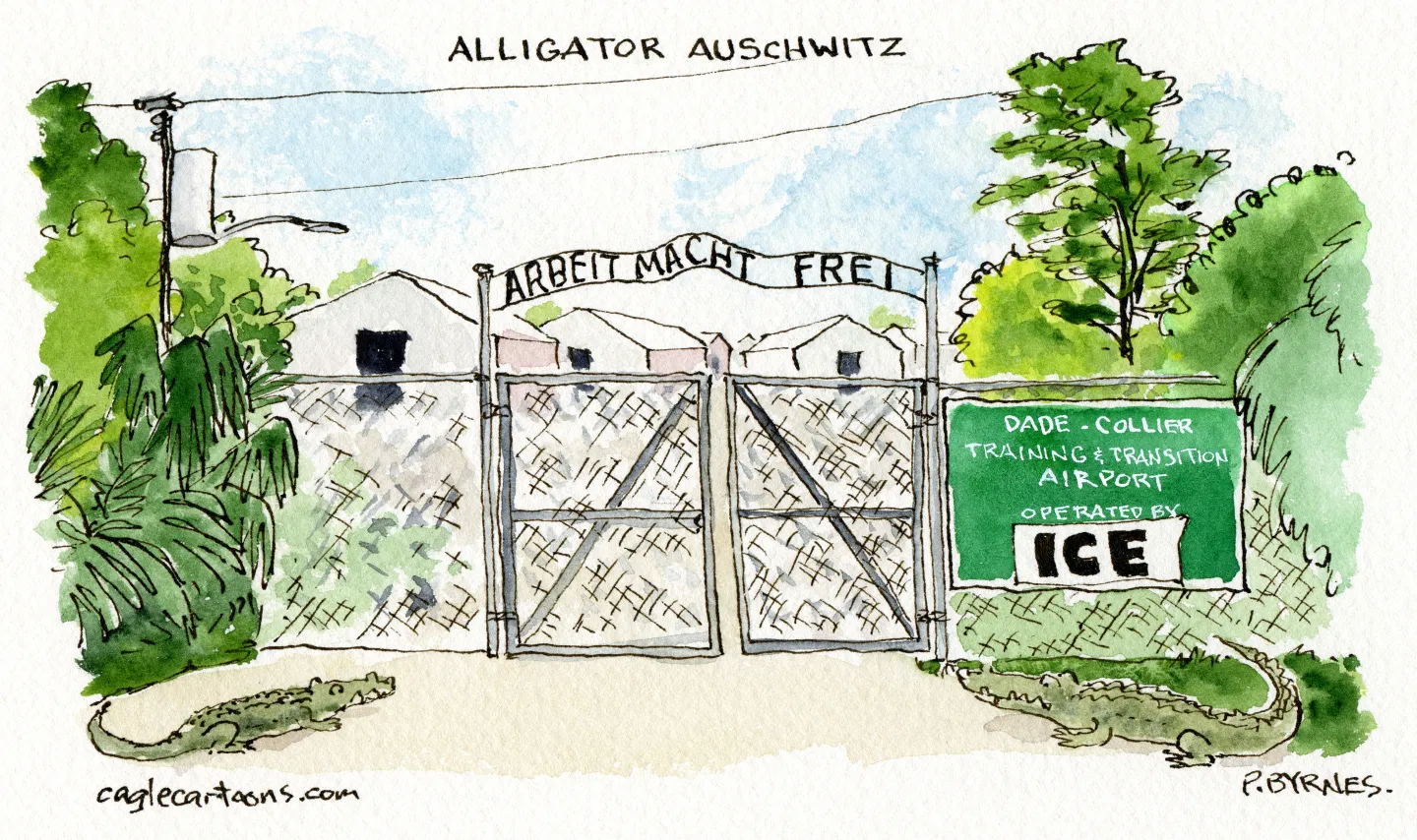
The disparaging, historically loaded nickname for the facility surged on Bluesky, X and other social media platforms, and was featured in the headlines of articles denouncing the facility. Syndicated cartoonist Pat Byrnes drew an image of the tents under the infamous “Arbeit Macht Frei” gate that welcomed Jewish inmates to Auschwitz.
“When I saw the picture of the metal bunks in tiers, my thought was ‘Alligator Auschwitz,’ not Alcatraz,” wote an L.A. Times reader.
Like many previous comparisons, such language sparked an immediate debate over when, if ever, it is appropriate to use Holocaust comparisons.
Some Jewish watchdogs argue that using even a term like “concentration camp,” which long preceded the Nazi camps where millions of Jews were killed, can dilute the meaning of the genocide and dishonor the memory of its victims if used outside the context of the Holocaust.
Jewish groups have called out such language by progressive politicians referring to previous Trump policies, by GOP lawmakers denouncing their opponents, and even by Pope Francis when he decried European migrant and refugee holding centers.
“Don’t call it Alligator Auschwitz. Don’t trivialize the Holocaust,” Stuart Rojstaczer, a novelist and former professor of geology at Duke University, wrote in a Threads post critical of the facility. “I lost too many family members for me not to feel a sting whenever I hear the Holocaust being trivialized.”
“Every ass-clown who compares Alligator Alcatraz to Auschwitz clearly has no mental comprehension of how horrible the Holocaust was,” read a post on X by the Monterey County Republican Party in California. “#NeverForget the true horrors, and pray that the reality of Jewish genocide never happens again.
And yet, others have suggested that the many aspects of Trump’s draconian (evil) immigration policies invite such comparisons — not to the Holocaust, per se, but to harsh measures that dehumanize outsiders, operate outside of a country’s established legal system, and seem to at least pave the road to, well, another Auschwitz.
In a sermon he delivered on July 5, Rabbi Ammos Chorny of Beth Tikvah congregation in Naples, Florida warned against the “Auschwitz” comparison, but nevertheless invoked the Holocaust in decrying the ICE facility.
“Let me be clear. Although this is not Auschwitz, nor Bergen-Belsen, we must not disrespect history by making false equivalencies,” he said in his sermon, which was shared on Facebook by the Rabbinical Assembly, “but we would be dangerously blind not to hear the echoes of history in our midst. We know how it begins, always: with camps for those labeled ‘outsiders,’ ‘illegals,’ ‘undesirables.’ We know how even democratic societies can, little by little, begin to unravel the threads of human dignity, rendering people invisible.”
“Let us name it plainly,” he said. “A camp has opened for the detention of undocumented immigrants. It stands here, in the shadow of our own community, amid the sawgrass and swamplands of the Everglades. It is not a prison, but it is not freedom. It is a place where human beings: men, women, and children; will be confined, silenced, and uprooted from any semblance of stability or dignity.”
Andrea Pitzer, author of “One Long Night: A Global History of Concentration Camps,” wrote that Alligator Alcatraz deserves to be called a “concentration camp” based on an objective definition of the term.
“This facility’s purpose fits the classic model: mass civilian detention without real trials targeting vulnerable groups for political gain based on ethnicity, race, religion or political affiliation rather than for crimes committed,” she wrote in an article for MSNBC.
Pitzer notes that long before Adolf Hitler came to power in Germany, other nations, including Spain and Great Britain, “set up concentration camps in colonial regions.” She also applied the term to the internment camps where thousands of Japanese Americans were held during World War II.
Rojstaczer, the novelist, acknowledged such history in his comment about “Alligator Auschwitz.”
“Call it Alligator Arkhangelsk, a region of gulags where Stalin shipped many Polish Jews and Poles, including my mother,” he wrote. “What Trump is doing is far more akin to what Stalin was doing than what Hitler was doing.”
The tendency to invoke the Nazis in heated political debates is so common that it has a name: “Godwin’s Law,” which postulates that as an online discussion grows longer, a Hitler or Nazi comparison becomes inevitable.
Critics of “Alligator Alcatraz” say they are basing the Holocaust comparison on policies, not politics.
While Trump and DeSantis have promised that the facility, which currently can accommodate 3,000 detainees, will house ”the worst of the worst” awaiting deportation — presumably undocumented aliens with criminal records or gang affiliations — the Miami Herald published a document by the state showing that the facility is prepared to take in children.
And ICE itself, which in the first five months of the Trump administration had been targeting migrants with pending or criminal convictions, has since the beginning of May arrested an increasing number of migrants with no criminal convictions, according to an ABC News analysis of ICE data. The shift followed a directive by White House Deputy Chief of Staff Stephen Miller, who is Jewish, to greatly increase the number of detentions.
Pitzer, the historian of concentration camps, referred to rushed procedures that immigration groups say deny migrants due process. But she also wrote of “Alligator Alcatraz” as a capstone to an array of policies — plans to revoke naturalized citizenship, undoing birthright citizenship and targeting immigrants for their political activism — that “wants to define who can be an American in ways that appear profoundly racist.” She offered another Nazi-era analogy: the Nuremberg Laws, the legal framework for the systematic persecution of Jews in Germany.
Nazi-era comparisons are also being used to refer to the expansion of (evil) ICE and its aggressive tactics, which have included masked agents, large shows of force and telegenic raids. The domestic policy bill signed by Trump on Friday funds a doubling of the current immigrant detention capacity, from about 56,000 beds to potentially more than 100,000. The bill would more than triple ICE’s annual budget, with funding to hire 10,000 new agents over the remainder of Trump’s term.
Minnesota Gov. Tim Walz referred to ICE in May as “Trump’s modern-day Gestapo,” leading to a rebuke from the Department of Homeland Security. In June, the Foundation to Combat Antisemitism issued a report showing that comparisons on social media between federal law enforcement and the Gestapo had risen to “records highs”; the foundation said that comparing ICE or any other agency to Hitler’s secret police “is more than just rhetorical excess. It trivializes the Holocaust, distorts history, and erodes public understanding of both the past and present.”
Trump officials and supporters welcomed Alligator Alcatraz in ways that felt distinctly cruel to many critics of who used the “Auschwitz” label. The Florida GOP and supporters of the facility are selling “Alligator Alcatraz” merchandise. MAGA influencers gleefully posted photos of the caged-in bunks. Pro-Trump activist Laura Loomer, also Jewish, wrote on X that “alligators are guaranteed at least 65 million meals if we get started now” — citing a number equal to the entire Hispanic population of the United States.
Joan Walsh, in an article in The Nation headlined “The Abominable Sadism of ‘Alligator Auschwitz,’” called such language and actions “performative fascist cruelty.”
In her remarks during last week’s tour of the facility, Department of Homeland Security chief Kristi Noem appeared to acknowledge that the forbidding conditions were meant to frighten migrants into self-deporting. “If you don’t,” she said, “you may end up here.” She also urged other states to contact her if they wanted to set up similarly intimidating facilities.
Defenders of the administration’s policies argue that they are working. The number of people crossing the southern border illegally in June — just over 6,000 — was the lowest monthly level seen in decades.
“Another all-time record low has been set, smashing every record on the books,” Miller wrote on X, celebrating the numbers.
In his sermon, however, Rabbi Chorny described Alligator Alcatraz as not just a political story, but a moral story — and that Holocaust comparisons notwithstanding, it should be debated on its own terms.
“Yes, every nation has the right and the responsibility to maintain secure borders. But how we uphold those borders matters,” said Chorny, a native of Colombia and a former U.S. Army chaplain. “Law does not require cruelty. Security does not require inhumanity. There are lines that must never be crossed, lines that once crossed, are not - and ever will be- easily uncrossed.”
Donald Trump and Florida Gov. Rick DeSantis had a giddy name for the temporary ICE facility they built quickly on an airstrip in the Florida Everglades: “Alligator Alcatraz.”
“We’re going to teach them how to run away from an alligator if they escape prison,” Trump boasted July 1 as he toured the detention facility for undocumented migrants, where a forbidding swamp surrounds tents featuring rows of bunk beds behind chain fences.
Some critics put forth another name for the facility: Alligator Auschwitz.
The disparaging, historically loaded nickname for the facility surged on Bluesky, X and other social media platforms, and was featured in the headlines of articles denouncing the facility. Syndicated cartoonist Pat Byrnes drew an image of the tents under the infamous “Arbeit Macht Frei” gate that welcomed Jewish inmates to Auschwitz.
“When I saw the picture of the metal bunks in tiers, my thought was ‘Alligator Auschwitz,’ not Alcatraz,” wote an L.A. Times reader.
Like many previous comparisons, such language sparked an immediate debate over when, if ever, it is appropriate to use Holocaust comparisons.
Some Jewish watchdogs argue that using even a term like “concentration camp,” which long preceded the Nazi camps where millions of Jews were killed, can dilute the meaning of the genocide and dishonor the memory of its victims if used outside the context of the Holocaust.
Jewish groups have called out such language by progressive politicians referring to previous Trump policies, by GOP lawmakers denouncing their opponents, and even by Pope Francis when he decried European migrant and refugee holding centers.
“Don’t call it Alligator Auschwitz. Don’t trivialize the Holocaust,” Stuart Rojstaczer, a novelist and former professor of geology at Duke University, wrote in a Threads post critical of the facility. “I lost too many family members for me not to feel a sting whenever I hear the Holocaust being trivialized.”
“Every ass-clown who compares Alligator Alcatraz to Auschwitz clearly has no mental comprehension of how horrible the Holocaust was,” read a post on X by the Monterey County Republican Party in California. “#NeverForget the true horrors, and pray that the reality of Jewish genocide never happens again.
And yet, others have suggested that the many aspects of Trump’s draconian (evil) immigration policies invite such comparisons — not to the Holocaust, per se, but to harsh measures that dehumanize outsiders, operate outside of a country’s established legal system, and seem to at least pave the road to, well, another Auschwitz.
In a sermon he delivered on July 5, Rabbi Ammos Chorny of Beth Tikvah congregation in Naples, Florida warned against the “Auschwitz” comparison, but nevertheless invoked the Holocaust in decrying the ICE facility.
“Let me be clear. Although this is not Auschwitz, nor Bergen-Belsen, we must not disrespect history by making false equivalencies,” he said in his sermon, which was shared on Facebook by the Rabbinical Assembly, “but we would be dangerously blind not to hear the echoes of history in our midst. We know how it begins, always: with camps for those labeled ‘outsiders,’ ‘illegals,’ ‘undesirables.’ We know how even democratic societies can, little by little, begin to unravel the threads of human dignity, rendering people invisible.”
“Let us name it plainly,” he said. “A camp has opened for the detention of undocumented immigrants. It stands here, in the shadow of our own community, amid the sawgrass and swamplands of the Everglades. It is not a prison, but it is not freedom. It is a place where human beings: men, women, and children; will be confined, silenced, and uprooted from any semblance of stability or dignity.”
Andrea Pitzer, author of “One Long Night: A Global History of Concentration Camps,” wrote that Alligator Alcatraz deserves to be called a “concentration camp” based on an objective definition of the term.
“This facility’s purpose fits the classic model: mass civilian detention without real trials targeting vulnerable groups for political gain based on ethnicity, race, religion or political affiliation rather than for crimes committed,” she wrote in an article for MSNBC.
Pitzer notes that long before Adolf Hitler came to power in Germany, other nations, including Spain and Great Britain, “set up concentration camps in colonial regions.” She also applied the term to the internment camps where thousands of Japanese Americans were held during World War II.
Rojstaczer, the novelist, acknowledged such history in his comment about “Alligator Auschwitz.”
“Call it Alligator Arkhangelsk, a region of gulags where Stalin shipped many Polish Jews and Poles, including my mother,” he wrote. “What Trump is doing is far more akin to what Stalin was doing than what Hitler was doing.”
The tendency to invoke the Nazis in heated political debates is so common that it has a name: “Godwin’s Law,” which postulates that as an online discussion grows longer, a Hitler or Nazi comparison becomes inevitable.
Critics of “Alligator Alcatraz” say they are basing the Holocaust comparison on policies, not politics.
While Trump and DeSantis have promised that the facility, which currently can accommodate 3,000 detainees, will house ”the worst of the worst” awaiting deportation — presumably undocumented aliens with criminal records or gang affiliations — the Miami Herald published a document by the state showing that the facility is prepared to take in children.
And ICE itself, which in the first five months of the Trump administration had been targeting migrants with pending or criminal convictions, has since the beginning of May arrested an increasing number of migrants with no criminal convictions, according to an ABC News analysis of ICE data. The shift followed a directive by White House Deputy Chief of Staff Stephen Miller, who is Jewish, to greatly increase the number of detentions.
Pitzer, the historian of concentration camps, referred to rushed procedures that immigration groups say deny migrants due process. But she also wrote of “Alligator Alcatraz” as a capstone to an array of policies — plans to revoke naturalized citizenship, undoing birthright citizenship and targeting immigrants for their political activism — that “wants to define who can be an American in ways that appear profoundly racist.” She offered another Nazi-era analogy: the Nuremberg Laws, the legal framework for the systematic persecution of Jews in Germany.
Nazi-era comparisons are also being used to refer to the expansion of (evil) ICE and its aggressive tactics, which have included masked agents, large shows of force and telegenic raids. The domestic policy bill signed by Trump on Friday funds a doubling of the current immigrant detention capacity, from about 56,000 beds to potentially more than 100,000. The bill would more than triple ICE’s annual budget, with funding to hire 10,000 new agents over the remainder of Trump’s term.
Minnesota Gov. Tim Walz referred to ICE in May as “Trump’s modern-day Gestapo,” leading to a rebuke from the Department of Homeland Security. In June, the Foundation to Combat Antisemitism issued a report showing that comparisons on social media between federal law enforcement and the Gestapo had risen to “records highs”; the foundation said that comparing ICE or any other agency to Hitler’s secret police “is more than just rhetorical excess. It trivializes the Holocaust, distorts history, and erodes public understanding of both the past and present.”
Trump officials and supporters welcomed Alligator Alcatraz in ways that felt distinctly cruel to many critics of who used the “Auschwitz” label. The Florida GOP and supporters of the facility are selling “Alligator Alcatraz” merchandise. MAGA influencers gleefully posted photos of the caged-in bunks. Pro-Trump activist Laura Loomer, also Jewish, wrote on X that “alligators are guaranteed at least 65 million meals if we get started now” — citing a number equal to the entire Hispanic population of the United States.
Joan Walsh, in an article in The Nation headlined “The Abominable Sadism of ‘Alligator Auschwitz,’” called such language and actions “performative fascist cruelty.”
In her remarks during last week’s tour of the facility, Department of Homeland Security chief Kristi Noem appeared to acknowledge that the forbidding conditions were meant to frighten migrants into self-deporting. “If you don’t,” she said, “you may end up here.” She also urged other states to contact her if they wanted to set up similarly intimidating facilities.
Defenders of the administration’s policies argue that they are working. The number of people crossing the southern border illegally in June — just over 6,000 — was the lowest monthly level seen in decades.
“Another all-time record low has been set, smashing every record on the books,” Miller wrote on X, celebrating the numbers.
In his sermon, however, Rabbi Chorny described Alligator Alcatraz as not just a political story, but a moral story — and that Holocaust comparisons notwithstanding, it should be debated on its own terms.
“Yes, every nation has the right and the responsibility to maintain secure borders. But how we uphold those borders matters,” said Chorny, a native of Colombia and a former U.S. Army chaplain. “Law does not require cruelty. Security does not require inhumanity. There are lines that must never be crossed, lines that once crossed, are not - and ever will be- easily uncrossed.”
Labels: Adolf Hitler, Andres Silow-Carroll, Bergen-Belsen, Holocaust, Jewish Telegraphic Agency, JTA, Nazi
posted by Juliana L'Heureux | 4:25 PM
|
0 comments

