Maine Writer

Its about people and issues I care about.

My Photo
Name:
Location: Topsham, MAINE, United States

My blogs are dedicated to the issues I care about. Thank you to all who take the time to read something I've written.

Sunday, January 09, 2022

Cult mentality succinctly defined

Echo opinion letter to the editor published in the Los Angeles Times: 

The Former Guy
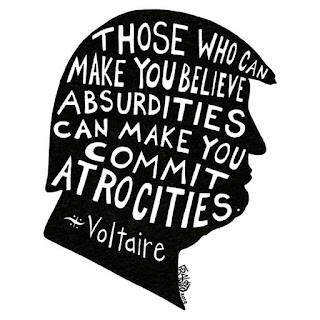
I don’t think it’s unreasonable to characterize what’s currently occurring in this country as a “cold” civil war. And unfortunately, there are too many Americans, including some legislators in Washington, who would like to see it become hot. As far-fetched as that may seem, it is possible. Voltaire sagely captured this when he wrote, “Any one who has the power to make you believe absurdities has the power to make you commit injustices.”

We know from history that fascism in its various forms is ultimately self-destructive, wreaking violence not only on those it opposes, but also on its purveyors.

Martin Niemoller’s poem “First They Came,” which laments not speaking up for other targeted groups, is worth considering at this critical time in our democratic experiment. It ends: “Then they came for me — and there was no one left to speak for me.”

From John Beckman, Chino Hills, California

Labels: , , , , , ,

Saturday, May 04, 2019

Hate and domestic US terrorism: an echo history essay

Transcending dangerous times, an echo essay: 

Domestic terrorism -Reigns of Terror in America


From a 1958 synagogue bombing in Atlanta to the events of recent weeks, the bloody-mindedness of broken men can be countered only by principle and fortitude.
By The New Yorker journalist Jill Lepore in print and podcast
November 4, 2018


"First They Came"
This article with an accompanying podcast was found while I was cleaning up past The New Yorker issues, as they accumulated in my "to read" pile. Indeed, Lepore's essay is even more relevant than when it was written, because several other hate crimes have occurred since last year, in 2018, when it was published.  

As I blog, the narrative, in my mind, can be summarized with the tragically familiar message by Martin Niemöller in "First They Came"* (See text at the end of this essay).  

Although Pastor Niemöller begins the stanza by identifying "socialists", in fact, the noun can be substituted with the name of any group being targeted for hate crimes.


Echo essay by Jill Lepore- On Friday, May 9, 1958, Rabbi Jacob M. Rothschild, of the Hebrew Benevolent Congregation, in Atlanta, delivered a sermon called “Can This Be America?” Crosses had been burned and men had been lynched, but Rothschild was mainly talking about the bombs: bundled sticks of dynamite tied with coiled fuses. In the late nineteen-fifties, terrorists had set off, or tried to, dozens of bombs—at black churches, at white schools that had begun to admit black children, at a concert hall where Louis Armstrong was playing, at the home of Martin Luther King, Jr. One out of every ten attacks had been directed at Jews, at synagogues and community centers in Charlotte, in Nashville, in Jacksonville, in Birmingham. In March, 1958, about twenty sticks of dynamite, wrapped in paper yarmulkes, had exploded in an Orthodox synagogue in Miami. The blast sounded like a plane crash.

“Our first duty is not to allow ourselves to be intimidated,” Rothschild told his congregation. Five months later, some fifty sticks of dynamite exploded at his temple, Atlanta’s oldest, blowing a twenty-foot hole in a brick wall, toppling columns, shattering stained-glass windows. “We bombed a temple in Atlanta,” a man claiming to be from the “Confederate Underground” said, when he telephoned the press that night. “Negroes and Jews are hereby declared aliens.”

Rothschild grew up in Pittsburgh, in Squirrel Hill. His family went to Temple Rodef Shalom, just blocks away from the Tree of Life Synagogue, where eleven people were recently shot and killed during services. Robert Bowers, the man charged in the case, had repeatedly posted on social media about a Jewish aid organization he thought was helping refugees cross the U.S.-Mexico border. The shooting followed a series of mail bombs sent to prominent critics of the President, allegedly by Cesar Sayoc, Jr., a Florida man whose white van was plastered with Trump stickers. In the days after these atrocities, Donald Trumpannounced his intention to end birthright citizenship—to declare, by executive order, that millions of U.S.-born children are aliens. Can this be America?

Rothschild, the liberal from Pittsburgh, moved to Atlanta to take up his pulpit in 1946, the year that a white-supremacist organization was founded in the city. The Columbians asked potential members three questions: “Do you hate Negroes? Do you hate Jews? Do you have three dollars?” On Yom Kippur in 1948, Rothschild sought to stir his congregation out of its silence. “There is only one real issue,” he said. “Civil rights.” The reign of terror Rothschild decried in 1958 had begun four years earlier, after the Supreme Court’s decision in Brown v. Board of Education, when White Citizens Councils began forming across the South to oppose desegregation. And then the bombings started, targeting the institutions that hold societies, and nations, together: schools, houses of worship, newspaper offices.

Standing at the site of the Atlanta temple blast, Mayor William B. Hartsfield declared, “Every political rabble-rouser is the godfather of every sneaking cross-burner and dynamiter at work in the South today.” In the Atlanta Constitution, the syndicated columnist Ralph McGill wrote, “To be sure, none said go bomb a Jewish temple or a school. But let it be understood that when leadership in high places in any degree fails to support constituted authority, it opens the gates to all those who wish to take law into their hands.” The F.B.I. investigated, as Melissa Fay Greene recounts in a book about the bombing, and five men were arrested. The American Nationalist, a California newspaper, ran a story that announced, “synagogue bombing a fraud: Jewish Groups Use Bomb Incident to Confuse Gentiles.” Only one man, George Bright, was ever tried; he was acquitted. McGill won a Pulitzer Prize. “If you call that a prize,” Bright scoffed. “Pulitzer was just a Jew.”

America’s latest reign of terror began not with Trump’s election but with Obama’s, the Brown v. Board of the Presidency. “Impeach Obama,” yard signs read. “He’s Unconstitutional.” In 2011, Trump began demanding that Obama prove his citizenship. “I feel I’ve accomplished something really, really important,” Trump told the press, when, that spring, the White House offered up the President’s birth certificate. This fall, Senator Elizabeth Warren, of Massachusetts, fell into the same trap. For the five years of Trump’s campaign for political attention, leading up to the 2016 election, and for the first two years of his Administration, attempts to fight Trump on his debased terms have only strengthened him.

Rothschild delivered a sermon to his congregation the Friday after the bombing, its title taken from the Book of Ezekiel: “And None Shall Make Them Afraid.” Eight hundred people crowded into the blasted synagogue. “Never did a band of violent men so misjudge the temper of the objects of their act of intimidation,” Rothschild said. “Out of the gaping hole that laid bare the havoc wrought within, out of the majestic columns that now lay crumbled and broken, out of the tiny bits of brilliantly colored glass that had once graced with beauty the sanctuary itself—indeed, out of the twisted and evil hearts of bestial men has come a new courage and a new hope.”

Courage and hope are not the language of Trump’s most vociferous political opponents. Blame and grievance are their language, the language of the times, the grammar of Twitter, the idiom of Trump, the taste of bile. Trump’s critics have often answered his viciousness with their own viciousness, his abandonment of norms with their abandonment, his fear-mongering with their fear-mongering, his unwillingness to speak to the whole of the country with their own parochialism.

But the bloody-mindedness of deranged and broken men can be countered only by principle and fortitude. Rothschild once introduced Dr. King at a banquet in Chicago. King, he said, had been met with “wild thunder.” Never did he speak with more thunder than during his Christmas Eve sermon in 1967, at the Ebenezer Baptist Church, in Atlanta, not far from Rothschild’s temple. “If we don’t have good will toward men in this world, we will destroy ourselves,” King said. “There have always been those who argued that the end justifies the means, that the means really aren’t important,” he said. “But we will never have peace in the world until men everywhere recognize that ends are not cut off from means, because the means represent the ideal in the making, and the end in process, and ultimately you can’t reach good ends through evil means, because the means represent the seed and the end represents the tree.” 

Another tree has been cut down. May a new seed be sown. ♦

This article appears in the print edition of the November 12, 2018, issue, with the headline “This America.”

Jill Lepore is a staff writer at The New Yorker and a professor of history at Harvard University. 


*Martin Niemöller was born in the Westphalian town of Lippstadt, Germany, on January 14, 1892. In 1910 he became a cadet in the Imperial German Navy. With the outbreak of World War I in 1914, Niemöller was assigned to a U-Boat, of which he was eventually appointed the commander. 

Under the stipulations of the armistice of November 11, 1918, that ended hostilities in World War I, Niemöller and other commanders were ordered to turn over their U-Boats to England. Along with many others, Niemöller refused to obey this order, and was, as a consequence, discharged from the Navy.

In 1920, he decided to follow the path of his father and began seminary training at the University of Münster.

Niemöller enthusiastically welcomed the Third Reich. But a turning point in Niemöller's political sympathies came with a January 1934 meeting of Adolf Hitler, Niemöller, and two prominent Protestant bishops to discuss state pressures on churches. At the meeting it became clear that Niemöller's phone had been tapped by the Gestapo (German Secret State Police). It was also clear that the Pastors Emergency League (PEL), which Niemöller had helped found, was under close state surveillance. Following the meeting, Niemöller would come to see the Nazi state as a dictatorship, one which he would oppose.
The Quotation

Niemöller is perhaps best remembered for the quotation:

First they came for the socialists (immigrants, Muslims, Democrats) and I did not speak out—because I was not a socialist.

Then they came for the trade unionists, and I did not speak out— because I was not a trade unionist.

Then they came for the Jews, and I did not speak out—because I was not a Jew.

Then they came for me—and there was no one left to speak for me.

Labels: , , , ,

Thursday, October 18, 2018

Secretary Pompeo ~ smiling in the face of murder

'That grip and grin will come back to haunt him': Pompeo justifiably takes heat for friendly Saudi sit-down

"Would a little more solemnity have harmed his mission?” asked Jon Alterman, a Middle East analyst with the Center for Strategic and International Studies. “It might have helped it.

The Week reports:  There's a growing consensus in Washington and Europe that Saudi Arabia, specifically Crown Prince Mohammed bin Salman, is culpable in the Oct. 2 disappearance and likely murder of U.S.-based Saudi journalist Jamal Khashoggi. And the latest group signaling its conviction of the crown prince's guilt is the U.S. intelligence community, The New York Times reports.
A Politico opinion by Nahal Toosi

Pressed on why he might believe Riyadh’s future findings, Secretary of State Mike Pompeo declined to acknowledge the possibility that Jamal Khashoggi was killed, describing him instead as “missing.” | Leah Millis/AFP/Getty Images
The secretary of state's amiable tone toward the Saudis in public following the suspected murder of a journalist has drawn criticism.

Just this week, Secretary of State Mike Pompeo published an essay arguing that one major reason President Donald Trump’s foreign policy vision will succeed is its “moral clarity.”

But then there he was: The same Mike Pompeo, in the same week, smiling and chatting amiably with Saudi leaders suspected of orchestrating the murder of journalist Jamal Khashoggi. 

Pompeo expressed confidence that the Saudis will conduct a legitimate probe into the case and hold wrongdoers accountable — a stance many in Washington found hard to believe.

Pompeo’s performance can be chalked up to any number of factors, including the inevitable trade-offs most U.S. administrations find they must make in dealing with unsavory allies who happen to be key to American interests. But it was also an example of Pompeo — a former Army tank commander who loves tough talk — toeing the Trump line, even if it risks tarnishing his image.

The approach, particularly Pompeo's friendly tone toward the Saudis in public, has drawn criticism from the foreign policy establishment, Democrats and newspaper editorial boards, with some warning he could be complicit in a Saudi cover-up.

“Would a little more solemnity have harmed his mission?” asked Jon Alterman, a Middle East analyst with the Center for Strategic and International Studies. “It might have helped it.”

Added a Democratic congressional aide: “That grip and grin will come back to haunt him.”

Khashoggi, a Saudi dissident who was living in the U.S. and writing for The Washington Post, is alleged to have been killed and dismembered after entering the Saudi consulate in Istanbul on Oct. 2 to obtain marriage-related documents.


Just this week, Secretary of State Mike Pompeo published an essay arguing that one major reason President Donald Trump’s foreign policy vision will succeed is its “moral clarity.” (MaineWriter~ "Ugh!", like Kim JungUn and Vladimir Putin are examples of "moral clarity!" HELLO?) 

But then there he was: The same Mike Pompeo, in the same week, smiling and chatting amiably with Saudi leaders suspected of orchestrating the murder of journalist Jamal Khashoggi. Pompeo expressed confidence that the Saudis will conduct a legitimate probe into the case and hold wrongdoers accountable — a stance many in Washington found hard to believe.

Pompeo’s performance can be chalked up to any number of factors, including the inevitable trade-offs most U.S. administrations find they must make in dealing with unsavory allies who happen to be key to American interests. But it was also an example of Pompeo — a former Army tank commander who loves tough talk — toeing the Trump line, even if it risks tarnishing his image.

The approach, particularly Pompeo's friendly tone toward the Saudis in public, has drawn criticism from the foreign policy establishment, Democrats and newspaper editorial boards, with some warning he could be complicit in a Saudi cover-up.

“Would a little more solemnity have harmed his mission?” asked Jon Alterman, a Middle East analyst with the Center for Strategic and International Studies. “It might have helped it.”

Added a Democratic congressional aide: “That grip and grin will come back to haunt him.”

Khashoggi, a Saudi dissident who was living in the U.S. and writing for The Washington Post, is alleged to have been killed and dismembered after entering the Saudi consulate in Istanbul on Oct. 2 to obtain marriage-related documents.

Turkish officials have alleged a 15-member Saudi hit squad targeted him, possibly for criticizing the powerful Saudi crown prince, Mohammed bin Salman. Turkish media on Wednesday published details from purported audio recordings that indicated the Saudi hit team severed Khashoggi’s fingers while interrogating him, then later beheaded and cut up his body.

The crown prince and Saudi King Salman have denied any knowledge of what happened. But while at first Saudi leaders insisted Khashoggi had left the consulate safely, more recently they’ve been floating another theory: that the Saudis sent to either interrogate or abduct Khashoggi went too far.

The case, and Saudi officials’ shifting narratives about it, has angered Republicans and Democrats on Capitol Hill, who already were unhappy with a range of Saudi actions, including their killing of civilians in the war in Yemen. U.S. lobbyists and business leaders have also been abandoning their Saudi ties in the wake of the Khashoggi incident.

Trump and his aides have been more cautious in their response, keeping in mind that Riyadh is a major part of their plans to weaken the regime in Iran while keeping oil markets stable. Trump has also balked at halting U.S. arms sales to the Saudis, saying it would hurt U.S. jobs.

From the start, Pompeo and the State Department have been hesitant to discuss the case. Pompeo issued his first statement about the journalist almost a week after Khashoggi vanished. The statement noted that were “conflicting reports” about what may have happened.

Since then, Pompeo and the department have largely stuck to the line that the U.S. doesn’t know much about what happened and have called for more facts to come out before making a judgment on the incident.

By State Department standards, observers say the U.S. tone has been mild for what is a growing diplomatic crisis. 

For example, while the department keeps saying it is “concerned” about Khashoggi’s fate, it has not raised the verbal heat as it traditionally would by saying it is “deeply concerned."

The State Department’s readouts of Pompeo’s meetings in Saudi Arabia and Turkey this week also don’t focus strictly on Khashoggi — whose killing was presumably the reason Trump dispatched his chief diplomat to the region. Instead, the readouts describe the discussions as covering a range of bilateral issues, including Syria. In at least one case, Khashoggi is the last topic listed.

And while a number of U.S. lawmakers, as well as Khashoggi’s family, have called for an independent investigation, Pompeo seems content to let the Saudis do their own probe, even thanking the Saudi king for his commitment to a “transparent” investigation.

The Washington Post wrote a blistering editorial about Pompeo’s friendly demeanor alongside the Saudi crown prince, saying Pompeo “appeared less intent on determining the truth than in helping the de facto Saudi ruler escape from the crisis he triggered.”

Pressed about why he might believe Riyadh’s future findings, Pompeo declined to acknowledge the possibility that Khashoggi was killed, describing him instead as “missing.” 

Pompeo also stressed the many interests the United States has in Saudi Arabia.

“I do think it’s important that everyone keep in their mind that we have lots of important relationships — financial relationships between U.S. and Saudi companies, governmental relationships, things we work on together all across the world — efforts to reduce the risk to the United States of America from the world’s largest state sponsor of terror, Iran,” Pompeo told reporters. “The Saudis have been great partners in working alongside us on those issues.”

Asked whether the Saudis had mentioned whether Khashoggi was dead or alive, Pompeo said: "I don't want to talk about any of the facts. They didn't want to either, in that they want to have the opportunity to complete this investigation in a thorough way."

Pompeo denied he was giving Saudi Arabia the benefit of the doubt. “It’s reasonable to give them a handful of days more to complete it so they get it right, so that it’s thorough and complete,” he said.

Since joining the Trump administration, Pompeo has often downplayed or denied any potential differences between him and the president. He’s supported Trump on just about every front.

He has defended the president after Trump claimed that North Korea no longer poses a nuclear threat to the United States, despite Pyongyang taking what experts say are few, if any, tangible steps toward denuclearization. The secretary also has gone along with Trump's desire to slash the number of refugees resettled in the United States, and he has not spoken out against Trump's efforts to slash the State Department's budget.

Trump this week went further than Pompeo in trumpeting Saudi leaders' talking points on Khashoggi, repeatedly pointing out that the crown prince and king denied any knowledge of what happened. The president even likened the case to the sexual assault accusations against Brett Kavanaugh during his confirmation hearings for the Supreme Court.

“Here we go again with, you know, you’re guilty until proven innocent,” Trump told The Associated Press in an interview released Tuesday night. “I don’t like that.”

Pompeo’s approach to the Khashoggi murder may be another example of the secretary of State choosing to stay in lockstep with the president.

It could also be part of his desire to stay tough on Iran.

Pompeo has long been a hawk on Iran. While serving in the House, Pompeo repeatedly slammed the Obama administration for agreeing to a nuclear deal with Iran — a deal Trump quit — casting the former president as naive for believing Iran would curb its nuclear program.


Since joining the Trump team, Pompeo has made weakening the Iranian regime a top goal — one that could shape his legacy at Foggy Bottom.

In the essay in Foreign Affairs posted this week, Pompeo lays out the administration’s strategy against Iran, calling for a maximum pressure campaign of sanctions and public exposure of the Iranian leadership’s brutality and corruption. Pompeo wrote that Trump’s approach to Iran involves a “moral confrontation” that he likened to how Ronald Reagan approached the Soviet Union.

Pompeo’s decision last month to certify to Congress that the U.S. should keep supporting the Saudis in Yemen, despite allegations they had committed war crimes, was believed to hinge in part on maintaining Saudi cooperation on Iran.

The Saudis have their own rivalry with Iran, making it unlikely a rupture with the U.S. would lead Riyadh to embrace Tehran. But the timing is critical now: Pompeo is working to ensure that the Saudis will fill any gaps in the energy market after Nov. 4, when a series of punishing U.S. sanctions on Iranian oil exports takes effect.

While there may be discomfort on the right about the forgiving tone Trump and Pompeo are taking with Saudi Arabia, there have been no calls to completely break off ties with the strategically important country.

Asked on Wednesday to discuss Pompeo’s performance in Saudi Arabia and Turkey, Republican lawmakers largely sidestepped the question.

“We have a tremendous relationship with the Saudis. They’re important to us, we’re important to them, but we have to be honest and watch these things closely,” said Republican Sen. Orrin Hatch of Utah.

The U.S. has to think about its long-term interests, said GOP Sen. John Kennedy of Louisiana.

“You’re a dream weaver if you think we can keep a lid on the Mideast by turning to all of the countries there and saying, ‘You’re all a bunch of authoritarian despots and we’re not going to talk to you anymore,’” Kennedy said. “You do that and you’re going to create a vacuum. And I can tell you who’s coming in: Russia, and China and a lot of other countries.”
Burgess Everett and Elana Schor contributed to this report.

MaineWriter post script ~ First they came for the socialists, and I did not speak out—Because I was not a socialist.

Then they came for the trade unionists, and I did not speak out—
Because I was not a trade unionist.

Then they came for the Jews, and I did not speak out—
Because I was not a Jew.

Then they came for me—and there was no one left to speak for me.
~Martin Niemöller 


Labels: , , , , , , , ,

Tuesday, October 24, 2017

I predict Donald Trump is now marginalizing American Catholics


American Catholic Bishops are facing the prophetic revelation described in "First They Came"
by Martin Niemöller~ Donald Trump is challenging their "loyalty"

Confidant of Pope Francis offers scathing critique of Trump’s religious supporters

(AP) A close confidant of Pope Francis, writing Thursday in a Vatican-approved magazine, condemned the way some American evangelicals and their Roman Catholic supporters mix religion and politics, saying their worldview promotes division and hatred.

The Rev. Antonio Spadaro, editor of the influential Jesuit journal La Civilta Cattolica, said a shared desire for political influence between “evangelical fundamentalists” and some Catholics has inspired an “ecumenism of conflict” that demonizes opponents and promotes a “theocratic type of state.”

Spadaro also took aim at conservative religious support for President Donald Trump, accusing activists of promoting a “xenophobic and Islamophobic vision that wants walls and purifying deportations.” Trump has sought to bar travelers from six Muslim-majority countries and vowed to build a wall on the Mexican border.

The article, “Evangelical Fundamentalism and Catholic Integralism: A Surprising Ecumenism,” was co-written by a Presbyterian pastor, the Rev. Marcelo Figueroa, who is editor of the Argentine edition of the Vatican newspaper, L’Osservatore Romano, in the pope’s native country.


Articles in La Civilta Cattolica are reviewed and approved by the Vatican Secretariat of State. Under Francis, who is a Jesuit, the publication has become something of an unofficial mouthpiece of the papacy.

The political alliance between Catholics and American Protestants that is at the heart of Spadaro’s article emerged in the late 20th century.

Anti-Catholic bias once split members of the two traditions, both religiously and politically. But in the 1980s and ’90s, some conservative religious leaders built an affiliation over such issues as abortion and marriage, culminating in a 1994 declaration written by the Rev. Richard John Neuhaus, a Lutheran who converted to Catholicism, and Chuck Colson, the Watergate felon turned born-again Christian.

Spadaro said this relationship has “gradually radicalized,” dividing the world into only good and evil and providing theological justification for a type of “apocalyptic geopolitics” advocated by such figures as White House adviser Steve Bannon, who is Catholic. (OMG~ #SteveBannon is "whaaaa?"....he's not Catholic, he's just evil.)

Spadaro specifically criticized the far-right Catholic American media organization ChurchMilitant.com. Spadaro said the media outlet framed the presidential election as a “spiritual war” and Trump’s ascent to the presidency as “a divine election.” (MaineWriter~ OMG, I'm a Roman Catholic and totally disagree with this description!!)

Michael Voris, who founded the outlet, said in an interview that he was shocked by the article.

“Here’s a fellow who is accusing us of trying to use the church to push a political agenda, which is completely absurd,” Voris said, when “they are using a leftist agenda to pursue leftist goals.”


Some political conservatives have accused Pope Francis of promoting socialism or Marxism, a characterization he rejects. 

The pope has frequently lashed out at the injustices of capitalism and the global economic system, and has urged governments to redistribute wealth to the poor.

Spadaro’s critique also appears aimed in part at America’s Catholic bishops, who have fought for religious exemptions from gay marriage laws and other measures church leaders consider immoral, and have often characterized those with opposing views as wishing to persecute Christians.

Spadaro wrote that “erosion of religious liberty is clearly a grave threat.” But he warned against mounting a defense of religious liberty in “fundamentalist terms.”

Archbishop William Lori of Baltimore, who leads the U.S. bishops’ advocacy on religious liberty, said in an interview that the article doesn’t mention the U.S. bishops and refers only to “a very narrow band of ecumenical relationships.”  (Hello?  I think Archbishop Lori is doing a major political side-step.)

American bishops work on a broad range of issues that reflect Catholic social teaching, not any other theology, Lori said.

Dear American Catholic Bishops- Donald Trump is evil, just so you know.  Stop supporting him before we Catholics are the victims of the prophetic message in "First They Came".

Frankly, I believe Donald Trump is marginalizing American Catholics to oppose the opposition he is experiencing from Mormons who oppose his anti-immigration agenda.  

I am disappointed by American Catholic Bishops, who are still supporting Donald Trump, while he is behaving like an evil and bigoted idiot.

Labels: , ,

Saturday, December 03, 2016

Jews and Muslims share fear of "Trumpziism"


Salaam-Shalom! 
Americans must stand against bigotry and racism, the social diseases now so caustic in our nation, post the Trumpzi election.

This report about Jews and Muslims, from the Christian Science Monitor (CSM) continues to remind me about the poignant relevance of the Pastor Martin Niemöller (1892–1984) poem titled "First They Came".  It's a startling poetic report about the cowardice of German intellectuals following the Nazis' rise to power in Germany and subsequent purging of their chosen targets, group after group. 

Pastor Martin Niemöller

First they came for the Socialists, and I did not speak out—
Because I was not a Socialist.

Then they came for the Trade Unionists, and I did not speak out—
Because I was not a Trade Unionist.

Then they came for the Jews, and I did not speak out—
Because I was not a Jew.

Then they came for me—and there was no one left to speak for me.”

Many variations and adaptations in the spirit of the original have been published in the English language. It deals with themes of persecution, guilt and responsibility.

Why Jews are coming to the defense of mosques in America- reported in "Bridging Divides" (CSM): by Jessica Mendoza
Jewish-Muslim cooperation is on the rise. 
Their ability to work together despite decades of conflict on issues of foreign policy could serve as a model for embracing shared American values.

LOS ANGELES — When Sheryl Olitzky first broached the subject of a Jewish-Muslim women’s group, Atiya Aftab didn’t buy it. “Why is someone calling me because I’m Muslim?” Ms. Aftab recalls thinking. “This is creepy.”

But as Ms. Olitzky made her case over lattes at a Starbucks in suburban New Jersey, Aftab found herself drawn in.

“This is a woman extending her hand to me, saying, ‘I want to get to know you. I want to be your protector. I want to have your back because I know what you’re going through, because of what the Jewish community has been through,’ ” says Aftab, a professor at Rutgers University’s Center for Middle Eastern Studies. “That was so compelling, so honest.”

After that meeting in 2010, the two women launched the Sisterhood of Salaam Shalom – then just a casual gathering of local Muslim and Jewish women talking about faith and family, and sharing their experiences as religious minorities in America. 

Today, the group has chapters in more than 50 cities.

The success of groups such as the Sisterhood point to a growing – and perhaps unprecedented – desire among American Muslims and Jews to work toward a common goal, some say.

Over the years, “More people have become aware of their common faiths given the rise of toxic anti-Muslim, anti-Semitic hate,” says Haroon Moghul, senior fellow and director of development at The Center for Global Policy, a New York think tank. “There’s been a definite change, and for the better.”

This spring, business, political, and religious leaders from both communities for the first time formed a joint advisory council that seeks to give the Muslim and Jewish Americans a national voice. And amid a post-election spike in anti-Islamic sentiment, local Jewish groups have stepped up their support for Muslims in their own communities.

When mosques in California this week received a threatening letter calling Muslims “a vile and filthy people” and saying that President-elect Donald Trump “is going to do to you Muslims what Hitler did to the jews (sic),” Jewish groups were among the first to reach out, says Ojaala Ahmad, communications director for the Council on Islamic Relations in Los Angeles. The letter was also sent to mosques in several other states, including Georgia, Michigan, Ohio, and Rhode Island.

One Jewish group out of New Haven, Conn., started an online campaign to raise funds for a Muslim nonprofit, urging fellow Jews to “hold ourselves accountable for the intersectional oppressions Muslim people are facing, and honor and join the movements Muslim Americans are building to combat white supremacy and advocate for their rights.”

“I think there’s more of a sense of urgency,” says Aftab at the Sisterhood. “We’ve heard from people all over the country, even all over the world, saying, ‘I need to reach out and do something constructive rather than be affected by this fear in a negative way.’ ”

The coming together of these two faith groups, despite decades of conflict on issues of foreign policy, could serve as an important model for others seeking to focus on shared American values, experts say.

Such efforts also demonstrate a continued drive among Americans to hold to ideals of democracy and pluralism by banding together and finding common ground in times of fear and confusion.

“Groups that are willing to talk and learn and still maintain their identities and distinctiveness represent a real promise for what a pluralistic society looks like,” says Brie Loskota, executive director of the Center for Religion and Civic Culture at the University of Southern California.

“Difference is a fundamental reality of humanity,” she adds. “If we can’t negotiate that – if every disagreement is an existential disagreement – then the work of knitting together a society of 300 million people becomes almost impossible.”
Building bridges

In Los Angeles, an encounter that echoed Olitzky and Aftab’s led to the formation of another Jewish-Muslim partnership.

After meeting at a local community center, Michelle Missaghieh, a rabbi, and Aziza Hasan, a mediator with years of experience in coalition-building, started organizing local meetings for women to study the Quran and Torah. The program became a key part of NewGround, an organization that fosters interfaith relationships through programs, grants, internships, even a leadership council for high school students..

For both NewGround and the Sisterhood of Salaam Shalom, the goal was to bridge a gap between two faith groups that shared a rich history and experience as religious minorities in Christian-majority America.

“For a Christian, to go to your weekly service generally means you don’t have to ask for a day off. Sunday is a day that most people don’t work,” says Ms. Loskota at USC. “If you’re Muslim, to get the middle of the day off on a Friday to go pray, that’s not easily accommodated.”

The same goes for dietary restrictions, modes of dress, and customs regarding behavior towards the opposite sex, Loskota says, not to mention more overt experiences of discrimination.

Crossing the boundaries of faith to form relationships around those shared realities not only allows Muslim and Jewish Americans to hear and understand each other’s stories. It also helps them create a community that can together compose a more powerful narrative about their place in American society, Loskota says.

“It’s moving the discourse from special privileges for a group or individual to an argument about who we are as a country,” she says. “Do we value people and their dignity?”
A symbol of cooperation

The Muslim-Jewish Advisory Council, which debuted just days after the election, represents the next step in community building between the two groups. Its main goals are to work at the policy level to fight discriminatory laws, as well as bolster support for grassroots efforts like the Sisterhood and NewGround, says Robert Silverman, the council’s executive director.

“This new council adds a leadership, national-level body that can talk about things happening throughout the country and get some change done,” he says. “You have to have community-based organizations; otherwise it’s just a bunch of talking heads. But if it’s only grassroots groups, it stays limited. You need both to work.”

At the same time, the council serves as an important symbol of cooperation for other groups seeking to build coalitions on the eve of Trump’s presidency.

For decades, Jews and Muslims in the US have clashed on the issue of Israel-Palestine, and the council is no different – Silverman notes its members often stand on opposite ends of the conflict. Yet all of them, he says, are dedicated to promoting both communities’ concerns in America.

“This [effort] is about the country we care about most, which also happens to be the country we live in,” Silverman says.

Jewish-Muslim relations are “the single thorniest interfaith issue of our time,” says Mr. Moghul at The Center for Global Policy. “And if we can find a way to talk and to understand and respect each other even as we disagree, then we are establishing a model.”

[Editor's note: This version was updated to clarify the circumstances in which NewGround was founded, and to correct the issue to which Mr. Moghul referred as 'the single thorniest interfaith issue of our time.']

With the obvious rise of white supremacy, (Trumpzism) and given the horrible Trump hire of Breitbart (aka, barfcart) news, a media where "fake news" rules, it's time for us who despise the diseases of bigotry and racism to remember the haunting words written in "First They Came".

Labels: , ,

Monday, December 07, 2015

Donald Trump is dangerous: Stop this insane campaign

"Addressing Trump’s controversial past statements about women, Baker writes, 'Houston, we have a problem'.”- The Washington Post reports quote from Ward Baker, NSRC (National Republican Senatorial Committee).
First They Came ...

Republicans better figure out what to do about Donald Trump- and fast. Maine Writer was having lunch with staunch Republicans who are devoutly religious, when I learned there is no support for his candidacy.  

I don't know who among Republicans are keeping Donald Trump's poll numbers ahead of the GOP line up, but it isn't the Christian community.

My friends are harbingers of how the Christian community perceives his candidacy. If Donald Trump is the Republican presidential nominee, based on my friends response to his potential candidacy, it will literally tank the entire GOP.  

What can the GOP do in the face of the Trumponian lunatic candidate? Obviously, Donald Trump the Chump's candidacy is a classic example of "what goes aroudn come around". Republicans have spewed right wing rhetoric for so long that they've created a bona fide ideological monster.

Unbelievably, the incendiary presidential campaign of Donald Trump the Chump is calling for a moratirium of all Muslims in America and, therefore, the entire world.

It's impossible to understand how Americans, who've been the beacons of liberty for the world, have somehow become victimized by the Islamic fear, and paranoia spewed by Donald Trump and echoed by many "stupid party" Republican colleagues.

Americans must remember the terrible lessons learned from the experience of Nazi Germany:

First They Came..for the Socialists, and I did not speak out—
Because I was not a Socialist.

Then they came for the Trade Unionists, and I did not speak out—
Because I was not a Trade Unionist.

Then they came for the Jews, and I did not speak out—
Because I was not a Jew.

Then they came for me—and there was no one left to speak for me.

"First they came ..." is a famous statement and provocative poem written by Pastor Martin Niemöller (1892–1984) about the cowardice of German intellectuals following the Nazis' rise to power and the subsequent purging of their chosen targets, group after group. Many variations and adaptations in the spirit of the original have been published in the English language. It deals with themes of persecution, guilt and responsibility.

Yet, rather than stand up to Trumponianism, the Republicans are now trying to adopt his caustic style.

Article by Robert Costa and Philip Rucker report in The Washington Post

Donald Trump is now such a force in the Republican Party that the official overseeing next year’s Senate races has proposed a delicate strategy for GOP candidates: Tap into Trumpism without mimicking Trump.

In a seven-page confidential memo that imagines Trump as the party’s presidential nominee, the head of the National Republican Senatorial Committee urges candidates to adopt many of Trump’s tactics, issues and approaches — right down to adjusting the way they dress and how they use Twitter.

In the memo on “the Trump phenomenon,” NRSC Executive Director Ward Baker said Republicans should embrace Trump’s tough talk about China and “grab onto the best elements of [his] anti-Washington populist agenda.” Above all, they should appeal to voters as genuine and beyond the influence of special interests.

“Trump has risen because voters see him as authentic, independent, direct, firm, — and believe he can’t be bought,” Baker writes. “These are the same character traits our candidates should be advancing in 2016. That’s Trump lesson #1.”

Baker’s memo, titled “Observations on Donald Trump and 2016,” amounts to a clear-eyed approach to the Trump challenge, to which many Republican elites have responded with only hand-wringing and the vague hope that somehow, someday it will disappear. In fact, the memo posits that Trump could build a powerful enough coalition to win the general election. Regardless of how far Trump’s candidacy ultimately goes, the memo is evidence of the effect he has had on his party.

Still, Baker sees limits to being like Trump. He writes that it is prudent for Senate candidates to craft their own political brands distinct from Trump’s and to distance themselves by quickly condemning his more controversial comments, such as “wacky things about women.” He cautions candidates against “piling on” Trump, however, warning that Republicans up and down the ballot would suffer if the GOP vote was divided or depressed.

Implied in the memo is an understanding that the national party would back Trump if he secured the nomination — managing his candidacy rather than disowning him as the standard-bearer.

The memo was dated Sept. 22 and addressed to NRSC senior staff members, but it since has been shared more widely and has become the subject of considerable discussion at the highest levels of the party in recent weeks as Trump continues to lead polls in early-voting states and nationally.

The document was shared with The Washington Post by a high-ranking Republican who did so on the condition of anonymity because it was not intended to be made public. Its authenticity was confirmed by a second top GOP official.

Trump is not the only candidate who has attracted Baker’s attention. The NRSC confirmed Wednesday that it has similar strategy memos about the possible nominations of other presidential candidates.

In a statement, NRSC spokeswoman Andrea Bozek said, “It would be malpractice for the Senatorial committee not to prepare our candidates for every possible Republican and Democrat nominee and election scenario.”


Baker begins his memo by foreshadowing Trump accepting the party’s nomination at the Republican National Convention in July in Cleveland. He draws a historical comparison to Wendell Willkie, a businessman and political outsider who won the GOP nomination in 1940, but lost to Franklin D. Roosevelt, who secured his third term.

Baker writes that Republicans must “understand the changing environment and recalibrate now.” For instance, he writes, “Trump is saying that the Emperor has no clothes and he challenges our politically correct times. Our candidates shouldn’t miss this point.”

(Maine Writer- Seems like Baker would rather see Republicans become ideological followers rather than inspirational leaders.)

Baker explains how Trump has connected with voters, especially when it comes to trade with China and immigration. “Trump will continue to advance those messages, but you don’t have to go along with his more extreme positioning,” Baker writes. “Instead, you should stake out turf in the same issue zone and offer your own ideas.”

Addressing Trump’s controversial past statements about women, Baker writes, “Houston, we have a problem.”

“Candidates shouldn’t go near this ground other than to say that your wife or daughter is offended by what Trump said,” Baker adds. “We do not want to re-engage the ‘war on women’ fight.”

Although some of Baker’s recommendations are unique to the current environment, many are standard tactics employed in campaigns past, such as show­casing “citizen narrators” or talking about “basic solutions” to policy problems to make candidates appear as accessible as Trump. This shows the conundrum the GOP is in: In grappling with Trump, it does not have many new tools at its disposal.

Time and again, Baker frames a future with Trump atop the ticket as an intense high-wire act for other Republicans. He calls Trump “a misguided missile” and says he “is subject to farcical fits.” With grim candor, Baker writes that he foresees a campaign year in which candidates repeatedly will have to fend off questions from reporters about the businessman’s comments and behavior.

“It is certain that all GOP candidates will be tied in some way to our nominee,but we need not be tied to him so closely that we have to engage in permanent cleanup or distancing maneuvers,” Baker writes, adding, “Don’t get drawn into every Trump statement and every Trump dust-up.”

Republicans, who hold a slim majority in the Senate, will be defending 24 seats next year, including in presidential battleground states where Democrats are mounting strong challenges. The most endangered GOP incumbents include Sens. Patrick J. Toomey (Pa.), Kelly Ayotte (N.H.), Rob Portman (Ohio), Ron Johnson (Wis.) and Mark Kirk (Ill.).

The task of protecting the majority has fallen to Baker, a retired Marine and Tennessee native. He was credited with many successes from the 2014 Senate campaigns and is close to such establishment fixtures as Senate Majority Leader Mitch McConnell (Ky.).

For months, veteran Republicans have been increasingly alarmed about the possibility of a Trump nomination. Sen. John McCain (R-Ariz.), who is up for reelection in 2016, acknowledged the anxiety Wednesday.

“Of course I worry. All of us have to worry about the viability of the top of the ticket,” McCain told reporters at a breakfast sponsored by the Christian Science Monitor.

McCain made an analogy to Barry Goldwater, a fellow Arizona senator who rallied the conservative grass roots to win the 1964 GOP nomination but lost in a landslide to Lyndon B. Johnson. 

“I think obviously we all know in history that when you have a weak top of the ticket, that has significant impact,” McCain said.
In his memo, Baker says Republicans should understand that Trump is riding a “reformist wave” sweeping the party’s ranks. It is partly ideological, he writes, but also driven by personality and aesthetics. He suggests that Senate incumbents and challengers should cast themselves as reformers.

Envisioning potential advertisements, Baker writes, “Feature candidates working on an old engine and note how sometimes you have to do a complete overhaul to get things working. Consider featuring a candidate in a field ripping up a rotten tree stump so the field can be cleared and planting can be done.”

Baker encourages campaigns to “up the vibe and change the look.”

“Voters are on to you when you do the standard walk and talk through a business, school, or factory,” he writes. He adds that candidates should “lose the suit and visit people in their homes and places of work.”

Baker also takes cues from Trump’s prolific use of social media to drive his message. “Promote tweets that push reforms or condemn Washington’s dysfunction,” he writes.

He warns against being distracted by Trump. “The Trump show may be going on, but back home our families are in a fight for their livelihoods,” he writes. “Always bring the campaign back home to real people and their daily struggle.”

Baker concludes the memo with a section titled, “Covering the Trump Bet,” which seems to throw cold water on the conventional wisdom that Trump will eventually fade.

“Trump has been gaining Democrat adherents and he’s solidifying GOP cohorts who feel they’ve been totally ignored by the Washington Ruling Class,” Baker writes. “If the environment aligns properly, Trump could win. It’s not a bet most would place now, but it could happen.”

Republicans should stop ringing their hands about Donald Trump and his Trumponian bigotry against anybody who he doesn't happen to like.  Moreover, Americans must wake up from this political nightmare and demand for the Grand Old Party to replace Trump the Chump, with a presidential worthy candidate.  

Labels: , , , , , , ,

Saturday, June 02, 2012

Americans Marginalized - Voting Rights, Access to Education, Welcoming Immigrants and Wealth Sharing

*Comment from Joe in Bangor follows blog - sent to me via email oneturkeyrun@comcast.net (thanks!)
http://en.wikipedia.org/wiki/First_they_came%E2%80%A6

Please allow literary freedom I've taken with a familiar poem, "First They Came", attributed to the quotes of German theologian Martin Niemoller (1892-1984):


First they came for the immigrants,
But I said nothing because I'm not an immigrant.


Then they came for the Trade Unionists,
But I said nothing, because I'm not a Union member.


Then they came after our voting rights,
But I said nothing, because I have the credentials to access voting stations.


Then they went after politicians with their wealth and influence,
But I said nothing, because this didn't have anything to do with me.


But then, they found a reason to come after me.....
And there was no one left to speak out for me.


Meaning journalists Ed Schultz, Rachel Maddow, Chris Matthews, Joe Scarborough, Mika Brzeninski and pundits on Morning Joe are absolutely essential to keeping our American freedoms in the media limelight.  They cut to the truth of political rhetoric and nuance.


This year is especially urgent for pundits to uphold American freedoms because right wing Republicans are assaulting the liberties we often take for granted - and we must speak out against their regressive reforms.


Right Wing Extremists are pushing back on immigration, while every single one of them are descended from immigrants - they won't open their hearts to others with the same ancestry.  


Extremists are assaulting voting rights for the poor and those who can't "prove" citizenship with a photo identification, even if they can't afford a driver's license as the only means of obtaining such documentation.  They take advantage of campaign finance reform by using their considerable wealth to influence politicians with ridiculously huge amounts of money. These bribes are now legal due to the Supreme Court's Citizens United ruling, permitting financial political degradation.  


Wealth advocates like the Koch brothers want to insure their right to greed by unduly influencing the election of officials who will protect their assets from taxes.


There's absolutely no end to the salient marginalization of American freedoms if these real right wing initiatives (already in progress) are allowed to continue. Eventually, allowed to systematically restrict one liberty after another, the extremists will also force Constructional amendments permitting their unbridled abilities to do whatever they want, similar to how the Citizens United Supreme Court ruling has allowed unbridled access to political monies.


Eventually, the litany of right wing extremist assaults will marginalize all of us.  


We must speak up for the Freedoms we loose. By doing nothing, a right wing majority will become a reality while the moderate rest of us will loose our freedom to speak.


*Comment: DEAR JULIE: 
AND SO WHY AREN'T YOU SPEAKING UP AND SUPPORTING THIS FEMALE PROFILE IN COURAGE...THE FEDERAL JUDGE WHO HAS BLOCKED THE ACTION BY PRES, OBAMA AND CONGRESS TO TAKE AWAY THE RIGHT TO A TRIAL. ?  WHAT IS THE REASON JULIE?  I BELIEVE IT WAS JOHN ADAMS SAID THE MOST IMPORTANT LIBERTY WAS THE RIGHT TO A TRIAL...BY DOING NOTHING ...WE LOSE THAT RIGHT?  STEP AWAY FROM THE ALTAR OF OBAMA AND SPEAK OUT AGAINST THIS TERRIBLE ACTION BY PRES. OBAMA AND BOTH PARTIES IN CONGRESS.
 
BEST
JOE
 
P.S. I  WILL VOTE FOR HIM BUT I WILL HOLD MY NOSE. BUT, YOU SHOULD NOT SKIM OVER LIBERTIES THAT ARE LOST AS A RESULT OF PRES. OBAMA.


Labels: