Maine Writer

Its about people and issues I care about.

My Photo
Name:
Location: Topsham, MAINE, United States

My blogs are dedicated to the issues I care about. Thank you to all who take the time to read something I've written.

Thursday, August 14, 2025

Donald Trump intends to create martial law in American cities just to prevent 2026 voters who oppose his policies from going to the polls

We tape Rachel Maddow to replay when Morning Joe turns to soft news. Rachel Maddow was on fire in this program, as is well reported in the Boston Globe❗  #RachelMaddowStrong❗

Rachel Maddow slams Trump’s National Guard deployment in D.C. as an ‘authoritarian takeover’

Echo report by Alyssa Vega in the Boston Globe
Augut 11, 2025:  MSNBC network host Rachel Maddow slammed Donald Trump’s deployment of the National Guard in Washington, D.C., as an “authoritarian takeover” that she says has little to do with combating crime in the nation’s capital.

Trump announced Monday (August 11) that he was putting the D.C. police department under federal control and deploying about 800 National Guard troops after asserting the district has been overtaken by “bloodthirsty criminals” and “drugged-out maniacs.”

Maddow, who lives in Western Massachusetts, opened Monday night’s episode of “The Rachel Maddow Show” by citing data that show D.C.’s crime rates have dropped in recent years.


“You think it’s really about crime? You think it’s really about being tough on crime?” Maddow said of the deployment.

“Let’s be generous here. Maybe it’s not really just a generic tough-on-crime thing. Maybe it’s specifically because it’s D.C., which is the seat of the U.S. federal government,” Maddow said. “Maybe [Trump’s] just really sensitive about protecting the federal government.”

“Jan. 6❓ (Insurrection❓) No, forget about that. He’s just sensitive about it now. Maybe that’s it,” Maddow said, referencing the attack on the Capitol on Jan. 6, 2021.  At the White House Monday, Trump did refer to recent incidents of violence in D.C., including the June 30, fatal shooting of a 21-year-old UMass Amherst student who was interning for a Kansas congressman. 

(Maine Writer- do you suppose "guns" had anything to do with this murder of an innocent student❓ Ya' think❓

The president has also taken to social media about the assault of a former DOGE employee in the district earlier this month.

But Maddow noted how Trump has yet to comment on the shooting that took place outside the headquarters of the US Centers for Disease Control and Prevention in Atlanta on Friday, killing a police officer. No one at the CDC was injured.
The suspect, Patrick Joseph White, who died during the incident, had blamed the COVID-19 vaccine for making him depressed and suicidal.
On her show, Maddow also cited Trump’s deployment of roughly 4,000 National Guard troops and 700 Marines in Los Angeles in June following protests over his immigration crackdown.
“When Donald Trump sent troops to Los Angeles this summer on the absurd pretext that some kind of war was on, Los Angeles Mayor Karen Bass and other L.A. officials didn’t just protest against it and try to stop it. They also warned the country that, ‘Yeah, he’s doing this to us first, but it’s going to be you next,’” Maddow said.
She continued by calling Trump’s deployment of the National Guard as an “attempted authoritarian takeover where our authoritarian leader just starts trying to turn our own military to face us, the people of this country.”
“The questions that are equally important in response to that right now are, number one: What will the troops do about that
❓ And number two: What will we do❓” Maddow said.
On Tuesday, Maddow posted on Instagram from an episode from last week saying that after six months of Trump’s second term Americans now “live in a country that has an authoritarian leader in charge.”
“We have a consolidating dictatorship in our country,” Maddow added.  (Maine Writer: In my opinion, Donald Trump wants to order martial law in all American cities where he knows 2026, mid term voters will vote against him and his right wing maga authorian policies.)

#DemocratsMustDOSomething❗

Labels: , , , ,

Monday, October 09, 2023

Poor People's Campaign mobilizing voters who could account for one-third of the electorate

Echo report published in The Village Voice, by Robert Hennelly, about teaching advocacy for the poor. This report was published in June 2023, and the information is revealing about the importance learning about the impact of poverty:

“If you’re poor and you can’t pay your light bill, when the lights go off, we are all Black in the dark.”

Reverend William Barber Gives the Poor People’s Campaign a Second Wind. A gathering in Washington sought to inform, train, and energize a new generation of advocates dedicated to improving the lives of those among us who are poor and ignored.

It’s a simple equation.
“Poverty=Death” a sign on the backdrop in large letters on the stage of the International Ballroom at the Washington D.C. Hilton.

Several hundred social justice advocates from more than 30 states gathered there for the plenary session of the Poor People’s Campaign’s Moral Poverty Action Congress, which ran from Juneteenth (June 19) to June 21, 2023.

The confab comes more than three years after the start of the Covid-19 pandemic, which disproportionally hit poor communities of color. Of the 1.2 million deaths, public health experts estimate that well over 300,000 lives were lost due to the inability to access healthcare. Essential workers were particularly hard hit. A joint Kaiser Health News/The Guardian investigation determined that — in the first wave alone — 3,600 healthcare professionals died, two-thirds of whom were people of color.

“Overall life expectancy declined by 2.7 years between 2019 and 2021, with AIAN [American Indians and Alaska Natives] people experiencing the largest life expectancy decline of 6.6 years, followed by Hispanic and Black people (4.2 and 4.0 years, respectively), and a smaller decline of 2.4 years for White people,” reported the Kaiser Family Foundation.

The original Poor People’s Campaign (PPC), which aspired to form a multiracial-interdenominational coalition of poor and low-wealth people, was in the planning stages when its most high-profile booster, Rev. Dr. Martin Luther King Jr., was assassinated in Memphis, in April 1968. King was in Memphis TN, to support striking sanitation workers, who had gone out after two of their co-workers had been crushed in their garbage truck while seeking sanctuary from the rain.


PPC has always been a movement about addition, not subtraction or division, that aims, through nonviolence and faith-informed action, to make the world less of a hell on earth. It looks to flip the American wealth pyramid, which spends hundreds of billions on war and weapons systems, while keeping the federal minimum wage at $7.25 an hour since 2009.

The Washington, D.C., PPC gathering was called to lobby Congress for issues such as universal healthcare, which faces long odds given the pushback from the well-funded medical industrial complex that spends lavishly to lobby politicians in Washington. “The Poor People’s Campaign: A National Call for Moral Revival” is a national crusade that began in 2018, and is dedicated to organizing the 140 million poor and low-income people in the nation, and their moral allies, to take action around the systemic injustices of racism, poverty, ecological devastation, and the denial of health care, militarism, and the false moral narrative of religious nationalism — all issues confronted in PPC’s literature.

Over the past few years, the PPC has seen a revival under the leadership of Rev. Dr. William Barber and Rev. Dr. Liz Theoharis. Barber came to national prominence during his Moral Monday campaigns, which he originated in North Carolina, where he was president of the state NAACP and pastor of the Greenleaf Christian Church in Goldsboro.

A substantial portion of the delegates sitting in the Hilton on Juneteenth were not alive when King walked the earth, including Sierra Edmisten, 28, a mother of four from Hastings, Nebraska. “I have four kids, all ages eight and under, and we struggle quite a bit on food stamps on and off,” Edmisten tells the Voice. “I work in childcare, and I can’t afford to feed my own kids.” Edmisten chokes up a bit when she recalls her circumstances back home but goes on to describe her success working with other members of her community, with Nebraska Appleseed, a community-based, social justice nonprofit, to beat back cuts to the SNAP [food stamp] program.

“We had pushed with Covid the SNAP benefits to 165% of the poverty level,” Edmisten says. “They wanted to snap that back to 135%, and we stopped that to at least 2025. So we kept 10,000 Nebraskans, including myself, on SNAP.”

The recent PPC plenary session took on the feeling of a well-produced gospel revival, with the live band and energized choir bringing the audience to their feet. C-SPAN was in the house, live-streaming the event. On June 18, NBC News reported that Barber had shared his last sermon at his North Carolina church — where he had been pastor for 30 years — and was now retiring to transition full-time to Yale Divinity School, where he would be the founding director of the Center for Public Theology & Public Policy. When Barber took the podium in the Hilton Ballroom, he referenced his retirement and told the adoring audience that it was his ambition to “train up a 1,000 people in five years … but the problem is, I didn’t think the Lord would let me hit 60 and get pregnant again with a new idea. I am a little old to be carrying a baby.”

The focal point of the session was a panel discussion, moderated by Barber, on new research by David Brady, a professor at the School of Public Policy at the University of California Riverside. Brady’s landmark study documented that risk factors related to cumulative poverty make being poor the fourth leading cause of death in the United States. In 2019, according to Brady’s research, poverty was linked to 183,000 deaths, or 500 hundred deaths per day — and that was before the Covid pandemic. Brady’s research is based on a panel study that tracked 20,000 people from 1997 to 2019. The study excluded subjects under 15 years old, meaning it did not include infant mortality — which has historically been exponentially higher for households of color. For Brady, those qualifications meant that his findings on the impact of poverty on mortality were “conservative.”

“I should not be in a hospital with my sick child, wondering if I can pay my rent at the end of the month because I can’t work while he is recovering.”

Brady explained to the audience that his tracking research documented a clear linkage between poverty, race, and premature death. Those trends would help contribute to America’s overall life-expectancy decline. He noted that, for several decades, the U.S. poverty rate, at 17%, had been well above the 9% to 10% of the population reported in peer nations, such as France and Germany.

The foundation for these race-based economic and health disparities becomes apparent early on in life, according to Brady’s analysis. “The reality is, child poverty in the U.S. is 10% for white kids, which is too high, but it’s a similar rate of poverty to what we see in Germany and France,” Brady told the audience. “The reason why the United States has such high poverty is that we have egregiously high child poverty for Black, Latino, and Native American children. In the U.S., a third of African American children are poor. No country in the history of rich democracies has had a child poverty rate that high.”

Perhaps most disconcerting was Brady’s observation that there were three times as many poor people, such as Sierra Edmisten, who were employed than those who were not working and were living in poverty.

Barber said that Brady’s data underscored the need for “a moral movement” that “connects the dots and the injustices” that have resulted in the nation having 140 million poor and low-income people — a statistic that includes those below the poverty line as well as those who struggle month-to-month to make ends meet. Said Barber, “That’s why, in this movement, we can tell you that there are 26 million poor and low-wealth Black people — that’s 60% of the Black population. There’s 30% of white people that are poor and low-wealth, that’s 66 million…. If you’re poor and you can’t pay your light bill, when the lights go off, we are all Black in the dark.”

“We are that movement that puts everybody in the room — a Black woman from Alabama in the same space as a Kentucky coal miner. And we put the Kentucky coal miner in the same space as a Native indigenous brother and his suicided children,” Barber observed. “And what we recognize is that everybody has the right to live. Because the truth of the matter is, if you die from cancer, you don’t die Black, you don’t die white, you don’t die Republican, you don’t die Democrat. You die dead.”

Gregg Gonsalves, assistant professor at the Yale School of Public Health, offered the audience some global perspective that put a sad spin on the notion of American exceptionalism. “Life expectancy in the United States — the Institute for Health Metrics in Seattle ranked us in the 40s worldwide for life expectancy,” Gonsalves told the several hundred delegates. “That does not just mean [ranking below] France and Germany. It means [below] other countries much, much poorer than we are. By 2040, we will be in the 60s in global health rankings in terms of life expectancy.”

He continued, “We came out being the highest per-capita death rate from Covid and the highest excess deaths from Covid among the G-7 — the big rich industrialized democracies. It’s not rocket science. We didn’t invest in healthcare. We didn’t invest in social protections, and it came back to bite us, basically.”

When it came time for questions from the news media, there were only two reporters who made their presence known and were given the microphone. “So much of your work in North Carolina was rooted in place and moral witness. Will you continue that kind of site-specific work in New Haven, where Yale, one of the nation’s most richly endowed universities, is set in a community where 31% of the Black population lives in poverty, as compared to 6% of the population statewide [in Connecticut]?” the Voice asked Barber.


"I am not going to continue, I have already started. I went there to do it,” Barber responded. “It’s not even an issue of continuing. Where my body goes my fight goes. And it’s not that I will continue — it’s already happening. Just last week, 1199 [the local SEIU labor union] in New Haven and Connecticut was standing up and using the Moral Monday movement to go to jail at the state capital to fight for a living wage. I am not going anywhere to lead a movement, because I don’t believe in helicopter leadership. I am going there to join in wherever the movement is.”

When the session ended, the Voice caught up with Edmisten and Megan Hamann, from Nebraska Appleseed, the nonprofit fighting for justice and opportunity for all Nebraskans. Edmisten said she felt “empowered” but said the data “was a little bit staggering. Even I wasn’t expecting the data to be as bad as it was, and so I feel there is a lot ahead of us that needs to get done.” The single mother of four said she was heartened by Barber’s reference to the role that single mothers just like her played in the creation of the first Poor People’s Campaign. “I did not know that. And so that was very exciting for me to hear, because behind every great movement, there’s always a bunch of women that are helping to push it. And to hear that this was one of those movements was awesome.”


On June 20, hundreds of PPC campaigners fanned out on Capitol Hill for some scheduled meetings and cold-call visits. By 4 p.m., hundreds of the activists had reassembled across the street from the U.S. Capitol complex, in front of the U.S. Supreme Court, for a national speak-out program. “It was a great time,” Edmisten told the Voice, before the SCOTUS program got underway. “We actually got an impromptu meeting with one of Representative Don Bacon’s (R-2nd) staff members that we did not have on the books. And he actually sat and listened to us for a good 20 minutes, and we felt really heard. He actually knew a little bit.”

Ten minutes later, Barber arrived on the scene and huddled with several campaigners, including Edmisten, who had been selected to tell their personal stories of struggle “to the nation.”
Hamann added, “It was new and very compelling, and we talk a lot about specific state issues and policies that happen with smaller scale opportunities. But I really appreciate zooming out and talking about the big-picture systems that get us here. These are important conversations to be having, and the more people involved in these conversations the better.”

Much of the PPC’s 2024, national organizing drive is focused on mobilizing the 85 million poor and low-income people who are eligible to vote, accounting for one-third of the electorate. “There is voter suppression that’s happening in Nebraska,” Hamann explained. “We just passed through a voter initiative voter ID law, which is incredibly concerning for people like me in our state.” As voting rights advocates point out, voter ID laws hurt citizens who don’t drive and so might not have a state ID. She adds, “ We do a lot of work getting voters registered at all of our community events. Our immigrants and communities program is actually very engaged in power-building and voter education and access.”

On June 20, hundreds of PPC campaigners fanned out on Capitol Hill for some scheduled meetings and cold-call visits. By 4 p.m., hundreds of the activists had reassembled across the street from the U.S. Capitol complex, in front of the U.S. Supreme Court, for a national speak-out program. “It was a great time,” Edmisten told the Voice, before the SCOTUS program got underway. “We actually got an impromptu meeting with one of Representative Don Bacon’s (R-2nd) staff members that we did not have on the books. And he actually sat and listened to us for a good 20 minutes, and we felt really heard. He actually knew a little bit.”

Ten minutes later, Barber arrived on the scene and huddled with several campaigners, including Edmisten, who had been selected to tell their personal stories of struggle “to the nation.”

“I am Sierra,” she told the crowd. “I am from Hastings, Nebraska. And I am one of many with this story,” Edmisten explained through her tears. “The first time I remember food insecurity being a real issue was when I was out of the house and pregnant with my oldest. I often skipped meals with my husband, where he would eat one day and I would eat the next.”

She continued, “In the third trimester, when they finally counted the baby as a person, we were able to eat at least once a day. After my son was born and off of formula, we were back to eating every other day for a while, so that we could make sure he could eat. This lack of nutrition, my doctor told me, was why my second pregnancy was so rough. I was on bed rest for three weeks, after I almost lost my second son, due to the lack of nutrition.

“This is uncalled for, when this is supposed to be a country of opportunity, especially when I live in our nation’s breadbasket. As a childcare worker, I also deeply care about access to quality jobs. It’s not right that so many jobs lack benefits, such as paid sick leave, retirement, and paid parental leave.

“I should not be in a hospital with my sick child, wondering if I can pay my rent at the end of the month because I can’t work while he is recovering. But I have found myself in this position multiple times. I should be worried about my son’s health, not the bills. But I don’t get that luxury. I shouldn’t be sitting in the hospital hiding my fear of losing our home from my child as he recovers. This is not the America I want for my children. We need change, and we need it now.”

“You are not alone,” Barber boomed, as he embraced Sierra.

“You are not alone, and we will not be silent anymore,” the large crowd chanted, following Barber’s lead.

Sierra was a long way from Nebraska, but she felt she had become part of something much bigger now. “It felt amazing to be able to share my story with others having the support of Bishop Barber next to me, knowing I wasn’t alone in my struggles,” she texted the Voice, before she started the long trek back home. ❖

Bob Hennelly is an award-winning print and broadcast journalist who covers labor and politics for Salon, Work-Bites, City & State, and InsiderNJ. He hosts the Stuck Nation Radio Labor Hour on Pacifica’s WBAI, 99.5 FM, and is the New York City Hall reporter for WBGO, 88.3 FM, NPR’s jazz station, in Newark, New Jersey.


Labels: , , , , ,

Sunday, June 14, 2020

Clergy: "We cannot condone the exploitation of a church and Bible as props" - Donald Trump's photo-op flops

Trump Accused Of Exploiting Sacred Symbols By Clergy Of Church Where He Married Melania

By The Rev. James R. Harlan | June 2, 2020 |
Palm Beach Florida

“We cannot condone the exploitation of a church and Bible as props that only further division,” said the church’s clergy.

On June 1, 2020 evening, police (with the participation of the Secret Service) in Washington, DC used tear gas, flash grenades, pepper spray and batons to clear peaceful protesters, including clergy, seminarians, medical personnel, and members of St. John’s Episcopal Church, out of historic Lafayette Square for the sole purpose of creating a political and partisan photo-op of Trump holding a Bible (upside down*) in front of our fellow Episcopal Church.

The Bible he held has much to say about how we ought to live our common life. It teaches us to care for the stranger, to love God, and to love our neighbors. It teaches us to love even our enemies, and to pray for those who persecute us.

The problem is not that Mr. Trump stood outside a church with Bible in hand. The problem is that he used violence to get there and exploited sacred symbols for purely political purposes—and without even the courtesy of getting in touch with the bishop or rector who first heard of this on the news. As the Bishop of Washington, Marianne Budde said last evening, “Let me be clear: the President just used a Bible, the sacred text of the Judeo-Christian tradition, and one of the churches of my diocese, without permission, as a backdrop for a message antithetical to the teachings of Jesus, and everything that our churches stand for. And to do so, he sanctioned the use of tear gas by police officers in riot gear to clear the church yard. I am outraged.”

At the Church of Bethesda-by-the-Sea, we regularly pray for the president and other political leaders. We pray that they might be led to govern with equity and justice, bringing life to those in the shadow of death. Our prayers for the president will continue, as they should. But because we pray for equity and justice, we cannot condone the use of violence against peaceful protesters. We cannot condone the exploitation of a church and Bible as props that only further division.

Donald Trump does not speak for these Christians
Law and order have but one legitimate goal: justice. Justice has but one true foundation: love. That is why our Baptismal Covenant calls each and every one of us to strive for justice and peace and respect the dignity of every human being. So, we err on the side of compassion, and hold to those promises we made at Baptism. And we rightly call on Trump and all political leaders to do the same in carrying out their work on behalf of all human beings in this nation.

In Christ’s Peace,
The Rev. James Harlan, Rector
The Rev. Burl Salmon, Associate for Christian Education, Pastoral Care, and Outreach
The Rev. Margaret McGhee, Curate


Please also read statements from our Bishop and the Presiding Bishop of the Episcopal Church.
https://www.facebook.com/notes/episcopal-diocese-of-southeast-florida/pastoral-message-from-the-bishop-as-a-bishop-it-is-not-possible-for-me-to-remain/3236468836392848/


https://episcopalchurch.org/posts/publicaffairs/statement-presiding-bishop-michael-b-curry-president-donald-trumps-use-church
*Donald Trump received a lot of backlash about the act of waving a RSV of the Bible in front of the St. John's Church, as many considered it to be a 'perversion of decency and the basic tenants of American liberty unequaled in our long history', as said by Steve Schmidt, an American strategist, on his Twitter. Moreover, Stephen Hendrickson, founder of Christianbook and member of Mother Jones’ board noted that the version of the Bible that Trump had was the wrong one. It was a Revised Standard Version. He claimed that not only is RSV outdated, but it also is not a Bible that evangelical Christians consider authoritative.

Labels: , , , , ,

Friday, June 12, 2020

Thank you General Mark Milley for reognizing how your expression of regret is a leadership skill

Wall Street Journal:  Top General Apologizes for Being at Trump Church Photo Shoot: "My presence in that moment and in that environment created a perception of the military involved in domestic politics".
WASHINGTON, DC - U.S. Army Gen. Mark A. Milley, 20th chairman of the Joint Chiefs of Staff in the Pentagon.

Top Pentagon general apologizes for role in Donald Trump's photo during protests a National Public Radio (NPR) echo:

https://www.npr.org/2020/06/11/875047527/top-general-apologizes-for-role-in-trumps-photo-during-protests

General Mark Milley, a top military official at the Pentagon, has apologized for participating in President Trump's walk to St. John's Episcopal Church, near the White House, after law enforcement forcibly cleared the protesters.


The divide between the Pentagon and the White House grows ever deeper. In a video commencement address to the National Defense University, the nation's top military officer, General Mark Milley, said he was sorry. The chairman of the Joint Chiefs of Staff apologized for being part of the entourage that accompanied Donald Trump across Lafayette Square in Washington DC, from the White House, over to a nearby church for a photo op.

National Public Radio's Pentagon correspondent Tom Bowman joined Rachel Martin:

MARTIN: So what exactly did General Milley say here?

BOWMAN: Well, it was really extraordinary. He said, I should not have been there at Lafayette Square in front of the church - and said his presence in that moment and in that environment created a perception of the military involved in domestic politics. As you recall, president posed for a photo op at the church after authorities had used tear gas and rubber bullets to disperse the protesters.

Milley himself was highly visible that day, wearing battle fatigues as he walked through the square. Now, his officials at the Pentagon said, well, he dresses that way because he was going to go to the operations center so that's not really a big deal. But it did cause consternation, you know, among retired officers and others. And listen, here's what else he had to say at NDU today.

"General Mark Milley: As many of you saw, the result of the photograph of me at Lafayette Square last week - that sparked a national debate about the role of the military in civil society. I should not have been there. My presence in that moment and in that environment created a perception of the military involved in domestic politics. As a commissioned, uniformed officer, it was a mistake that I have learned from. And I sincerely hope we all can learn from it."

BOWMAN: And he went on to say, Rachel, that - to these graduates who will be the future admirals and generals, that they must hold dear the principle of an apolitical military. And this comes in the wake of Defense Secretary Mark Esper's distancing himself from the White House, saying he didn't agree that active troops should have been used or could have been used in the - against the protesters, although the president was basically saying, I'm going to use the military to dominate. He said he was against that.

MARTIN: I mean, it's sort of an understatement to say that the president's relationship with the military he oversees has been complicated - and now this. I mean, help us understand the significance of this apology in this broader relationship.

BOWMAN: Well, it's very significant. And General Milley's basically sending the message to the troops - listen, you know, we can't get involved in politics. This is the wrong thing to do. But you have a president who has really no knowledge of the military talking about my generals, as he has in the past, or going to military bases and saying, I know you soldiers support me. This is clearly a pushback from - at the White House. You can't get involved in these kinds of things with active-duty military. And again, I think is basically standing up to the White House is what we're seeing here.

But the big thing, again, is General Milley wants to tell the troops, listen, I made a mistake. We can't get involved in politics; we have to stay apolitical.

MARTIN: And we have to acknowledge that this is all happening in the backdrop of another debate over the symbolism of Confederate statues, Confederate flags and the renaming, perhaps, of American military bases that have been named after Confederate generals. And this is just another issue where the president and the military disagree, the military at least wanting to have that conversation.

BOWMAN: Yeah. They want to have their conversation, and basically, President Trump's saying, will not happen. This is part of American heritage.

MARTIN: NPR's Pentagon correspondent Tom Bowman. Thank you so much, Tom.

BOWMAN: You're welcome, Rachel.

Labels: , , , , , ,

Wednesday, June 03, 2020

Archbishop Wilton D. Gregory is correct - Trump is ‘baffling’ and ‘reprehensible’


Donald Trump said he help up "a Bible" when he created an irreverant photo-op outside of the iconic St. John's Episcopal Church in Washington DC.  Trump had peaceful demonstrators doused with tear gas for the purpose of clearing the way for him to walk to the church from Lafayette Park.
Echo blog from Hays Daily News in Hays Kansas

WASHINGTON –
A day after a justifiably much-criticized photo op at a iconic and fire-damaged church near the White House, Donald Trump took his anti-protester (quasi martial law) “law and order” message to a beloved Catholic shrine, a visit that drew swift condemnation from a top church official.

Trump and Melania Trump traveled across town Tuesday for a brief visit to Saint John Paul II National Shrine, adjacent to The Catholic University of America. 

In fact, the shrine is a place of prayer for Catholics, but welcomes people of all faiths.

The Trumps posed for photos in front of a statue of Saint Pope John Paul II outside the shrine and stood silently for a few minutes, hands clasped in front of them. They did not make remarks.

Thankfully, the Washington Archbishop Wilton D. Gregory slammed the presidential uninvited visit in a statement shortly before the Trumps’ arrival.

“I find it baffling that and reprehensible that any Catholic facility would allow itself to be so egregiously misused and manipulated in a fashion that violates our religious principles, which call us to defend the rights of all people even those with whom we might disagree,” Gregory said in a statement.

Trump also is scheduled to sign an executive order on international religious freedom on Tuesday.

Trump’s visit to the shrine comes just one day after he walked across Lafayette Park next to the White House and posed for cameras outside St. John’s Episcopal Church, which suffered slight damage after it was set on fire by protesters late Sunday night.

Violent protests have erupted in Washington and dozens of other cities across the country following the death of George Floyd, a black man in Minneapolis who died in the custody of police. Former police officer Derrick Chauvin has been charged with third-degree murder and manslaughter in Floyd’s death.
Donald Trump plays the race card when he pretends to support "law and order"- a euphamism for "racism".
Critics hammered Trump because police used tear gas and shields on protesters in Lafayette Park, essentially clearing a path for the president to walk to the historic building known as the church of presidents. The show of force came roughly half an hour before a 7 p.m. curfew was to take effect in Washington.

“Tear-gassing peaceful protesters without provocation just so that Donald Trump could pose for photos outside a church dishonors every value that faith teaches us,” said a joint statement from House Speaker Nancy Pelosi, D-Calif., and Senate Minority Leader Chuck Schumer, D-N.Y.

Joe Biden, the presumptive Democratic nominee for president, said in a speech Tuesday in Philadelphia that the St. John’s event proves Trump is “more interested in serving the passions of his base.”

“When peaceful protesters are dispersed by the order of the president from the doorstep of the people’s house, the White House – using tear gas and flash grenades – in order to stage a photo op at a noble church, we can be forgiven for believing that the president is more interested in power than in principle,” Biden said.

Church officials protested that Trump did not call them about his plans to visit to St. John’s on Monday.


Mariann E. Budde, bishop of the Episcopal Diocese of Washington, which includes St. John’s Episcopal Church, told CNN she was outraged by the use of tear gas to get people out of the way for a photo op.
“The president just used a Bible, the most sacred text of the Judeo-Christian tradition, and one of the churches of my diocese, without permission, as a backdrop for a message antithetical to the teachings of Jesus and everything that our churches stand for,” she said.

Bishop Gregory noted that Saint Pope John Paul II was “an ardent defender of the rights and dignity of human beings” and “certainly would not condone the use of tear gas and other deterrents to silence, scatter or intimidate them for a photo opportunity in front of a place of worship and peace.”

White House officials said Trump did want to pay his respects to St. John’s, which suffered a basement fire during protests Sunday.

The president also wanted to leave the White House grounds to prove he was not (hiding) “in the bunker” because of the protesters, said one official who requested anonymity to discuss the president’s communications strategy.

Trump was particularly angry when word got out that the Secret Service escorted him to the bunker of the White House during protests just beyond the gates of the executive mansion on Friday, the official said.

After the St. John’s visit, the White House put out a statement saying protesters had been repeatedly warned to exit the park ahead of the 7 p.m. curfew.

“The perimeter was expanded to help enforce the 7 p.m.curfew in the same area where rioters attempted to burn down one of our nation’s most historic churches the night before,” spokesman Judd Deere. “Protesters were given three warnings by the U.S. Park Police.”

In a morning tweet less than two hours before his visit to the shrine,Trump took credit for crackdowns in Washington – and Minneapolis.

“D.C. had no problems last night,” he said. “Many arrests. Great job done by all. Overwhelming force. Domination. Likewise, Minneapolis was great (thank you President Trump!).”

A couple hundred peaceful protesters gathered down the street from the national shrine ahead of Trump’s arrival, holding up signs and chanting “no justice, no peace” and “black lives matter.” Police on the scene wore baseball caps and vests, but not riot gear.

As Trump’s motorcade arrived, some protesters shouted expletives, and others raised their middle finger.

Kathy Warner, a 77-year-old retired teacher, said she was there to honor Floyd’s memory and to protest the president. She held a sign that read “in solidarity – RIP George Floyd – Black Lives Matter.” Warner said she hoped passing drivers would read the message and “think about the injustice done to African Americans for centuries.”

Warner said she has a 49-year-old son and that her heart “hurts for moms whose sons can’t reach that age.”

She called Trump’s visit to St. John’s on Monday “obscene” for the way he “poses with the Bible.”
The shrine to the late Pope John Paul II sits on the site of the former John Paul II Cultural Center, which the Knights of Columbus bought in 2011. The lay Catholic organization established it as a shrine to John Paul and added a permanent museum exhibit about his life. Daily masses are held at the shrine, which is a destination for Catholic pilgrims.

The U.S. Conference of Catholic Bishops declared it a national shrine on March 14, 2014, after John Paul was canonized as a saint.

“It is meant to be a place of genuine encounter with God that leads to a renewal of individuals, families, societies, and cultures,” reads the shrine’s official website, adding it is a place where God “heals and renews every dimension of human life.”

Contributing: William Cummings

Labels: , , , , ,

Monday, April 30, 2018

President Macron ~ say whaaaa? En Anglais!

Love the humorist Andy Borowitz!  He points out that President Macron of France can speak French and English!

Satire from The Borowitz ReportAmericans Startled by Spectacle of President Who Can Speak English! En Anglais, s'il vous plait!

President Emmanuel Macron of France visited Washington DC on April 24-25, 2018.
French Tri-Couleurs ~ Red, White and Blue drapeau
WASHINGTON, DC- (The Borowitz Report) An echo from The New Yorker—Americans who were watching television on Wednesday morning witnessed the startling spectacle of an English-speaking President, viewers have confirmed.
En anglais! Bravo!
All of the major cable news networks interrupted their regularly scheduled programs to cover the phenomenon, as a man who was identified as “President” spoke in complete, grammatically correct English sentences with no visible sign of strain or discomfort.

Just minutes into the telecast, thousands of viewers called the networks to inquire if they were witnessing a hoax.

“I couldn’t believe what I was seeing,” Carol Foyler, a viewer in Akron, Ohio, said. “It had to be special effects or something.”

While the spectacle might have appeared jarring to many, cable news insiders reported that the networks had in fact aired several hundred speeches by an English-speaking President between the years 2009 and 2017.

Labels: , , , ,

Sunday, April 22, 2018

Paying the failed Trump administration legal fees

Wasting money in the Donald Trump administration ~ Mar-a-lago expenses and all those legal bills.

A letter to the editor ~ echo ~ published in the Lubbock Avalanche-Journal in Texas by Larry Goldston

Who’s covering the legal costs?

Recently, while a large group of us were huddled around the coffee pot, the subject came up, of “who is paying all the legal fees and lawyer costs” of ALL of the folks primarily in Washington DC, that have departed their jobs, either of their own volition or fired, and now being investigated from every direction. 

Legal fees paid to all the lawyers involved in the Failed Trump Administration's scandals are ultimately paid by...."guess who?"

It seems they ALL are lawyered up. At $300 to $400 an hour or much more, times the number involved, that cost is not going to be cheap.

I was asked by a few, since I send out a few hundred newsletters to some various groups, to find out who is writing the checks to cover these expenses, and to let them know. We discussed the source, and I decided that our local congressman would be the place to start. I called his office on the morning of Feb. 8, and spoke to a couple of his office staff, they had no clue, but said they would be back with me in 2-3 days. Well, here it is the 14th, and still no answer, after I called back on the 13th and left another message.

I thought, this will be an easy question, probably take 30 nano seconds for a reply. Wow, was I wrong, Now, I know that our congressman is a newby, and probably his staff too. But in reality, my next call was to a different elected official, someone with more horsepower, and got an answer on the first call. It seems to me that if our congressman, would spend more time in training his staff, returning calls by the staff, providing answers to constituents, and less time in front of cameras he would have a more positive opinion floating around his district.

While thinking about the evolution of this question, I’m now wondering, if we even really NEED congressmen and senators. Everyone has a computer, or they can go to the public library and use theirs, to vote “from the people” about every question involving running this country. At least, we would not be subject to the pontification, for hours on end, “the sound and fury, signifying nothing” for the most part, of those living on our dime in DC. Also just think how traffic would be reduced.

Can you imagine the cost saving of this change, not only in “over salaried, high medical expenses, and retirement, ” of elected congressmen and senators, but additional saving paid out through the lobby network, maybe we could get back into the black, our budget, eventually.

I know who is paying for most of these legal fees, DO YOU? 

I suspect, you will not be happy with the answer.

Larry Goldston, Lubbock

Labels: , , ,

Friday, August 11, 2017

Humanitarian obituary - Val Halamandaris: those who knew him are mourning

Everyone who had the chance to meet Val Halamandaris remembered their experience because he was a humble humanitarian. 

Val's death is a loss to those of us who pray for inspired leaders to strive for policies to improve the human condition.

Thankfully, I kept the card from Val along with this lovely photograph.
Juliana L'Heureux with Joseph Pickering (center) and Val, in Boston MA, at the Top of the Pru.

It was an honor to call Val a colleague, when I worked for home health care and hospice.  This is a photograph to remind me of those good times, with Joseph Pickering to my left, and Val Halamandaris obviously enjoying our conversation, taken in Boston at a National Home Care and Hospice annual meeting.
I recall how the top of the Prudential Building on that night allowed for a full view of a magnificent full moon.

During those special times, we were filled with optimism about our nation's capacity to care for others.  Following is Val's impressive obituary.


Washington DC: Val Halamandaris NAHC (National Association for Homecare and Hospice),  President.

 It is with great sadness that the National Association for Home Care & Hospice (NAHC) announces the passing of its president, Val J. Halamandaris, after a long illness on July 23, 2017. Often referred to as the "leader of the last great civil rights movement", Val worked tirelessly for 50 years to improve the lives and secure the rights of America's elderly and infirm. 

A self-described "small-town boy who came to Washington, D.C. many years ago, full of ideals," Val responded to President John F. Kennedy's call to public service by joining the staff of Senator Frank E. Moss (D-UT) and enrolling in George Washington University and then Catholic University Law School. 

Val was quickly drawn to the issues facing senior citizens with the U.S. Senate Committee on Aging and was instrumental in crafting the landmark Medicare and Medicaid programs, including the home health benefit. In 1967, Val and Senator Moss created the "Moss Amendments," which set minimum federal standards for nursing homes. In 1969, Val led an eight-year investigation of nursing homes around the United States, culminating in a 12-volume report, the first of 25 major reports Val wrote for Congress. 

In 1972, Val produced the first hearings on hospice and wrote the original legislation to provide Medicare coverage for hospice. 

Val's investigation into Medicare and Medicaid fraud made such abuse a felony and led to the creation of state and federal oversight of the problem. Working with Rep. Claude Pepper (D-FL) in the House of Representatives, Val continued his fight for the aged by helping create the Medicare hospice benefit and reforming the sale of health insurance to senior citizens. Distressed by the conditions he found in America's nursing homes, Val left Congress to find what he called "a better way" health care in the home. When Val founded NAHC, institutionalization of the elderly was the rule and home care was unknown to many. Due in no small part to Val's hard work, leadership and unflagging advocacy, NAHC now represents the nation's 33,000 home care and hospice organizations, two million nurses, therapists and other caregivers and the 12 million infirm, ill, and disabled Americans who receive health care in their homes. Inspired by an encounter with Mother Theresa, Val founded the Caring Institute in 1985 to promote the values of caring and public service and grant scholarship money to young persons. President Bill Clinton called Val "a remarkable human being and one of the most exceptional people that I have ever known" and Claude Pepper said Val was "the best, brightest, and most talented person to have worked for him in 50 years of public service." To the end of his days, Val was guided by these words from President Kennedy: "What we need to do is take care of people till the end of their days, we have the resources, and we have the money. What is at stake is the very future of American democracy and how we are going to be viewed through the prism of history because all great civilizations can be measured by a common yard stick- how did they take care of our vulnerable populations." For his lifetime of dedication to the public good, Val will be posthumously honored with the Pope Francis Award for Charity and Leadership in October. One of the most impactful Americans of the last 50 years, Val cannot be replaced and will never be forgotten. He is survived by his wife, Kathleen M. Brennan; three sons, their wives; six grandchildren and one brother. 

A Funeral Mass for Val will be held at 10 a.m. on Saturday at St. Peter's Roman Catholic Church on Capitol Hill in Washington, DC. In lieu of flowers, memorial contributions may be made to the Caring Institute http://www.caringinstitute.org/donate.html.A">www.caringinstitute.org/donate.html.A Funeral Mass for Val will be held at 10 a.m. on Saturday at St. Peter's Roman Catholic Church on Capitol Hill in Washington, DC. 

+Rest in Peace Val Halamindaris

Labels: , , ,

Sunday, January 22, 2017

Women's March "An Amazing Day" from Marge Kilkelly


Image may contain: one or more people, crowd, tree, sky and outdoor
Washington DC "Women's March", January 21, journal account by Marge Kilkelly
So very proud of my many relatives and friends who supported and attended the important international "Women's Marches throughout American cities and the world. Here is a first person account from Maine friend Marg Kilkelly, who kindly gave me permission to share with my blog: 

Image may contain: 1 person, standing and text
Maine friend Marg Kilkelly wore her orange shirt autographed by friends and family who were with her in spirit on the Woman's March in Washington DC on January 21!

Washington DC: Probably too many pictures...but I can't help it (she writes)- Women's March today, January 21, 2017. 


We stayed together, and supported each other-each person being represented in name on my blaze orange TShirt. I was asked several times why were there so many names on my shirt? I simply said they were friends and family who were joining me in spirit because they could not be here in person. 

Each person marched for their own reasons. Some with anger, some with fear and some with a determination to be sure their position on a variety of issues were heard. Since so many of you joined me, I thought I would give you a full look at our day together.

Morning began with my wonderful Church of the Transfiguration providing blessings of well wishes and banana bread. 

Metro was mobbed but orderly, so I'm glad I had my smart card charged and did not have to stand in line...(she said smugly). 

Yes I made a hat complete with whiskers. Met wonderful women on the ride. They were three going together, two social workers and an economic development person...who had been in the Peace Corps in Romania! Great conversations! They offered that I might join them, but I decided to wander on my own at my own pace and we said our goodbyes with well wishes. Arriving at Judiciary Place, with hundreds of others, I headed off to the DC Mall. Now this was the moment of my bad decision making. I stood on a patio near the Canadian Embassy ...you could tell because they have about 200 Canadian flags hanging up....the view was breathtaking and I had a place to sit! I took several pictures of the crowd gathering, caught up with granddaughter to add her to my shirt and checked messages. But could I just take advantage of this perfect position? Well, oh no, not me! Always looking for adventure, I needed to descend the perch and navigate my way across the Mall to 3rd st. That adventure ended about midway where I did get my favorite picture....but got really stuck. As the crowd tightened (and I mean tightened)..people were walking back to where I had started in groups holding hands, weaving in and out around others. 

I decided to join them and headed back towards "Oh Canada".....and, of course, just like trying the shorter line in the grocery store, all was lost. The crowds had filled in every nook and cranny. Kids up in a tree with an enviable view, reported that it was shoulder to shoulder in 3 out of 4 directions and the 4th was the opposite of the March. 

So I decided to hang out and people/sign watch. If I couldn't hear what was being said, I might as well read what other people were thinking.I stood near the fence beside a woman hanging out, as well. Marci and I ended up "foxhole bonding" and spent the rest of the event together. Two women from Seneca NY, joined us for a bit and shared their power bars and news of the outside world. 

Phones were pretty much out of commission most of the day. People all day were kind, gracious, thoughtful and caring. 

The Women's March was a bit discombobulated, because there were too many people for the original route...a good news/bad news story....Marci saved the day, as she knew the streets, and we joined a group headed cross lots to merge with the main group. 

We walked by Archives and its steps packed with people and then....wonder of wonder....we discovered a cache of Porta Potties! No lines, no waiting and fully "tp" stocked! Now, that may seem like a small thing...but it's not. We resumed with the March in a much more relaxed and comfortable fashion and headed towards the Washington Monument. Two groups merged and the music and chanting got louder and actually echoed between buildings and flowed like the "wave" of sound through the crowd. 

Throughout the day, every time I looked around I saw people in every direction. Folks even older than me and
parents with kids walking and infants riding. 

One sign on a carriage said,"I marched before I could walk". 

Diversity was the theme of the day. People from around the world and next door of every ethnic background participated. LGBT or straight was irrelevant-everyone just seemed to be enjoying each other's company and camaraderie. 

Wheel chairs drove the route and folks could be heard offering to assist some who seemed challenged by the walk. 

Even one person who got wedged between the bleachers near the White House and needed to have a hand up to get over the offending narrow spot to get loose. Before you laugh too hard please know that I do have feelings too ;). A flock of birds were seated on their own bleacher-porch rail as we went by. Marci and I continued towards Farragut North and I saw Sharon Treat...first Maine person I had seen. (Guess my decision to hang out and wait-which caused me to meet Marci was actually pretty good!) 
Metro was mobbed, but had extra trains on. I met a group who had driven from Milwaukee - 2 days travel- and Sheila from Silver Spring...we exchange email addresses promise to share pictures and we're back in Glenmont. The Transfiguration folks were there to welcome us back with juice, water, snacks and most importantly smiles, hugs and thanks. An amazing day.

From https://www.facebook.com/marge.kilkelly

Thanks Marge! 

Labels:

Monday, November 07, 2016

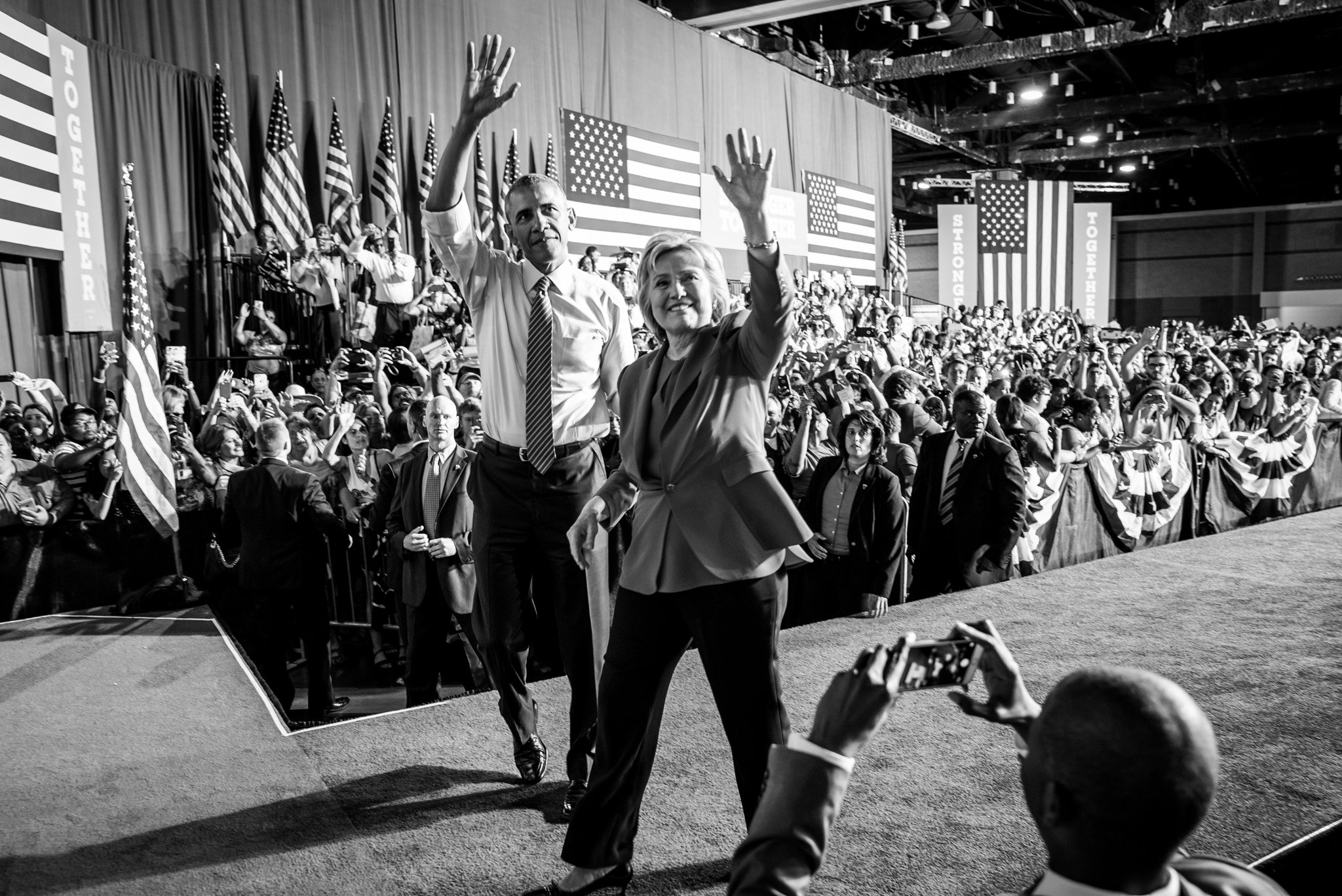
My blog today is a picture - Barack Obama and Hillary Clinton

First Lady of Arkansas, Hillary Rodham Clinton
Senator from Illinois and President of the United States Barack Obama

Native child of Illinois Hillary Rodham

Native son of Hawaii, Barak Obama

New York State Senator and Secretary of State Hillary Clinton
taaaadaaaa

Now....Washington DC !

Labels: , , , ,

Wednesday, February 03, 2016

Mosque visit in Baltimore- President Obama affirms religious tolerance

In 1957, when dedicating the Islamic center in Washington, D.C., President Eisenhower said, "I should like to assure you, my Islamic friends, that under the American Constitution … and in American hearts … this place of worship, is just as welcome … as any other religion." (Applause.)

"We are one American family. We will rise and fall together. It won't always be easy. There will be times where our worst impulses are given voice. But I believe that ultimately, our best voices will win out. And that gives me confidence and faith in the future. (Applause.)"... President Obama February 3, 2016.

Today, President Obama visited a Mosque in Baltimore, Maryland.
As a matter of fact, yes, President Obama, I've 3 times visited a Mosque. Two times, I've visted the Islamic Mosque and Cultural Center in Washington DC and once, when walking in Singapore, my husband and I entered a downtown Mosque.

A Mosque is a place where people who practice Islam, the religion founded by Mohammed (b. 632 AD), go to worship.

Building religious and cultural bridges with the millions of people who practice Islam is essential if the world hopes to eradicate terrorism fueled by radicalism among some groups like ISIS (the self declared Islamic State). In fact, many more Americans should respectfully visit Mosques, to learn more about the religion followed by 2.08 Billion people. Moreover, the Muslim population is increasing at 1.84% a year.

Here is President Obama's transcript of remarks he made at a Mosque in Baltimore, Maryland.
ISLAM IN AMERICA: President Barack Obama at a
Baltimore mosque: ‘An attack on one faith is an attack on all our faiths’ by Casey Tolan
Barack Obama's remarks Wednesday at the Islamic Society of Baltimore, as released by the White House:

THE PRESIDENT: Well, good afternoon. And, Sabah, thank you for the wonderful introduction and for your example — your devotion to your faith and your education, and your service to others. You're an inspiration. You're going to be a fantastic doctor. And I suspect, Sabah, your parents are here because they wanted to see you so — where are Sabah's parents? There you go. (Applause.) Good job, Mom. She did great, didn't she? She was terrific.To everyone here at the Islamic Society of Baltimore, thank you for welcoming me here today. I want to thank Muslim Americans leaders from across this city and this state, and some who traveled even from out of state to be here. I want to recognize Congressman John Sarbanes, who is here. (Applause.) As well as two other great leaders in Congress — and proud Muslim Americans — Congressman Keith Ellison from the great state of Minnesota — (applause) — and Congressman Andre Carson from the great state of Indiana. (Applause.)

This mosque, like so many in our country, is an all-American story. You've been part of this city for nearly half a century. You serve thousands of families — some who've lived here for decades as well as immigrants from many countries who've worked to become proud American citizens.

Now, a lot of Americans have never visited a mosque. To the folks watching this today who haven't — think of your own church, or synagogue, or temple, and a mosque like this will be very familiar. This is where families come to worship and express their love for God and each other. There's a school where teachers open young minds. Kids play baseball and football and basketball — boys and girls — I hear they're pretty good. (Laughter.) Cub Scouts, Girl Scouts meet, recite the Pledge of Allegiance here.

With interfaith dialogue, you build bridges of understanding with other faith communities — Christians and Jews. There's a health clinic that serves the needy, regardless of their faith. And members of this community are out in the broader community, working for social justice and urban development. As voters, you come here to meet candidates. As one of your members said, "just look at the way we live...we are true Americans."

So the first thing I want to say is two words that Muslim Americans don't hear often enough — and that is, thank you. Thank you for serving your community. Thank you for lifting up the lives of your neighbors, and for helping keep us strong and united as one American family. We are grateful for that. (Applause.)

Now, this brings me to the other reason I wanted to come here today. I know that in Muslim communities across our country, this is a time of concern and, frankly, a time of some fear. Like all Americans, you're worried about the threat of terrorism. But on top of that, as Muslim Americans, you also have another concern -- and that is your entire community so often is targeted or blamed for the violent acts of the very few.

The Muslim American community remains relatively small --several million people in this country. And as a result, most Americans don't necessarily know -- or at least don't know that they know — a Muslim personally. And as a result, many only hear about Muslims and Islam from the news after an act of terrorism, or in distorted media portrayals in TV or film, all of which gives this hugely distorted impression.

And since 9/11, but more recently, since the attacks in Paris and San Bernardino, you've seen too often people conflating the horrific acts of terrorism with the beliefs of an entire faith. And of course, recently, we've heard inexcusable political rhetoric against Muslim Americans that has no place in our country.

No surprise, then, that threats and harassment of Muslim Americans have surged. Here at this mosque, twice last year, threats were made against your children. Around the country, women wearing the hijab — just like Sabah — have been targeted. We've seen children bullied. We've seen mosques vandalized. Sikh Americans and others who are perceived to be Muslims have been targeted, as well.

I just had a chance to meet with some extraordinary Muslim Americans from across the country who are doing all sorts of work. Some of them are doctors; some of them are community leaders; religious leaders. All of them were doing extraordinary work not just in the Muslim community but in the American community. And they're proud of their work in business and education, and on behalf of social justice and the environment and education. I should point out they were all much younger than me — (laughter) — which is happening more frequently these days. And you couldn't help but be inspired, hearing about the extraordinary work that they're doing. But you also could not help but be heartbroken to hear their worries and their anxieties.

Some of them are parents, and they talked about how their children were asking, are we going to be forced out of the country, or, are we going to be rounded up? Why do people treat us like that? Conversations that you shouldn't have to have with children — not in this country. Not at this moment.

And that's an anxiety echoed in letters I get from Muslim Americans around the country. I've had people write to me and say, I feel like I'm a second-class citizen. I've had mothers write and say, "my heart cries every night," thinking about how her daughter might be treated at school. A girl from Ohio, 13 years old, told me, "I'm scared." A girl from Texas signed her letter "a confused 14-year-old trying to find her place in the world."

These are children just like mine. And the notion that they would be filled with doubt and questioning their places in this great country of ours at a time when they've got enough to worry about — it's hard being a teenager already — that's not who we are.

We're one American family. And when any part of our family starts to feel separate or second-class or targeted, it tears at the very fabric of our nation. (Applause.)
It's a challenge to our values — and that means we have much work to do. We've got to tackle this head on. We have to be honest and clear about it. And we have to speak out. This is a moment when, as Americans, we have to truly listen to each other and learn from each other. And I believe it has to begin with a common understanding of some basic facts. And I express these facts, although they'd be obvious to many of the people in this place, because, unfortunately, it's not facts that are communicated on a regular basis through our media.

So let's start with this fact: For more than a thousand years, people have been drawn to Islam's message of peace. And the very word itself, Islam, comes from salam — peace. The standard greeting is as-salamu alaykum — peace be upon you. And like so many faiths, Islam is rooted in a commitment to compassion and mercy and justice and charity. Whoever wants to enter paradise, the Prophet Muhammad taught, "let him treat people the way he would love to be treated." (Applause.) For Christians like myself, I'm assuming that sounds familiar. (Laughter.)

The world's 1.6 billion Muslims are as diverse as humanity itself. They are Arabs and Africans. They're from Latin America to Southeast Asia; Brazilians, Nigerians, Bangladeshis, Indonesians. They are white and brown and black. There's a large African American Muslim community. That diversity is represented here today. A 14-year-old boy in Texas who's Muslim spoke for many when he wrote to me and said, "We just want to live in peace."

Here's another fact: Islam has always been part of America. Starting in colonial times, many of the slaves brought here from Africa were Muslim. And even in their bondage, some kept their faith alive. A few even won their freedom and became known to many Americans. And when enshrining the freedom of religion in our Constitution and our Bill of Rights, our Founders meant what they said when they said it applied to all religions.

Back then, Muslims were often called Mahometans. And Thomas Jefferson explained that the Virginia Statute for Religious Freedom he wrote was designed to protect all faiths — and I'm quoting Thomas Jefferson now — "the Jew and the Gentile, the Christian and the Mahometan." (Applause.)

Jefferson and John Adams had their own copies of the Koran. Benjamin Franklin wrote that "even if the Mufti of Constantinople were to send a missionary to preach to us, he would find a pulpit at his service." (Applause.) So this is not a new thing.

Generations of Muslim Americans helped to build our nation. They were part of the flow of immigrants who became farmers and merchants. They built America's first mosque, surprisingly enough, in North Dakota. (Laughter.) America's oldest surviving mosque is in Iowa. The first Islamic center in New York City was built in the 1890s. Muslim Americans worked on Henry Ford's assembly line, cranking out cars. A Muslim American designed the skyscrapers of Chicago.

In 1957, when dedicating the Islamic center in Washington, D.C., President Eisenhower said, "I should like to assure you, my Islamic friends, that under the American Constitution … and in American hearts … this place of worship, is just as welcome … as any other religion." (Applause.)

Barack Obama was making his first visit to a US mosque as president and suggested to those Americans who had not visited a mosque, ‘think of your own church or synagogue or temple and a mosque like this will be very familiar.’
President Barack Obama visits a Baltimore Mosque
Barack Obama , on his first visit to a US mosque as president, told non-Muslim Americans, ‘think of your own church or synagogue or temple and a mosque like this will be very familiar.’ Photograph: Jonathan Ernst/Reuters

And perhaps the most pertinent fact, Muslim Americans enrich our lives today in every way. They're our neighbors, the teachers who inspire our children, the doctors who trust us with our health — future doctors like Sabah. They're scientists who win Nobel Prizes, young entrepreneurs who are creating new technologies that we use all the time. They're the sports heroes we cheer for — like Muhammad Ali and Kareem Abdul-Jabbar, Hakeem Olajuwon. And by the way, when Team USA marches into the next Olympics, one of the Americans waving the red, white and blue — (applause) — will a fencing champion, wearing her hijab, Ibtihaj Muhammad, who is here today. Stand up. (Applause.) I told her to bring home the gold. (Laughter.) Not to put any pressure on you. (Laughter.)

Muslim Americans keep us safe. They're our police and our firefighters. They're in homeland security, in our intelligence community. They serve honorably in our armed forces — meaning they fight and bleed and die for our freedom. Some rest in Arlington National Cemetery. (Applause.)

So Muslim Americans are some of the most resilient and patriotic Americans you'll ever meet. We're honored to have some of our proud Muslim American servicemembers here today. Please stand if you're here, so we can thank you for your service. (Applause.)

So part of the reason I want to lay out these facts is because, in the discussions that I was having with these incredibly accomplished young people, they were pointing that so often they felt invisible. And part of what we have to do is to lift up the contributions of the Muslim American community not when there's a problem, but all the time.

Our television shows should have some Muslim characters that are unrelated to national security — (applause) — because — it's not that hard to do. There was a time when there were no black people on television. And you can tell good stories while still representing the reality of our communities.

Now, we do have another fact that we have to acknowledge. Even as the overwhelming majority — and I repeat, the overwhelming majority — of the world's Muslims embrace Islam as a source of peace, it is undeniable that a small fraction of Muslims propagate a perverted interpretation of Islam. This is the truth.

Groups like al Qaeda and ISIL, they're not the first extremists in history to misuse God's name. We've seen it before, across faiths. But right now, there is a organized extremist element that draws selectively from Islamic texts, twists them in an attempt to justify their killing and their terror. They combine it with false claims that America and the West are at war with Islam. And this warped thinking that has found adherents around the world — including, as we saw, tragically, in Boston and Chattanooga and San Bernardino — is real. It's there. And it creates tensions and pressure that disproportionately burden the overwhelming majority of law-abiding Muslim citizens.

And the question then is, how do we move forward together? How do we keep our country strong and united? How do we defend ourselves against organizations that are bent on killing innocents? And it can't be the work of any one faith alone. It can't be just a burden on the Muslim community — although the Muslim community has to play a role. We all have responsibilities. So with the time I have left, I just want to suggest a few principles that I believe can guide us.


First, at a time when others are trying to divide us along lines of religion or sect, we have to reaffirm that most fundamental of truths: We are all God's children. We're all born equal, with inherent dignity.

And so often, we focus on our outward differences and we forget how much we share. Christians, Jews, Muslims — we're all, under our faiths, descendants of Abraham. So mere tolerance of different religions is not enough. Our faiths summon us to embrace our common humanity. "O mankind," the Koran teaches, we have "made you peoples and tribes that you may know one another." (Applause.) So all of us have the task of expressing our religious faith in a way that seeks to build bridges rather than to divide.

Second, as Americans, we have to stay true to our core values, and that includes freedom of religion for all faiths. I already mentioned our Founders, like Jefferson, knew that religious liberty is essential not only to protect religion but because religion helps strengthen our nation — if it is free, if it is not an extension of the state. Part of what's happened in the Middle East and North Africa and other places where we see sectarian violence is religion being a tool for another agenda — for power, for control. Freedom of religion helps prevent that, both ways — protects religious faiths, protects the state from — or those who want to take over the state from using religious animosity as a tool for their own ends.

That doesn't mean that those of us with religious faith should not be involved. We have to be active citizenry. But we have to respect the fact that we have freedom of religion.

Remember, many preachers and pastors fought to abolish the evil of slavery. People of faith advocated to improve conditions for workers and ban child labor. Dr. King was joined by people of many faiths, challenging us to live up to our ideals. And that civil activism, that civic participation that's the essence of our democracy, it is enhanced by freedom of religion.

Now, we have to acknowledge that there have been times where we have fallen short of our ideals. By the way, Thomas Jefferson's opponents tried to stir things up by suggesting he was a Muslim — so I was not the first — (applause.) No, it's true, it's true. Look it up. (Laughter.) I'm in good company. (Laughter.)

But it hasn't just been attacks of that sort that have been used. Mormon communities have been attacked throughout our history. Catholics, including, most prominently, JFK — John F. Kennedy — when he ran for President, was accused of being disloyal. There was a suggestion that he would be taking orders from the Pope as opposed to upholding his constitutional duties. Anti-Semitism in this country has a sad and long history, and Jews were exclude routinely from colleges and professions and from public office.

And so if we're serious about freedom of religion — and I'm speaking now to my fellow Christians who remain the majority in this country — we have to understand an attack on one faith is an attack on all our faiths. (Applause.) And when any religious group is targeted, we all have a responsibility to speak up. And we have to reject a politics that seeks to manipulate prejudice or bias, and targets people because of religion.

We've got to make sure that hate crimes are punished, and that the civil rights of all Americans are upheld. (Applause.) And just as faith leaders, including Muslims, must speak out when Christians are persecuted around the world — (applause) — or when anti-Semitism is on the rise — because the fact is, is that there are Christians who are targeted now in the Middle East, despite having been there for centuries, and there are Jews who've lived in places like France for centuries who now feel obliged to leave because they feel themselves under assault — sometimes by Muslims. We have to be consistent in condemning hateful rhetoric and violence against everyone. (Applause.) And that includes against Muslims here in the United States of America. (Applause.)

So none of us can be silent. We can't be bystanders to bigotry. And together, we've got to show that America truly protects all faiths.

Which brings me to my next point: As we protect our country from terrorism, we should not reinforce the ideas and the rhetoric of the terrorists themselves. I often hear it said that we need moral clarity in this fight. And the suggestion is somehow that if I would simply say, these are all Islamic terrorists, then we would actually have solved the problem by now, apparently. (Laughter.) Well, I agree, we actually do need moral clarity. Let's have some moral clarity. (Applause.)

Groups like ISIL (aka "evil ISIS) are desperate for legitimacy. They try to portray themselves as religious leaders and holy warriors who speak for Islam. I refuse to give them legitimacy. We must never give them that legitimacy. (Applause.) They're not defending Islam. They're not defending Muslims. The vast majority of the people they kill are innocent Muslim men, women and children. (Applause.)

And, by the way, the notion that America is at war with Islam ignores the fact that the world's religions are a part of who we are. We can't be at war with any other religion because the world's religions are a part of the very fabric of the United States, our national character. (Applause.)

So the best way for us to fight terrorism is to deny these organizations legitimacy and to show that here in the United States of America, we do not suppress Islam; we celebrate and lift up the success of Muslim Americans. That's how we show the lie that they're trying to propagate. (Applause.) We shouldn't play into terrorist propaganda. And we can't suggest that Islam itself is at the root of the problem. That betrays our values. It alienates Muslim Americans. It's hurtful to those kids who are trying to go to school and are members of the Boy Scouts, and are thinking about joining our military.

That kind of mindset helps our enemies. It helps our enemies recruit. It makes us all less safe. So let's be clear about that.

Now, finally, just as all Americans have a responsibility to reject discrimination — I've said this before — Muslims around the world have a responsibility to reject extremist ideologies that are trying to penetrate within Muslim communities.

Here at this mosque, and across our country and around the world, Muslim leaders are roundly and repeatedly and consistently condemning terrorism. And around the globe, Muslims who've dared to speak out have often been targeted and even killed. So those voices are there; we just have to amplify them more. (Applause.)
And it was interesting, in the discussion I had before I came out, some people said, why is there always a burden on us? When a young man in Charleston shoots African Americans in a church, there's not an expectation that every white person in America suddenly is explaining that they're not racist. They can Everybody is assumed to be horrified by that act. And I recognize that sometimes that doesn't feel fair.

But part of the answer is to make sure that the Muslim community in all of its variety, in all the good works that it's doing, in all the talent that's on display, that it's out there visible on a consistent basis — not just at a certain moment. (Applause.)

But what is also true is, is that there is a battle of hearts and minds that takes place — that is taking place right now, and American Muslims are better positioned than anybody to show that it is possible to be faithful to Islam and to be part of a pluralistic society, and to be on the cutting-edge of science, and to believe in democracy. (Applause.)

And so I would urge all of you not to see this as a burden, but as a great opportunity and a great privilege to show who you are. To use a little Christian expression — let your light shine. Because when you do you'll make clear that this is not a clash of civilizations between the West and Islam. This is a struggle between the peace-loving, overwhelming majority of Muslims around the world and a radical, tiny minority. And ultimately, I'm confident that the overwhelming majority will win that battle. (Applause.) Muslims will decide the future of your faith. And I'm confident in the direction that it will go.

But across the Islamic world, influential voices should consistently speak out with an affirmative vision of their faith. And it's happening. These are the voices of Muslim clerics who teach that Islam prohibits terrorism, for the Koran says whoever kills an innocent, it is as if he has killed all mankind. (Applause.) These are the voices of Muslim scholars, some of whom join us today, who know Islam has a tradition of respect for other faiths; and Muslim teachers who point out that the first word revealed in the Koran — igra — means "read" — to seek knowledge, to question assumptions. (Applause.)

Muslim political leaders have to push back on the lie that the West oppresses Muslims, and against conspiracy theories that says America is the cause of every ill in the Middle East. Now, that doesn't mean that Muslim Americans aren't free to criticize American — U.S. foreign policy. That's part of being an American. I promise you, as the President of the United States, I'm mindful that that is a healthy tradition that is alive and well in America. (Laughter.) But like leaders everywhere, these leaders have been offering, and need to continue to offer, a positive vision for progress, and that includes political and economic progress.

And we have to acknowledge that much of the violence in places like the Middle East is now turning into fights between sects — Shia, Sunni and others — where differences are often exploited to serve political agendas, as I said earlier. And this bloodshed is destroying Muslim families and communities, and there has to be global pressure to have the vision and the courage to end this kind of thinking and this approach to organizing political power.

It's not historically unique. It's happened in every part of the world — from Northern Ireland to Africa, to Asia, to right here in the United States — in the past. But it is something that we have to fight against.

And we know it's possible. Across the history of Islam, different sects traditionally have lived and thrived together peacefully. And in many parts of the world they do today, including here in the United States.

Like people of all religions, Muslims living their faith in a modern, pluralistic world are called upon to uphold human rights, to make sure that everyone has opportunity. That includes the aspirations of women and youth and all people. If we expect our own dignity to be respected, so must we respect the dignity of others. (Applause.)

So let me conclude by saying that as Muslim communities stand up for the future that you believe in, that you exhibit in your daily lives, as you teach your children, America will be your partner. We will — I will — do everything I can to lift up the multiplicity of Muslim voices that promote pluralism and peace. (Applause.) We will continue to reach out to young Muslims around the world, empowering them with science and technology and entrepreneurship, so they can pursue their God-given potential, and help build up their communities and provide opportunity. It's why we will continue to partner with Muslim American communities — not just to help you protect against extremist threats, but to expand health care and education and opportunity — (applause) — because that's the best way to build strong, resilient communities.

Our values must guide us in this work. Engagement with Muslim American communities must never be a cover for surveillance. (Applause.) We can't give in to profiling entire groups of people. There's no one single profile of terrorists. We can't securitize our entire relationship with Muslim Americans. We can't deal with you solely through the prism of law enforcement. We've got to build trust and mutual respect. That's how we'll keep our communities strong and our communities united.

As I was in discussion with the young people before I came in here, I said this will be a process. Law enforcement has a tough job. Some of these groups are specifically trying to target Muslim youth. We're going to have to be partners in this process. There will be times where the relationship is clumsy or mishandled. But I want you to know that from the President to the FBI Director, to everybody in law enforcement, my directive and their understanding is, is that this is something we have to do together. And if we don't do it well, then we're actually not making ourselves safer; we're making ourselves less safe.

And here, I want to speak directly to the young people who may be listening. In our lives, we all have many identities. We are sons and daughters, and brothers and sisters. We're classmates; Cub Scout troop members. We're followers of our faith. We're citizens of our country. And today, there are voices in this world, particularly over the Internet, who are constantly claiming that you have to choose between your identities — as a Muslim, for example, or an American. Do not believe them. If you're ever wondering whether you fit in here, let me say it as clearly as I can, as President of the United States: You fit in here — right here. (Applause.) You're right where you belong. You're part of America, too. (Applause.) You're not Muslim or American. You're Muslim and American. (Applause.)

Don't grow cynical. Don't respond to ignorance by embracing a world view that suggests you must choose between your faith and your patriotism. Don't believe that you have to choose between your best impulses and somehow embrace a world view that pits us against each other — or, even worse, glorifies violence. Understand your power to bring about change. Stay engaged in your community. Help move our country forward — your country forward. (Applause.)

We are blessed to live in a nation where even if we sometimes stumble, even if we sometimes fall short, we never stop striving for our ideals. We keep moving closer to that more perfect union. We're a country where, if you work hard and if you play by the rules, you can ultimately make it, no matter who you are or how you pray. It may not always start off even in the race, but here, more than any place else, there's the opportunity to run that race.

And as we go forward, I want every Muslim American to remember you are not alone. Your fellow Americans stand with you — just as Sabah described her friends after she decided that she was going to start wearing a hijab. That's not unusual. Because just as so often we only hear about Muslims after a terrorist attack, so often we only hear about Americans' response to Muslims after a hate crime has happened, we don't always hear about the extraordinary respect and love and community that so many Americans feel.

I'm thinking about the seven-year-old boy in Texas who emptied his piggy bank to help a mosque that had been vandalized. (Applause.) Or all the faith communities that rallied around Muslim Americans after the tragedy in Chapel Hill. The churches and the synagogues standing shoulder-to-shoulder with their local mosques, including the woman carrying a sign saying "We love our Muslim neighbors." Think of our men and women in uniform who, when they heard that a little girl was afraid because she's a Muslim, sent her a message — "I Will Protect You." (Applause.)

I want every American to remember how Muslim communities are standing up for others, as well. Because right now, as we speak, there are Muslims in Kenya who saved Christians from terrorists, and Muslims who just met in Morocco to protect religious minorities, including Christians and Jews. (Applause.) The good people of this mosque helped this city move forward after the turmoil of last year. Muslim Americans across the country helped African American churches rebuild after arson.

Remember the Muslim Americans in Boston who reached out to victims of the Marathon bombing; the Muslim Americans across the country who raised money for the families of San Bernardino; the Muslim Americans in Chattanooga who honored our fallen servicemembers, one of them saying, "in the name of God, the God of Abraham, Moses, Jesus, and Muhammad, God bless our fallen heroes." (Applause.)

We are one American family. We will rise and fall together. It won't always be easy. There will be times where our worst impulses are given voice. But I believe that ultimately, our best voices will win out. And that gives me confidence and faith in the future. (Applause.)

After more than 200 years, our blended heritage, the patchwork quilt which is America, that is not a weakness, that is one of our greatest strengths. It's what makes us a beacon to the world. It's what led that mother who wrote to me — the one who worries about her young daughter — it led her to end her letter with hope, despite her fears. She said, "I still believe in one nation, under God, indivisible, with liberty and justice for all." (Applause.)

May God's peace be upon you. May God bless the United States of America. Thank you very much, everybody. (Applause.)

In fact, although I agree with President Obama's remarks, made in Baltimore, the Muslim community must, likewise, welcome the community to visit them in their Mosques. I assume one barrier to this exchange are the Mosques' locations. Usually, they are located in ordinary places like former bank buildings or empty stores. But, buildings are not what makes Islam...it's their faith community. They must be as open to religious exchanges as are the Christian churches and Jewish synagogues. 

Labels: ,