Maine Writer

Its about people and issues I care about.

My Photo
Name:
Location: Topsham, MAINE, United States

My blogs are dedicated to the issues I care about. Thank you to all who take the time to read something I've written.

Sunday, November 10, 2019

Chilling history about Naziism - brutal first person experience

Remembering Kristallnacht
Local rabbi recalls 'Night of Broken Glass'- opinion echo published in the Pittsburgh Jewish Chronicle.


Pedestrians viewing a Jewish store in Berlin damaged during Kristallnacht, November 10, 1938.
During Kristallnacht, also known as the “night of broken glass,” anti-Semitic rioters terrorized Jews throughout Germany and its territories. They vandalized homes and businesses, attacked and harassed Jewish people, and destroyed their places of worship. Kristallnacht offered a terrifying vision of what was to come: the annihilation of six million European Jews.

November 9, 1938: The Final Solution had begun with us in Germany — men into concentration camps, businesses looted, moneys confiscated. When it ended, 6 million Jews across Europe, murdered. Who could foretell any of this?

We had no inkling. Certainly not I, as an 8-year-old mischievious boy who had, that evening, peeked into the huge synagogue (as big as Rodef Shalom) next door. Why not? It was my father’s, the rabbi’s, and I had done so many times before.

We went to sleep, and fire engines awakened my little brother and me — delighted, till we saw that it was our synagogue burning as we were yanked from the window. In the room next door, my father the rabbi was being interrogated by the Gestapo. That had happened several times before about 4 a.m., always with searches for the supposed secret documents of the B’nai B’rith of which my father was district president. 

(Chilling horror!) That evening when the Gestapo agents left, they took my father with them, along with several hundred Jewish men. They were trucked to Dachau, a concentration camp two hours away. In this dank, freezing winter night, they left — no coats, no goodbyes and their astonished families, wondering and no one to ask. After a month or six weeks, they were released one by one.

For days, members of our community (Augsburg: population 300,000, 1,500 Jews) wondered whether we had been singled out or had this occurred elsewhere in Germany. Eventually, we learned that this had happened to every German Jewish community. Anti-Semitism had been nurtured for years and had led to this.

How did our and other families cope in this period when women largely dealt with family and home while business and finances were the male domain? Decisions were shared, but rarely left entirely to the women, who were now utterly on their own.

My mother was told that it was not safe to be alone in our apartment with two little boys and we moved into the home of the congregational president, which we boys thoroughly enjoyed. We were safe, but my mother was concerned with our future and immediately left for Stuttgart, the nearest American consulate, as our only hope was emigration as soon as possible. She spent two icy days standing in line, received a number and was told to wait till they contacted her — how long? — perhaps two or three years.

My family had begun to plan for emigration to America in the summer of 1938; our American family had provided the necessary papers, which were endless. The families had remained in touch since their arrival in the 1870s. Not much practical work needed to be done — just downsizing our furniture to fit into a small home that we might be able to afford; we boys would grow and there would be little money for new clothes, so we purchased two, three or four sizes too large. Tight government regulations, changing daily, limited what we could take, if we would be able to leave. My mother had to grapple with all this this while keeping two boys and their friends, whose school had been closed, occupied. Radio programs might have been helpful, but we had carefully avoided owning a radio to avoid the mandatory demand to listen to all Nazi speeches.

My family, along with all others, yearned for news about our men. Were they healthy in this cold, wet winter? What was happening to Jews elsewhere in Germany? Could they help us? Each family had endless questions, but it was not even wise to ask. My family had an unusual additional source as we subscribed to the weekly New York Times (we had always read English and French) and through some bureaucratic error, it continued to arrive.

Friendly non-Jews were careful; what was permissible? Who was watching, listening? The most courageous act I saw was a milkman who, on Nov. 10, pushed his way through a large crowd of gawkers and delivered as always, despite the police waving him off.

We children were given only information as absolutely necessary. Fortunately for my mother, 5– and 8-year-olds could be handled. She and everyone else knew or quickly learned that a single wrong remark could doom a family.

What happened to our small family? After six weeks, my father, along with most other men, was released. Neither then nor later did he talk about this period. My parents worked hard to prepare for emigration as my parents understood that the mood might change without warning. Generously the British government, through the Chief Rabbi, provided temporary visas for several hundred rabbis and scholars, provided they did not work, and my father left for England. We children and my mother, eliminating all but three toys each, remained in Augsburg as we had no money in England and the small amount the German government permitted us to withdraw each week would see us through.

When my mother in March of 1939 saw tanks on the roads leading to Czechoslovakia, she felt that war was imminent, phoned my father in London, told him we would arrive the next day and answered no questions. She gave our prepared dinners to friends and took our ever ready suitcases to the train for England. That began 10 months in London with our family that had arrived a few months earlier and now had enough family with them that we ate in shifts.

There would be plenty of adventure till we resettled in the United States, but we were safe and ever, ever grateful. pjc

Rabbi Walter Jacobs is Rodef Shalom’s rabbi emeritus and senior scholar.

Labels: , ,

Friday, August 16, 2019

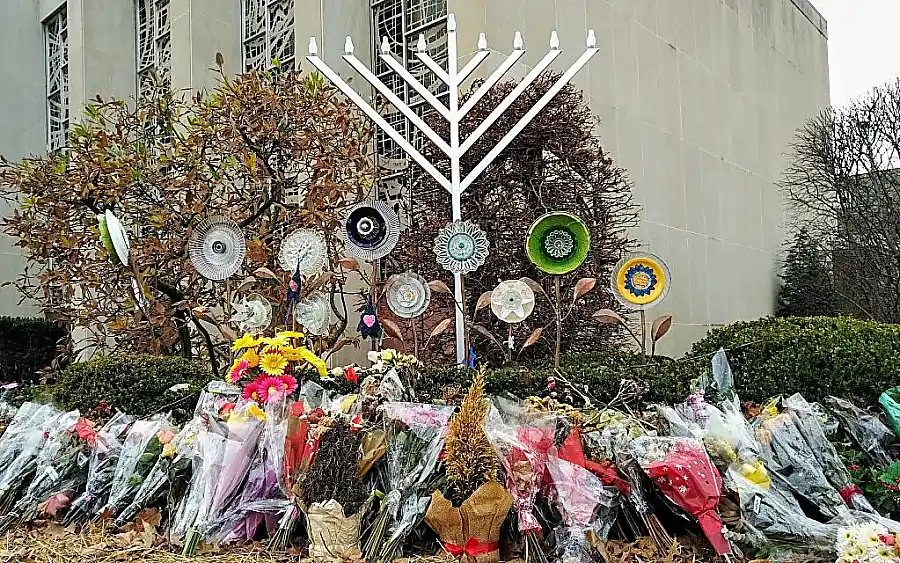
Remember, Repair, Together - Tree of Life Synagogue memorial and commemoration

Day of programming announced to commemorate Oct. 27, 2018, massacre of eleven Jewish worshipers at the Tree of Life Synagogue, in Pittsburgh's Squirrel Hill neighborhood.

Planned events will include Torah study and opportunities for volunteering. 

Published in the Pittsburgh Jewish Chronicle by Toby Tabachinck

Initial plans have been announced for a day of activities marking the one-year commemoration of the Oct. 27 massacre at Tree of Life building, the most violent anti-Semitic attack in U.S. history.

Emblematic of the tenor of the day’s activities, to be held on Sunday, Oct. 27, 2019, is a new logo with the words “
Remember,” “Repair” and “Together”.

Programming will focus on honoring the victims, families and survivors affected by the mass shooting, which took the lives of 11 congregants of Tree of Life*Or L’Simcha, New Light, and Dor Hadash congregations. 
The day will include speakers, Torah study, and a host of volunteer opportunities. A public memorial service to remember those murdered will be held at 5:00 p.m. at Soldiers and Sailors Memorial Hall in Oakland, Pennsylvania.

"Remember" is to honor the victims and their legacies, and to remember how Pittsburgh rallied behind the Jewish community after the shooting. This will largely be done at a community service at Soldiers and Sailors on Oct. 27.

"Repair" comes from a Hebrew saying that translates to "repair the world." This will be on the minds of volunteers during service projects that will be announced.

"Together", the Pittsburgh community will gather just as it did after the shooting.

A commemoration committee comprised of representatives of the 11 victims’ families are planning the program.

Other representatives included the City of Pittsburgh Department of Public Safety, the director of the Pittsburgh resiliency center, and other advisers.

“On October 27, 2019, we will commemorate one year since the attack with public events to honor the memories of the deceased and those most closely impacted,” said Rabbi Amy Bardack, planning committee chair and director of Jewish life and learning at the Federation. “The theme encompasses three elements. ‘Remember’ means recalling the lives that we lost and remembering the attack so that we can prevent future attacks. ‘Repair’ means both repairing emotional wounds in the community and repairing our sense of brokenness in ourselves and in the world. ‘Together’ means that we were heartened by the support we felt from the city, county, many different faith communities and diverse communities, and all over the world. ‘Together’ also means that we are not in this alone.”

Schedules for the events are still in the planning stage and will be available on the official website, www.pittsburghoct27.org.

“There are already over 30 community service sites that will be available,” noted Adam Hertzman, director of marketing for the Federation. “There will be a variety of different types of organizations throughout the city. We are conscious of the fact that the October 27 attacks affected not only the Jewish community, but really all of Pittsburgh, and that many different people of all faiths and diverse communities will potentially want to volunteer.”

The commemoration planning committee evolved from “the same committee that has been meeting almost from the beginning to coordinate help for the victims’ families and people with psychological trauma,” Hertzman explained.

The victims’ families have requested that the day be “non-political,” according to Hertzman, allowing the focus of the commemoration to be “on the lives we lost and the needs of the victims. We are hoping that the people who have political interests don’t choose to demonstrate or show their political leanings on that particular day.”

The day will provide an opportunity “for the community to come together,” said Barb Feige, executive director of TOL*OLS. “Not one entity owns the event– it happened to all of us. I think the lovely opportunities for both Torah study and volunteerism are particularly meaningful and a reflection of the dedication and the personalities of those we lost.”

The commemoration’s motto—“Remember,” “Repair” and “Together”—captures the essence of the overarching aims of the day, according to Ellen Surloff, immediate past president of Dor Hadash.

“We want to remember those of all three congregations who lost their lives on Oct. 27 and we want to honor them,” she said. “There will be opportunities to do service projects that day which will honor their memories. There will be opportunities for Torah study that day, and that will also honor their memories.

“The ‘repair’ is we are all going to be together, and we will be doing projects,” she continued. “’Together’ is just seeing the whole community come together and show support just like they did in the immediate aftermath. It’s really an opportunity to reflect on the people whose lives were lost, reflect on the last year and the impact it’s had on everyone, the survivors, the community, the greater Jewish community, the Jewish community in the world at large.”

Although there will be some events “that will be unique to the survivor group or unique to the three congregations,” public events have been scheduled “because just as the entire community, Jewish and non-Jewish, helped us to heal, they can help us to remember and honor on the one-year anniversary.”

While the programming for the day is designed to help the community remember and to heal, Rabbi Jonathan Perlman, spiritual leader of New Light and a member of the commemoration committee, is approaching the day of commemoration events with some apprehension.

“I’m a little skeptical,” he said. “There are people on the committee that expect a media spectacle, they expect a great deal of attention, Pittsburghers and people coming from elsewhere. And they say this is based on the evidence they have from other sites of tragedy, like in Parkland, or Colorado, Columbine, for the one-year anniversaries and other anniversaries. They said the same thing is going to happen here.

“I don’t know,” he said. “The thing is that I really feel that all the love and the hugging and the memorials and the goodness came out around the first two or three months of the killing. 

Pittsburghers really showed themselves, and showed themselves well. I don’t really see them coming back to say, ‘We need to do our own memorialization’ and turn this into a holiday where we return to the scene of the crime or go back and have another vigil with the same numbers.”

The “mood” for Perlman, is that “it is over,” he said.

“We all have our souvenirs and our t-shirts and bumper stickers and it’s not going to be in the same numbers as it was last year. And we are planning for a great number of people to come out. We are reserving Soldiers and Sailors Memorial Hall, expecting we are going to get the same numbers.

“I’m the skeptical one on the committee,” he said. “Everyone else seems to be very enthusiastic. What I don’t want to happen is that the people feel the pressure to go to all these activities and then be re-traumatized about what happened. I want them to feel positive about going forward.”

Still, Perlman praised the “creativity” of the planning committee, organizing a variety of volunteer opportunities, Torah study, and being mindful of the needs of the victims’ families.

Toby Tabachnick can be reached at ttabachnick@pittsburghjewishchronicle.org

Labels: , , , ,

Friday, June 07, 2019

What it's like to be a rabbi from Pittsburgh

“So, where are you from?”

It is really the most innocuous of questions. At least, it was for me until a few months ago.


“Pittsburgh.”

“Ohhhhhhhhh. I’m sorry. That must be hard.”

This is what it is like to be a rabbi from Pittsburgh in the wake of the Oct. 27th shooting 
(Tree of Life – Or L'Simcha Congregation in the Squirrel Hill neighborhood of Pittsburgh, Pennsylvania, on October 27, 2018, while Shabbat morning services were being held. Eleven people were killed and seven were injured). 

At a convention in Denver; at a retreat in Allentown; at a family bat mitzvah in San Diego; when I visit Erie to lead a small congregation there; the conversation with strangers often comes back to this. 

People see my kippah (yarmulke)  and they know I’m a Jew. 

And when people hear that I’m a Jew from Pittsburgh, well, the responses are almost uniformly cringeworthy.

“Oh, that’s terrible.”

“Wow, were you close?”

“Did you know any of the victims?”

“You must be afraid.”

What do I say to these seemingly well-meaning individuals? 

Do they want to engage on this topic? Do I? Is this going to be a polite conversation, like that time at the bar with the three strangers, before they turned back to their drinks and searched for a segue to another, less intense topic? Or is it going to be excruciating and awkward, like the bar mitzvah guest who proclaimed the need for every congregant to come to shul armed to the teeth? 

Will I be shown eyes of compassion from a woman at a suburban Jewish Community Center? 

Or will my new address be used by a total stranger as a pivot to his own opinion, based in misinformation, telling me I should thank God the president is keeping us all safe from all those terrorists trying to infiltrate from Mexico?

Most Jewish Pittsburghers have been here for a few years, or decades, or even generations, and have fond memories of Pittsburgh through the years. They swap stories at kiddush about delis they used to love or that time they saw Willie Stargell on Penn Ave. in a Cadillac. Me? My family and I arrived here in late August; we bought a house and moved in on Oct. 21st. Six days later, a white supremacist who was radicalized over the internet shot up the synagogue three blocks from my own.

I’m probably like you: Being Jewish in Pittsburgh is about a lot of things, and almost all of them are great. I love seeing chalk drawings of the Shabbat times on Murray Avenue or being told to look for somebody’s grandfather in the 1954 Confirmation photo at the shul in Erie. I’ve been here less than a year, and I already have four favorite restaurants. And there’s nothing more majestic to me than a big, yellow bridge.

But for the rest of the country, when they see my kippah (
yarmulke) and hear where I’m from, it means a whole different thing. I’ve learned to accept it — to steel myself for it, even. I hope that when I tell a person where I’m from, they can engage me with a level of compassion and an attempt to gain understanding. 

But that isn’t always the case.

We are all transformed by the shooting here in Pittsburgh, in big ways and small. In one simple way, though, we are emissaries of a reality that others do not comprehend. We have obtained a kind of intimate knowledge of communal tragedy that others do not have.

That status conveys upon us a sacred responsibility to represent Pittsburgh as a real place with history, diversity, complexity and community. But it also requires us to be able to frame the shooting for the person we’re speaking with from somewhere else.

Whenever we speak to somebody else about Pittsburgh, that person projects their own feelings and emotions onto us and expects that we’ll reflect their own opinion back to them. It doesn’t have to be that way. Each of us can control our own narrative of what Pittsburgh is and what the shooting means to us. Pittsburgh is ours to transmit. We need to be able to explain what a wonderful and warm community it is. We also each need to choose an aspect of the tragedy to impart to others, as our sacred duty to educate and lift up. Maybe it’s the sadness we felt at a funeral or a shiva of one of the victims, or how we knew one of them and the way they inspired us. Maybe we are frustrated by our newfound feelings of vulnerability in synagogue. 

Maybe we are angry that our political leaders do nothing about mass shootings and hate-speech. Whatever it is, we own it. It is our narrative.

Next week, I’m off to Portland. I expect many people will ask me “the question.” I will do my best to thoughtfully absorb the way they react. And then I will tell them how wonderful Pittsburgh is and how it is so much more than one horrific moment. And then I will try to invite them into a conversation about what they think the shooting means. And I will tell them what I think the shooting meant, and continues to mean.

We Jewish Pittsburghers may be stuck answering uncomfortable questions in regards to our hometown for the foreseeable future. But we should always remember that we are the ones who get to choose how we answer, and we are the ones who write the narrative of who we choose to be. For the Pittsburgh Jewish Chronicle

From Mark Asher Goodman, a rabbi and writer in Pittsburgh PA.

Labels: , ,

Friday, March 01, 2019

Anti-Antisemitism rooted in right wing extremism

Pittsburgh Jewish Chronicle echo: “Since the 1940s, anti-Semitism is at the core of right wing extremist groups. Their members believe racial tensions exist because of manipulative Jews who operate above whites and non-whites."

“Right-wing extremism was responsible for all 50 anti-Semitic murders in the United States last year,” according to Kathleen Blee. Blee presented that fact as part of her lecture “Anti-Semitic and Other Hate Violence: The Current Context, Perpetrators, and the Role of Social Media.” 


Congregation Dor Hadash’s Adult Education Committee presented the program, on Sunday, Feb. 17, at Rodef Shalom Congregation.

Blee is a professor of sociology and Bettye J. and Ralph E. Bailey Dean of the Kenneth P. Dietrich School of Arts and Sciences and the College of General Studies at the University of Pittsburgh. She is the author of eight books, including “Women in the Klan: Racism and Gender in the 1920s.” Her lecture focused on right-wing extremism, which includes white supremacist groups such as the Klu Klux Klan, neo-Nazis, white-power skinheads and Christian Identity groups. The latter is “a fake religion based on race as its central idea,” she explained. The final component of this catch-all classification is a series of intertwined groups under the “alt-right” umbrella operating primarily in cyberspace.


“Since the 1940s, anti-Semitism is at the core of these groups,” Blee stated. Their members believe racial tensions exist because of manipulative Jews who operate above whites and non-whites.


Blee explained that right-wing extremists share a belief that whites are superior to other races; deny the Holocaust in public while privately taking glory in its history; see Jews as conspiratorial and elitist; have a deep fear of race suicide caused by declining birth rate and demographic shifts; view immigrants as an invasionary force; and believe in and promote the idea of race wars. These groups can be nationalistic as well, but “while they can be in favor of America first, they hate the federal government and see it as being controlled by Jewish elites.”

The members of these groups operate in a world “a lot more complicated than we often think and what the media tells us,” said Blee. People joining these groups aren’t particularly anti-Semitic or racist before becoming members, but they discover these ideas after getting pulled in by acquaintances, friends or recruiters. Fear is the motivating force, she said.

While right-wing extremist groups operate in a culture of violence, members aren’t violent before joining. Blee explained that “in this world you learn that there are people to be feared and that violence is possible. That combination with a sense of urgency in stopping those groups can move people to catastrophic ends.”

Members often come from middle class backgrounds, dispelling the belief that all right-wing extremists are marginalized members of society. Rather, members’ lives are “changed dramatically,” getting tattoos, losing friends and family and becoming the stereotype portrayed in the media.

Blee said that these groups are more fragile and porous than previously believed. People leave for a variety of reasons but often it is because a member’s personal life no longer makes sense in the context of the group or because they have made friends with people targeted by these groups.

While members leave, they often maintain their racist beliefs before deradicalizing, remaining vulnerable to relapse. 

Interestingly, many people change their minds and deradicalize but stay in the groups, stuck for a variety of reasons.* (!)
Understanding these groups can help detect and stop violent white supremacists, according to Blee. She highlighted several strategies used to combat the recruitment of new members, including developments in the world of technology.

Moonshot CVE (Countering Violent Extremism), a Google startup, is one such tool. It works to disrupt and ultimately end violent extremism through Google ads, digital redirection of search engine results and counter messaging campaigns.

Blee concluded her talk by discussing what can be done to combat right-wing extremist groups. She said it was important to be aware of how hate groups recruit new members, such as the use of flyers, music and parties. She stressed the importance of not circulating propaganda on social media left by these groups and recommended supporting the work done by organizations like the Anti-Defamation League and the Southern Poverty Law Center.

Congregation Dor Hadash President-elect Donna Coufal framed Blee’s lecture in the wake of the Oct. 27, terrorist attack at the Tree of Life synagogue building: “There is a certain irony to having Kathy speak to us today,” she said. “Only a year-and-a-half ago she gave a talk to Dor Hadash members on white supremacists and racist hate groups. We were all fascinated and asked many questions.

“The links to anti-Semitism were disturbing and thought-provoking, but I for one never thought that such a short time later, Dr. Blee would be standing here talking to a much larger group, all of us touched by an act of hatred.”

Tree of Life*Or L’Simcha member Austin Shifrin was pleased to hear Blee’s lecture, saying she was an “excellent speaker and very well versed. I’m glad Dor Hadash was able to present this program.” He concluded by saying that it was “reassuring to have an academic come in with facts.” PJC

Dave Rullo is a freelance writer.

*IMO The evil power of cultism

Labels: ,

Friday, January 18, 2019

Lasting impact of trauma after the Tree of Life Synagogue massacre

Echo editorial Published in the Pittsburgh Jewish Chronicle by Iris Valanti
"Many people who experience horrific, traumatic events do not immediately feel ready to talk about what happened; this is a completely normal response. But trauma comes from the Greek word meaning wound, and much of what we know about how to heal physical wounds also informs our understanding of what the human brain needs in order to heal from emotional trauma."

Follow up to the October 27, 2019, Tree of Life Synagogue mass shooting. The sole suspect, 46-year-old Robert Gregory Bowers, was arrested and charged with 29 federal crimes and 36 state crimes.

Looking back on the recently completed year, no event of 2018 has made more of a lasting mark on this (Pittsburgh) community than the tragic shooting of 11 friends and neighbors, in late October.

In the months since, many opportunities for counseling and healing have been offered, including drop-in counseling, individual therapy and support groups, coordinated by Jewish Family and Community Services (JFCS).

One counselor, EMDR trauma therapy expert Dr. Jamie Marich, came from Ohio to help staff the drop-in counseling sessions at the Jewish Community Center of Greater Pittsburgh, and led several trauma therapy workshops to help even those in the counseling business understand the deep effects of trauma on individuals and the community.

Marich and JFCS Counseling Services offers this advice to those who are struggling in the aftermath of the shooting and who have not yet received any counseling: Do it now.

Many people who experience horrific, traumatic events do not immediately feel ready to talk about what happened; this is a completely normal response. But trauma comes from the Greek word meaning wound, and much of what we know about how to heal physical wounds also informs our understanding of what the human brain needs in order to heal from emotional trauma.
“With physical wounds and with emotional wounds, we know that the sooner medical care is administered, the lower the chances of long-term complications,” says Marich. “When we go through a traumatic experience, the area of the brain that puts us on alert and keeps us protected during the experience — the limbic brain — goes into a panic mode.

“For many survivors of trauma, this panic button of protection doesn’t reset. This can result in long-term complications including post-traumatic stress, adjustment disorders, depression, anxiety and a variety of other emotional difficulties. The likelihood of such problems increases significantly if treatment is not received within the first 1-3 months after the traumatic experience.”

In short, survivors’ symptoms can grow worse the longer they wait to receive care, and the impact of these symptoms may be felt strongly by those they love, continuing the cycle of harm.

The good news? Many approaches to healing from trauma do not require survivors to talk specifically about what happened during the event. There are a variety of techniques and strategies that can help to both cope more effectively with the new reality as well as to shift how traumatic memories are stored in the brain. When we learn to live less in “limbic activation,” the impact of what happened may just remain a bad memory as opposed to a hot, charged and volatile memory that controls our lives.

While it is certainly possible for people to heal old traumatic memories, we know that the earlier a person begins the healing process, the better the chances of long-term health and recovery. Human beings have many resilient characteristics that help us endure and get through horrible experiences one way or another. Helping professionals recognize that peoples’ internal strength has helped them get through the initial recovery from this horrible tragedy. And they can work with these same qualities to help transform the impact of the traumatic experience in as healthy a manner as possible.

To learn more about the idea of “trauma as wound,” visit the TEDx talk by Dr. Jamie Marich, as well as other trauma resources at traumamadesimple.com.

JFCS can answer any questions and refer people to an appropriately trained trauma treatment professional in the Pittsburgh area. Call them at 412-422-7200. PJC

Iris Valanti works for Jewish Family and Community Services.

Labels: , , ,